8 Sales Process Management Tools To Streamline Workflows and Win Deals
Rox Editorial Team

Sales Process Management Tools exist to solve a problem that can get pricey: the average rep loses almost two days a week to non-selling tasks. Manual CRM updates and follow-ups drain time that should go toward closing deals.
Lead research and scheduling do the same. Sales automation software eliminates these repetitive activities, especially when you have pipeline management tasks that slow down revenue teams. The right tools don’t store your data they act on it and move deals forward while keeping everything in sync automatically.
We’ve rounded up eight sales process management tools that create simplified processes, reduce busywork, and help your team win more deals.
What are sales process management tools?
Sales process management tools are specialized software platforms that handle the full spectrum of sales activities, from original prospecting through deal closure. These systems centralize customer data and track sales opportunities while automating routine tasks. They provide analytics that inform decision-making. Modern platforms combine contact databases with pipeline visualization, engagement sequencing and forecasting into unified workspaces. This eliminates the need to switch between disconnected tools.
These tools execute repeatable sales tasks across teams and systems without requiring hands-on input at every step. A lead fills out a form. The system scores the lead, assigns it to the right rep and sends a calendar link automatically. This spans beyond simple email scheduling. It includes lead scoring based on customer behavior and automated follow-up sequences. Stage-based task creation and approval routing for proposals are also part of the process.
What are key features to look for sales process management tools?
You need to evaluate specific capabilities that affect how your team works when you choose the right sales process management tools. Fancy dashboards mean nothing if the platform can’t handle your workflow, so focus on features that match your selling motion.
Contact and account management are the foundations. Systems that enrich prospect data and map relationships between decision makers work best. Your reps should see that the IT Director they contact reports to a CIO who works with your company on another project.
Pipeline tracking needs customization options that match your exact sales stages. The system should accommodate a “Technical Review“ phase between demo and proposal if your process has one. Reps should update deal status and modify close dates without multiple menus to navigate.
Task automation eliminates repetitive work. The system should trigger follow-up sequences when prospects download content or alert customer success teams when deals close.
Analytics capabilities transform raw data into practical patterns. Managers should identify that one team’s win rate dropped because demos-to-proposals declined, while another crushes quota by targeting specific verticals.
Mobile functionality proves itself in ground scenarios. Reps need to update opportunity status while leaving customer meetings or access account notes in client lobbies. Voice command logging while driving between appointments and offline data access when wifi drops demonstrate practical mobile design.
Top Sales Process Management Tools 2026
Rox
What It Does
Rox operates as an AI-native revenue operating system that deploys autonomous agents across your entire sales workflow. Traditional tools merely suggest actions. Rox’s AI agents execute tasks directly within your data warehouse. They perform research, monitor account signals and manage outreach without waiting for manual approval at each step.
The platform combines CRM, product usage, support tickets, finance systems and external web data into a unified knowledge graph that eliminates the data silos slowing down revenue teams.
The Command interface arranges multi-agent workflows through natural language requests. Ask it to “prep me for the ACME renewal and draft follow-ups.” The system fans out research across usage patterns and support signals, identifies missing stakeholders, refreshes enrichment data, proposes next actions, drafts personalized outreach, updates the CRM opportunity and assembles a proposal.
Beta customers reported measurable gains: 90% reduction in rep preparation time, 40-50% increases in average selling price and twofold revenue per representative. New reps ramp 50% faster using Rox. Experienced teams uncover 15% more six-figure deals through AI-surfaced insights.
Key Features
Rox delivers research capabilities that ground account intelligence in unified context from private and public data sources. The Meet function records, transcribes and converts meetings into applicable next steps. Outreach automation personalizes prospect engagement using data combined across your entire stack. Revenue tracking updates and advances pipeline opportunities directly in your workflow.
The platform maintains SOC 2 Type II compliance and encrypts all customer data using AES-256 both in transit and at rest. Integrations with Salesforce, HubSpot, Gmail, Microsoft Outlook and Slack connect to existing revenue infrastructure. Teams access functionality across web applications, Slack channels, iOS devices and macOS desktops.
Pricing
Starter: Free tier has 10 agents
Core: $50 per month for 100 agents and 5,000 actions
Enterprise: Custom pricing with additional governance controls
Rox uses action-based metering where each task consumes a specific number of Agent Actions based on complexity and underlying resources. Monthly allocations refresh at billing cycles. Core plan users can renew early when hitting limits.
Best For
Rox fits Global 2000 enterprises and AI-native B2B companies running Salesforce among cloud data warehouses like Amazon Redshift. RevOps leaders implementing full-scale AI transformation across fragmented sales tooling benefit most from the unified execution layer.
Teams without data warehouse infrastructure or standardized CRM foundations should establish those systems first before layering Rox automation.
HubSpot Sales Hub
What It Does
HubSpot Sales Hub functions as an all-in-one sales automation platform that connects with HubSpot CRM. It consolidates contact information, emails, calls, meetings and deals into a unified workspace. The platform addresses fragmented sales workflows by centralizing data and automating routine tasks, which boosts productivity for sales teams.
The software has AI-powered features that analyze customer behavior, prioritize high-potential leads and surface accounts showing real intent. Breeze AI writes follow-up emails and summarizes calls, saving each rep approximately four hours weekly.
Conversation intelligence captures voice data and gives an explanation of sales conversations while tracking specific terms and engagement patterns.
Key Features
HubSpot delivers automated multi-channel outreach that adapts based on prospect engagement. Sequences allow up to 5,000 per account and 500 email sends per user daily on Professional tier. The platform has calling functionality with 3,000 monthly minutes on Professional and 12,000 on Enterprise, plus call recording and transcription. Meeting scheduling eliminates back-and-forth coordination through personal and team meeting links.
Sales automation triggers tasks and email notifications when deals change. Professional tier offers up to 300 customizable workflows and Enterprise expands to 1,000 workflows. Forecasting tools provide default and custom reporting, with Enterprise adding forecasting across team hierarchies. Playbooks guide reps through sales processes, with up to 5,000 playbooks available on Professional and Enterprise tiers.
Document tracking notifies reps when prospects open or share proposals, which allows timely follow-ups. The platform supports up to 15 deal pipelines on Professional and 100 on Enterprise, with Smart Deal Progression available at Professional level.
Pricing
Tier | Price | Core Seats | Key Additions |
|---|---|---|---|
Free | $0/month | 2 users | Deal tracking, live chat, meeting scheduling |
Starter | $15-20/month per seat | 1 included | Automation, 2 pipelines, payment collection |
Professional | $90-100/month per seat | 5 included | Conversation intelligence, forecasting, sequences |
Enterprise | $150/month per seat | 5 included | Custom objects, AI lead scoring, playbooks |
Professional and Enterprise tiers have one-time onboarding fees of $1,500 and $3,500.
Best For
HubSpot Sales Hub fits growing businesses needing integrated marketing and sales alignment, with continuous data flow between Sales Hub and Marketing Hub. The platform suits teams that prioritize ease of use over technical complexity, as users praise the interface consistently.
Organizations already using other HubSpot Hubs benefit from cross-functionality and synced data across the ecosystem.
Salesforce Sales Cloud
What It Does
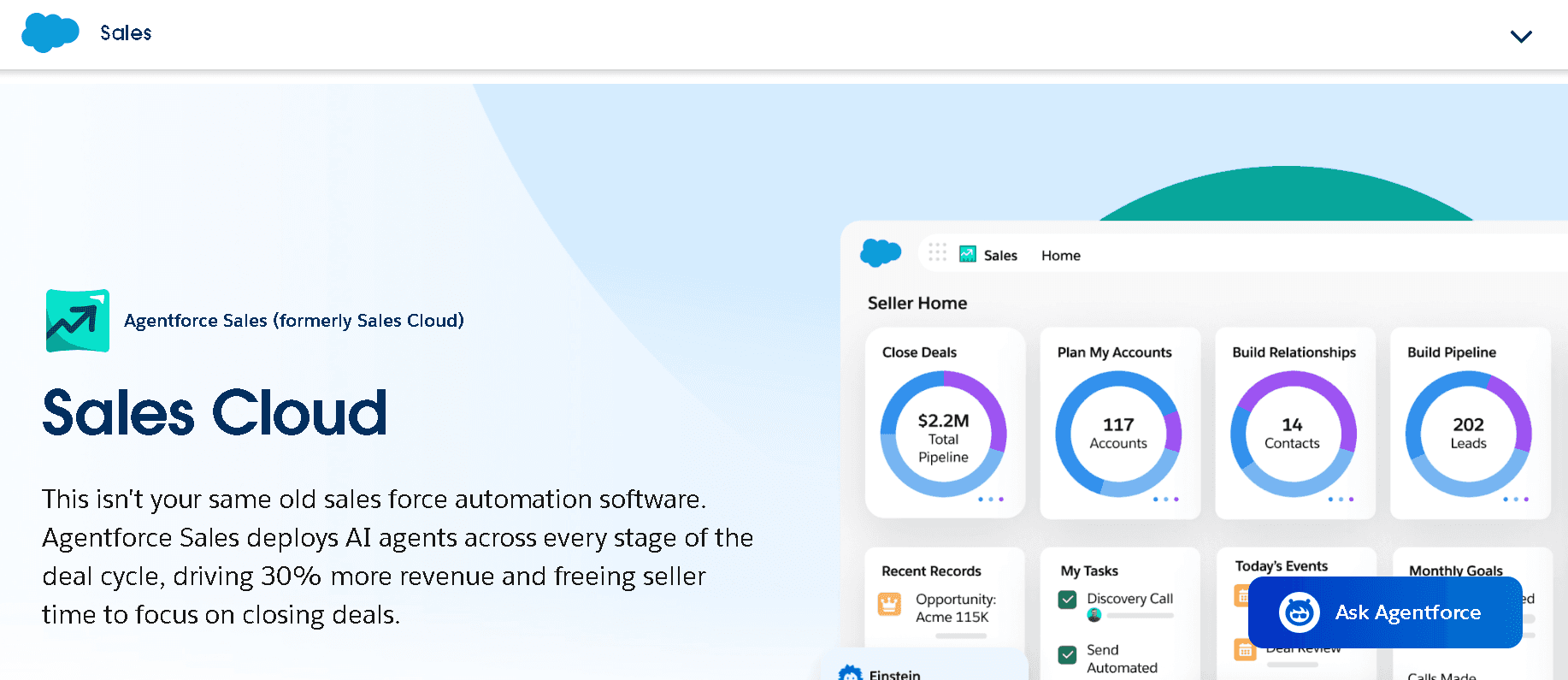
Salesforce Sales Cloud positions itself as the leading sales automation platform for enterprise teams managing complex, multi-stage deal cycles. Agentforce AI agents work autonomously across prospecting, qualification and closing stages. This drives 30% more revenue and frees sellers for 25 hours weekly. Sales Cloud unites sales enablement, prospecting, engagement, pipeline management, quoting and performance tracking into one platform, unlike point solutions.
The software captures emails, events and engagement activities in the CRM and associates them with relevant leads, contacts, accounts and opportunities. AI prioritizes leads based on customer profiles that generate the most revenue, while deal-specific insights guide sellers through each stage.
Key Features
Activity capture syncs communications without manual logging. Lead scoring uses AI to rank prospects by conversion likelihood. Pipeline inspection provides visibility into deal health for teams of all sizes. Workflow automation handles territory assignments and quote generation. Conversation intelligence analyzes sales calls, and mobile access lets reps update records from any location.
The platform integrates with Customer 360 for unified customer profiles in various departments. Approvals, templates, and collaboration tools keep teams aligned on opportunities. Territory management optimizes account coverage. Customizable forecasting categories align with business objectives.
Pricing
Tier | Monthly Cost | Core Capabilities |
|---|---|---|
Starter Suite | $25/user | Lead/account/opportunity management, AI email sync, simple flows |
Pro Suite | $100/user | Everything in Starter plus forecasting, quoting, AppExchange |
Enterprise | $175/user | Advanced pipeline management, conversation intelligence, Agentforce |
Unlimited | $350/user | Predictive AI, sales engagement, Premier Success Plan |
Agentforce 1 Sales | Complete AI suite, unmetered Agentforce, Maps, Spiff, Tableau Next |
Best For
Salesforce fits organizations with multiple sales teams, regions or complex product hierarchies that require extensive customization. Teams relying on accurate forecasting for resource planning and those needing measurable sales execution improvements benefit from the detailed feature set.
Pipedrive
What It Does
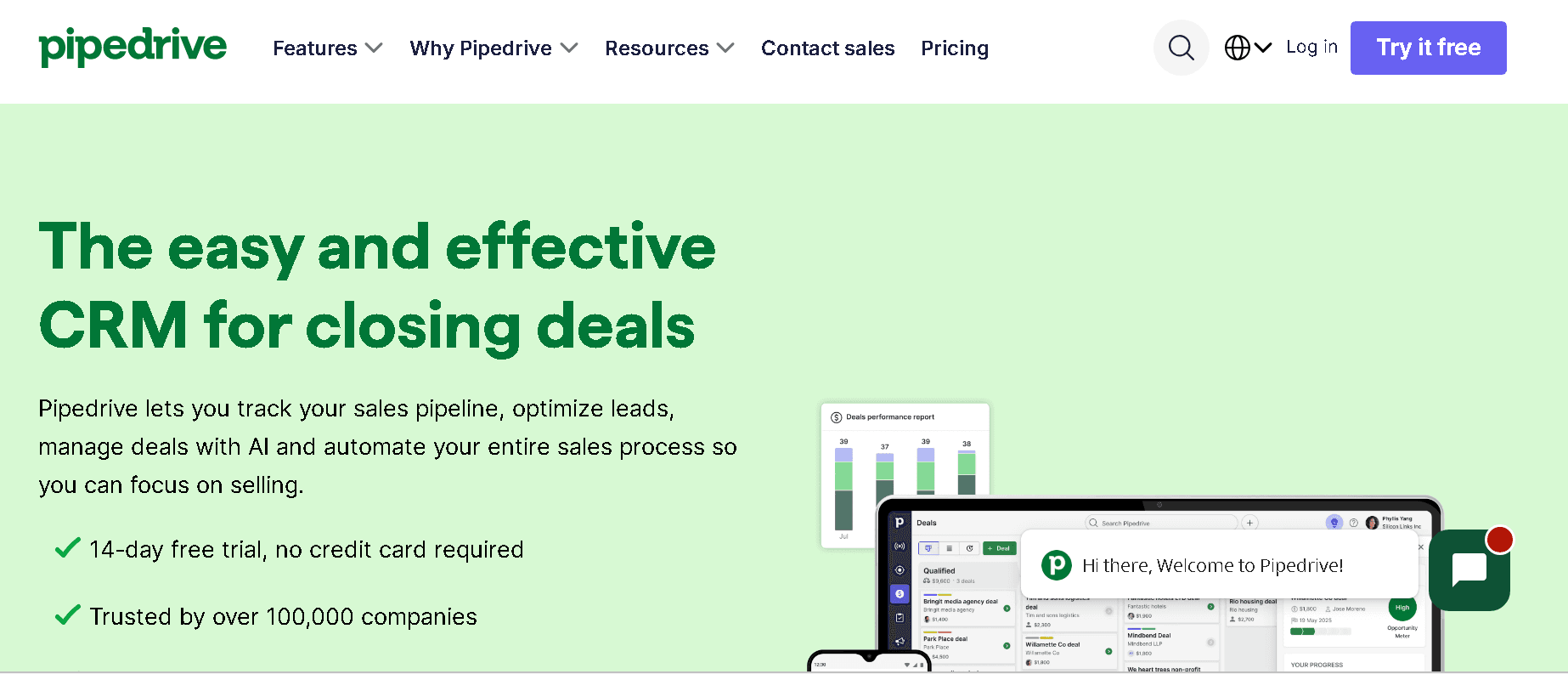
Visual pipeline management drives Pipedrive‘s approach to sales automation. The system centers on a kanban-style interface that lets teams track deals through customizable stages. The platform operates on a deal-driven methodology where each chance moves through pipeline stages representing specific steps in the sales process. Reps drag and drop deals between stages.
The system unites contact management, activity tracking, and communication history into one workspace. Email synchronization allows sending and receiving messages within the platform. Call logging and meeting tracking ensure all customer interactions remain available to team members.
Key Features
Pipedrive’s AI Sales Assistant predicts deal outcomes and suggests which prospects to pursue. It delivers daily snapshots of team performance. Automation workflows trigger actions when deals reach specific stages. Sequences build structured lead-nurturing campaigns using manual emails and follow-up tasks.
The platform integrates with over 400 third-party tools and connects email clients, marketing automation, and project management systems. Deal card customization highlights key fields in pipeline views. This reduces clutter and speeds up deal reviews.
Pricing
Plan | Monthly Cost | Lead/Deal Limits | Notable Features |
|---|---|---|---|
Lite | $24/user | 2,500 per user | Deal card customization, web to mobile calls, 2FA |
Growth | $49/user | Higher limits | Forecast reports, sequences, contacts timeline |
Premium | $79/user | Expanded capacity | LeadBooster, custom scoring, team inbox, projects |
Ultimate | $99/user | 20,000 per user | Enhanced security, maximized usage limits[214] |
All plans include a 14-day free trial.
Best For
Pipedrive suits small-to-medium sales teams that prioritize visual pipeline management over technical complexity. The platform works especially well for organizations transitioning from spreadsheets who need easy-to-use interfaces with minimal learning curves.
Flowla
What It Does
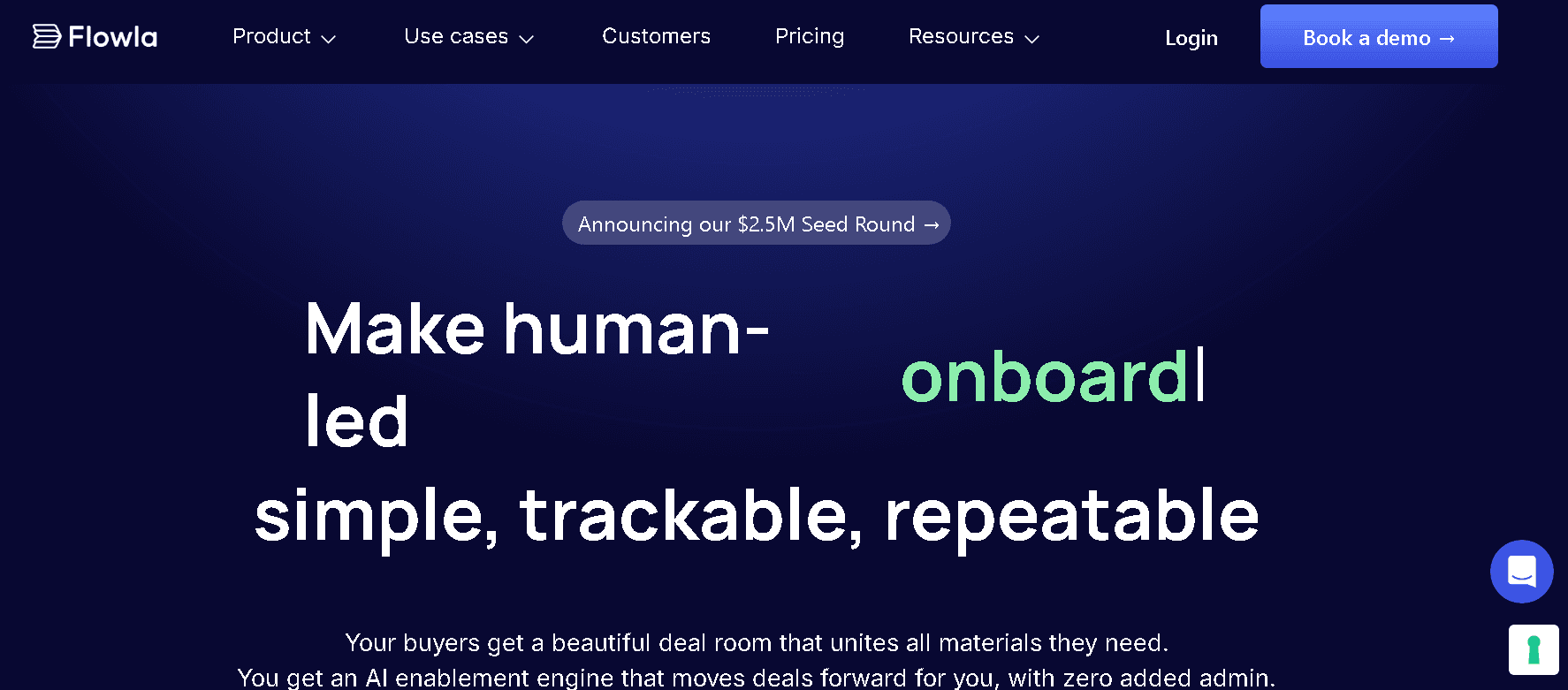
Flowla transforms deal execution through AI-powered digital sales rooms that serve as centralized workspaces for buyer collaboration. The platform combines client-facing rooms with backend workflow automation and delivers measurable results: 34% more closed-won deals, 35% faster onboarding, and 2X customer success team productivity.
The AutoPilot workflow engine automates post-call activities. These include personalized follow-ups, stakeholder research, CRM synchronization, and onboarding handoffs. AI agents draft business cases and generate custom assets. They also create follow-up emails while reps maintain approval control. Engagement tracking identifies new stakeholders and monitors content interaction duration. It alerts teams to deals warming up or going cold.
Key Features
Flowla provides interactive mutual action plans with embedded content and in-app forms for data collection. The platform offers native e-signature capabilities and centralized content libraries. It integrates with Salesforce, HubSpot, Attio, Slack, and Zapier to maintain unified workflows. SOC 2 Type II, GDPR, and CCPA compliance will give enterprise-grade security. Teams can implement Flowla within two weeks. They use ready-made templates and hands-on onboarding support.
Pricing
Plan | Monthly Cost | Seats | Core Features |
|---|---|---|---|
Starter | $0 | Unlimited | 5 rooms, all Pro features |
Pro | $49/user | Individual | Unlimited rooms, analytics, integrations |
Team | $79/user | Minimum 5 | AutoPilot, AI agents, dashboards |
Enterprise | Custom | Minimum 20 | Custom domains, SSO, white labeling |
Best For
Flowla suits revenue teams executing complex sales cycles that require buyer collaboration and internal workflow automation. The platform works in sales and customer success functions. It supports deal closure through renewals.
Freshsales
What It Does
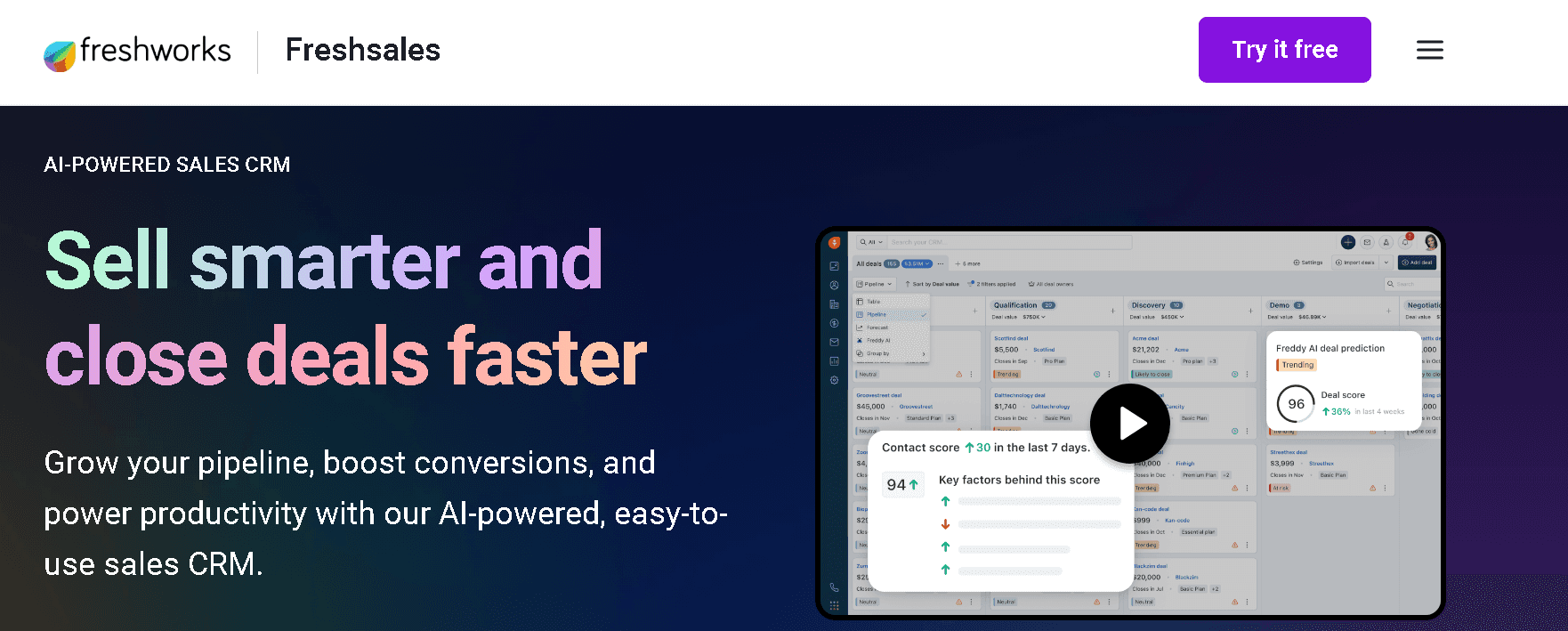
Freshsales addresses the administrative burden crushing sales productivity by deploying Freddy AI across lead management, deal tracking, and customer engagement workflows. The platform captures and qualifies leads automatically while it routes and tracks them. It highlights the best opportunities and writes personalized emails.
Teams using Freshsales report administrative tasks dropping by 20% even while acquiring 10X more customers. The system functions as a complete CRM solution with a single source of truth for each customer journey. It enables context sharing and customized communications across sales and marketing departments.
Key Features
Freddy AI scores contacts based on conversion likelihood and provides deal insights that identify which opportunities to prioritize. It generates sales emails with rephrase and expand capabilities. The platform has built-in chat, email, and phone functionality among other features like sales sequences for automated outreach.
Multiple sales pipelines with customizable stages, territory management with auto-assignment rules, and contact lifecycle tracking support complex sales processes. Advanced workflows automate repetitive tasks, while forecasting insights predict revenue patterns.
Pricing
Plan | Monthly Cost | Core Capabilities |
|---|---|---|
Free | $0 | Up to 3 users, Kanban views, email templates, built-in phone |
Growth | $9/user | Contact lifecycle stages, simple workflows, product catalog |
Pro | $39/user | Freddy AI scoring, sales sequences, multiple pipelines, advanced workflows |
Enterprise | $59/user | Custom modules, forecasting insights, field permissions, audit logs |
All paid plans bill annually.
Best For
Freshsales suits startups and small-to-medium businesses that require efficient pipeline management with minimal learning curves. The platform works especially well for teams that transition from simple tools and need AI assistance without enterprise complexity.
Clay
What It Does
Clay operates as a data enrichment and workflow orchestration platform connecting to 150+ providers rather than maintaining its own database. The platform pulls information from Apollo, Clearbit, People Data Labs, Hunter and dozens of other sources at once. Waterfall enrichment checks multiple providers in sequence at the time of searching for contact details; if Apollo can’t find an email, Clay queries the next provider in line. This multi-source approach achieves higher match rates than single-provider solutions.
Claygent, Clay’s AI research agent, scrapes publicly available web data to find office locations, founder backgrounds or company initiatives. The system functions as upstream workflow automation for sales process management tools and preps and enriches leads before routing them to CRMs or outreach platforms.
Core Features
Clay provides access to data providers through a unified marketplace using credit-based consumption. The platform integrates with Salesforce, HubSpot, Salesloft and Microsoft Dynamics 365 CRM with bidirectional sync. Automation logic builds if/then workflows that enrich leads, apply scoring rules and trigger next steps without code. Teams can bring their own API keys to provide flexibility beyond Clay’s rate limits.
Pricing
Plan | Monthly Price | Annual Price | Data Credits | Actions |
|---|---|---|---|---|
Free | $0 | $0 | 100/mo | 500/mo |
Launch | $185 | $167 | 2,500/mo | 15,000/mo |
Growth | $495 | $446 | 6,000/mo | 40,000/mo |
Enterprise | Custom | Custom | Custom | Custom |
March 2026 restructuring united three plans into two while dropping data marketplace costs 50-90%.
Best For
Clay suits RevOps teams with engineering resources who want maximum flexibility over data workflows. The platform works for sales teams already buying credits from multiple enrichment tools who need centralized management.
Close
What It Does
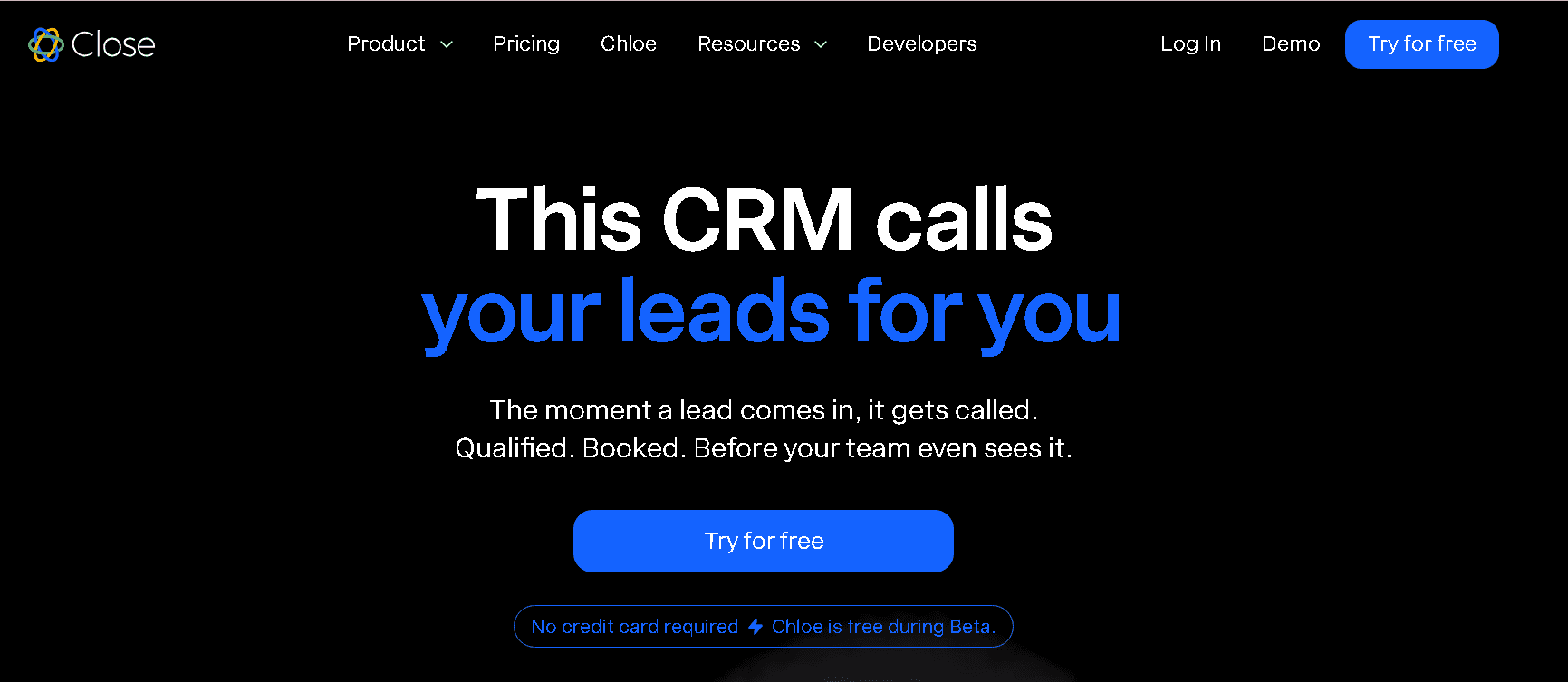
Close positions itself as a sales-first CRM where conversations happen, rather than a database that simply stores contact information. Reps can reach out, follow up, and schedule meetings without third-party dialers or email plugins because calling, emailing, and SMS are built in.
The platform performs 50% faster than competing CRMs and was built for high-velocity teams who talk to leads instead of just tracking them.
Chloe, Close’s AI assistant, captures and summarizes every call. It pulls insights from conversations and logs transcripts with action items to the CRM. The system prepares follow-ups based on call transcripts. It updates contact fields with enriched data from LinkedIn and web sources. Teams using Chloe report booked appointments increasing by about 50%.
Key Features
Close delivers Power Dialer for calling through lead lists and Predictive Dialer that dials multiple numbers at once. Smart Views create dynamic lists of hot prospects or stalled deals based on up-to-the-minute activity.
Sales sequences include email, SMS, and task reminders that run on autopilot. The centralized inbox captures form submissions, calls, emails, and meetings on each lead profile.
Pricing
Plan | Annual Price | Key Features |
|---|---|---|
Essentials | $35/user/month | Built-in calling, email, SMS, multiple pipelines |
Growth | $99/user/month | Power Dialer, workflows, bulk email |
Scale | $139/user/month | Predictive Dialer, call coaching, unlimited recording |
Best For
Close suits small-to-medium sales teams focused on phone-based outbound sales who need integrated communication tools without managing multiple platforms.
What are key trends in 2026 for sales process management tools?
Sales automation platforms are changing from rule-based workflows to agentic AI systems that reason, verify data, and adapt based on buyer behavior rather than following fixed sequences. These multi-agent workflows operate like teams of digital sales assistants in 2026.
Each agent focuses on specific tasks and collaborates to complete end-to-end processes. Organizations deploying agentic systems report manual tasks dropping by 60-80%. Mid-market teams experienced improved pipeline visibility, with 84% seeing gains.
Up-to-the-minute data enrichment has become standard as static lead information loses effectiveness quickly. Platforms now pull live data from public and intent-based sources. Enriched leads convert 2.4× better than outdated records. AI scoring engines analyze millions of signals at once to prioritize genuine buying intent.
This improves SQL accuracy by 40%. Multi-agent workflows reduce sales cycle time by 22% through coordinated task execution.
Conclusion
The right sales process management tool for your team depends on your team’s size and selling motion. Small teams moving from spreadsheets benefit from Pipedrive’s visual simplicity. Enterprise organizations managing complex hierarchies need Salesforce’s extensive customization.
Phone-heavy teams thrive with Close’s integrated dialer. RevOps leaders pursuing full AI transformation should explore autonomous agent platforms like Rox.
The platforms we covered address different pain points, but they share one goal: eliminating the administrative burden that steals two days each week from your reps. Start by identifying which non-selling tasks consume the most time. Then match that workflow to the tool designed for it.
FAQs
What exactly are sales process management tools and how do they help sales teams?
Sales process management tools are specialized software platforms that centralize customer data, automate routine tasks, track sales opportunities, and provide analytics across the entire sales cycle.
They help teams by eliminating manual work like data entry and follow-ups, automatically scoring and routing leads, triggering task sequences based on deal stages, and providing real-time visibility into pipeline health.
Which sales process management tool is best for small businesses just starting out?
For small businesses and startups, Pipedrive and Freshsales are excellent choices. Pipedrive offers an intuitive visual pipeline interface with drag-and-drop functionality, making it ideal for teams transitioning from spreadsheets. Freshsales provides a free tier for up to 3 users and affordable paid plans starting at $9/user/month with AI-powered features.
How much do sales process management tools typically cost?
Pricing varies widely based on features and team size. Free options exist like HubSpot Sales Hub (2 users) and Freshsales (3 users). Entry-level paid plans range from $9-$35 per user monthly (Freshsales Growth, Close Essentials).
Mid-tier solutions cost $49-$100 per user monthly (Pipedrive, HubSpot Professional, Salesforce Pro Suite).
What’s the difference between traditional CRM tools and AI-powered sales automation platforms?
Traditional CRMs primarily store and organize customer data, requiring manual updates and actions from sales reps. AI-powered platforms like Rox and Salesforce’s Agentforce go further by autonomously executing tasks researching accounts, monitoring buying signals, drafting personalized outreach, and updating records without manual intervention.
Can sales process management tools integrate with existing business software?
Yes, most modern sales process management tools offer extensive integrations. Platforms like HubSpot, Salesforce, and Pipedrive connect with 400+ third-party applications including email clients (Gmail, Outlook), marketing automation tools, project management systems, and communication platforms (Slack, Microsoft Teams).
Similar Articles
We build with the best to make sure we exceed the highest standards and deliver real value.

Get started today
See how the Rox agent can put your pipeline generation, deal management, and account expansion on autopilot.