Top 10 AI prospecting tools for sales in 2026
Rox Editorial Team

Rox leads this list below as the only warehouse-native option; the rest range from outbound automation platforms to data enrichment tools.
Yet 33% of field sales teams still aren’t using AI at all. The results are striking for those who have adopted AI for sales prospecting. Teams using AI sales prospecting tools have seen a 5x boost in positive response rates.
In this piece, we’ll explore the best AI prospecting tools available in 2026, what they do and which platforms deliver the most value for different sales teams.
What AI prospecting software actually does?
AI prospecting software uses machine learning, natural language processing, and predictive analytics to automate how sales teams find, qualify, and involve potential customers. These platforms analyze data from multiple sources at once.
Company databases, social media profiles, CRM systems, news feeds and job postings feed into the system to build prospect profiles with more data points than reps could gather manually.
These tools handle five key prospecting activities at their core. They identify and score leads by analyzing historical sales data and customer behavior to rank prospects based on conversion likelihood. The software detects buying signals such as job changes, funding announcements, technology adoptions and website visits to surface high-value opportunities.
AI automates research and data enrichment by pulling information from LinkedIn, call transcripts and internal documents to create complete prospect profiles in seconds.
AI personalizes outreach at scale by generating tailored emails and messages that reference specific details like recent company announcements or past interactions. The technology analyzes engagement patterns to recommend optimal timing and messaging for each prospect.
These platforms automate repetitive tasks: cold email outreach, follow-ups, data entry, scheduling and CRM updates. This automation increases sales team productivity by handling administrative work that consumed hours each week.
Top AI prospecting tools and software for sales teams
Scores of AI sales prospecting tools have emerged in recent years. Major platforms from Salesforce and LinkedIn have joined specialized vendors in the space.
Name | Features | Price |
|---|---|---|
Rox |
• Unified account context graph • Autonomous revenue execution • Signal-based pipeline + expansion detection |
• Core starts at $50/month • Enterprise (custom) |
Artisan |
• Intent-based lead prioritization • Multi-channel outreach + follow-ups • Meeting booking automation | Free–$600/month + Enterprise |
Cognism |
• Intent + technographic signals • Chrome + CRM integrations | ~$15K–$100K+/year |
Clay |
• Waterfall enrichment workflows • AI research agent (Claygent) • No-code GTM automation | Free–$495/month + Enterprise |
Seamless.AI |
• Verified emails & phone data • LinkedIn Chrome extension • CRM enrichment + intent signals | Free–$147+/user/month |
HubSpot Sales Hub |
• Pipeline + deal tracking • Automated outreach + workflows • Forecasting + reporting | Free–$150/user/month |
Outreach |
• Multi-channel sequencing • Pipeline + deal intelligence • Forecasting + coaching AI | ~$100–$1,000/user/month |
Salesloft |
• Revenue orchestration workflows • Conversation intelligence • Forecasting + coaching | ~$75–$125/user/month |
Gong |
• Call transcription + insights • Deal risk detection • Forecasting + coaching analytics | ~$1,200–$2,400/seat/year |
LinkedIn Sales Navigator |
• AI lead recommendations • Job change + intent alerts • Relationship mapping + CRM sync | ~$90–$160/month |
Rox – AI-Powered Revenue Intelligence & Sales Automation Platform
Rox is the warehouse-native revenue agent for Global 2000 revenue organizations. Unlike traditional AI prospecting tools that depend on incomplete CRM data or outbound sequencing workflows, Rox unifies internal and external revenue signals into a single system of context that powers autonomous revenue execution across the full customer lifecycle.
Built directly on the data warehouse, Rox closes the context gap that causes enterprise revenue teams to miss opportunities, delay deal cycles, and operate from fragmented account intelligence. Its context graph continuously assembles signals from the warehouse, inboxes, call transcripts, product usage, billing systems, support platforms, and external sources to create a living understanding of every account.
Instead of functioning as an AI SDR or outbound automation platform, Rox deploys one autonomous revenue agent per account that can identify pipeline opportunities, orchestrate account actions, surface expansion signals, support renewals, and coordinate GTM execution without relying on reps to manually connect information across systems.
For enterprise organizations managing complex land-and-expand motions, Rox positions AI prospecting as part of a larger Revenue Orchestration strategy rather than a standalone outbound workflow.
Key Features
Warehouse-native Revenue Orchestration
Context graph powered by warehouse-level account intelligence
One autonomous revenue agent per account
Unified system of context across GTM teams
Autonomous revenue execution across the lifecycle
AI-driven account prioritization
Revenue signal orchestration from structured and unstructured data
Expansion and renewal intelligence
Real-time opportunity and risk detection
CRM-independent orchestration layer
Unified Permission Model with enterprise governance controls
Native support for Snowflake, Databricks, and BigQuery
Use Cases
Enterprise AI prospecting
Autonomous pipeline generation
Revenue lifecycle orchestration
Strategic account intelligence
Expansion opportunity identification
Renewal risk detection
Multi-threaded enterprise account management
RevOps automation
Context-aware GTM execution
Enterprise revenue coordination
Pricing
Plan | Price | Actions | Accounts |
|---|---|---|---|
Starter | Free | 2,000/month | 10 |
Core | $50/month | 10,000-100,000/month | Unlimited |
Enterprise | Custom | Custom | Unlimited |
Rox uses action-based pricing where each task performed by AI agents counts as specific Agent Actions. Tasks requiring more advanced models or deeper data processing consume more actions.
Best For
Global 2000 revenue organizations
Enterprise RevOps teams
Complex B2B sales organizations
Usage-based and land-and-expand GTM models
Companies operating on Snowflake, Databricks, or BigQuery
Enterprises seeking warehouse-native AI revenue orchestration
Organizations moving beyond CRM-dependent sales engagement platforms
Artisan – AI-Powered Outbound Sales Automation Platform
Ava operates as Artisan’s autonomous AI BDR and handles lead finding through meeting booking without manual campaign management. The platform searches 250M+ verified B2B contacts, enriches profiles using 22+ data sources, and prioritizes prospects by conversion likelihood using intent signals like funding rounds and leadership hires.
Beyond prospecting, Ava launches customized multi-channel sequences across email and social channels while queuing call steps in the native dialer.
Key Features
Autonomous AI SDR (“Ava”)
AI-powered lead discovery and enrichment
Intent-based prospect prioritization
Personalized multi-channel outreach
Automated reply handling and meeting booking
CRM integrations and workflow automation
Continuous A/B testing for outbound campaigns
Built-in B2B contact database and signals intelligence
Use Cases
Teams deploy Artisan to run intent-driven cold outbound and CRM re-engagement campaigns. Account managers use Ava to run upsell and add-on campaigns with account-aware customization sent on behalf of each account owner.
Pricing
Plan | Price | Credits/Month | Key Features |
|---|---|---|---|
Free | $0 | 300 | Lead search, enrichment, agent swarm research |
Intern | $250 (annual) | 12,000 | Outbound campaigns, HubSpot sync, Slack integration |
Employee | $600 (annual) | 30,000 | Salesforce sync, webhooks, priority support |
Enterprise | Custom | Custom | Implementation support, dedicated CSM, SSO/SAML |
End-to-end campaigns cost around 25 credits per contact. Email enrichment costs 2 credits and phone enrichment costs 10 credits. Each new account starts with a 10,000 credit free trial (approximately $300 value).
Best For
Artisan fits startups, mid-market companies, and enterprises that need to scale outbound quickly with clearly defined ICPs. Teams generate pipeline at one-fifth the cost of a human BDR.
Cognism - Compliance-First B2B Data Platform
Cognism built its B2B sales intelligence platform for teams selling into European markets specifically, where GDPR compliance isn’t optional. The platform delivers verified contact data with particular strength in EMEA regions, claiming over 90% coverage for European decision-makers.
Diamond Data represents Cognism’s core differentiator: manually verified mobile numbers that deliver connect rates about 3x higher than standard database contacts.
Key Features
AI-powered prospect and account discovery
Phone-verified Diamond Data® contacts
GDPR- and compliance-focused data workflows
Intent and technographic data
Sales Companion Chrome extension
CRM and sales engagement integrations
Automated data enrichment
LinkedIn prospecting support
Global B2B contact database with strong EMEA coverage
Use Cases
Enterprise SDR teams in Europe rely on Cognism for GDPR-compliant prospecting with verified mobiles. Revenue operations teams enrich Salesforce and HubSpot with accurate contact details. Finance, healthcare, and legal industries use the platform where strict data regulations matter most.
Pricing
Package | Platform Fee | Per User/Year | 5-Person Team Total |
|---|---|---|---|
Grow/Standard | ~$15,000-$16,500 | ~$1,500 | ~$22,500-$24,000/yr |
Elevate/Pro | ~$25,000-$27,500 | ~$2,500 | ~$37,500-$40,000/yr |
Enterprise | Custom | Custom | $30K-$100K+/yr |
Onboarding adds $2,000-$5,000, with API and enrichment overages reaching $5,000-$15,000 annually at scale. All contracts run annually with no monthly option.
Best For
Cognism fits mid-market and enterprise teams with $15,000+ annual data budgets targeting EMEA markets. Organizations in compliance-sensitive industries extract maximum value from the certification stack and verified contact approach.
Clay - AI Data Enrichment and Orchestration
Clay functions as a workflow orchestration platform that connects 150+ data providers into automated enrichment sequences. Clay queries multiple providers until verified data is found, unlike single-source databases. This approach achieves 70-90% coverage rates compared to 30-50% from individual tools.
The waterfall method charges only for successful data retrieval and eliminates costs for failed lookups.
Key Features
AI-powered lead enrichment and prospecting
Access to 100+ data providers
Waterfall enrichment workflows
Claygent AI research agent
Automated prospect research and scoring
Personalized outbound message generation
Real-time buying and intent signals
CRM and sales engagement integrations
No-code GTM workflow automation
Spreadsheet-style prospecting interface
Use Cases
Teams deploy Clay to build net-new prospect lists from LinkedIn Sales Navigator and Apollo. They enrich existing CRM data with firmographic and technographic details. The platform normalizes stale customer records on recurring schedules and detects intent signals.
These signals include job changes, funding rounds and technology implementations. Clay tripled enrichment rates for teams versus previous single-provider solutions.
Pricing
Plan | Monthly Price | Data Credits/Month | Actions/Month | Key Features |
|---|---|---|---|---|
Free | $0 | 100 | 500 | Unlimited seats, Claygent, 200 rows/table |
Launch | $185 | 2,500 | 15,000 | Phone enrichment, job signals, 50K rows/table |
Growth | $495 | 6,000 | 40,000 | CRM sync, HTTP API, webhooks, web intent |
Enterprise | Custom | 100,000+ | 200,000+ | Data warehouse sync, SSO, RBAC, dedicated strategist |
Best For
Clay fits RevOps teams and growth-stage companies that build complex, multi-step workflows. These workflows unite enrichment, AI research and automation in one platform. Organizations replacing 3-4 separate tools find Clay’s total cost competitive.
Skylead - AI Prospecting and Multichannel Outreach Platform
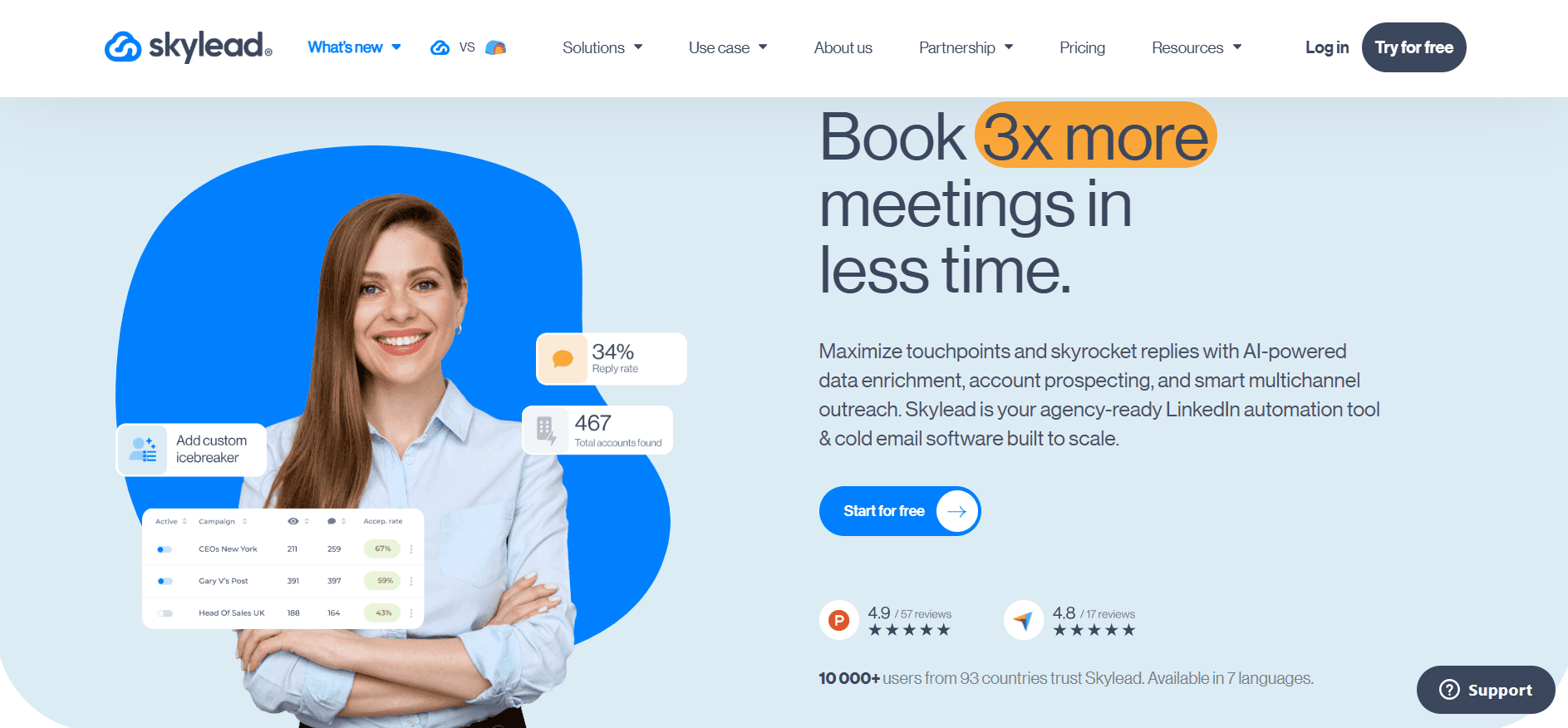
Skylead is a LinkedIn automation and cold email platform built for agencies and sales teams that want to connect prospecting, enrichment, and outreach in one workflow. Its AI Data Enrichment combines 20+ providers and 10+ signals across accounts and contacts, helping users identify target companies, find decision-makers and filter prospects against their ICP. Data can include open roles, funding information, technology stack, current roles, skills and company details.
Once prospects are found and qualified, teams can move them directly into multichannel LinkedIn and email sequences. Its AI SDR then handles conversations from the first reply through to a booked call.
Skylead also includes features designed specifically for agencies, such as AI Training Sets, which let agencies refine the AI SDR with their own feedback and sales methodology, then apply that expertise to client campaigns without clients being able to view, copy, edit or delete the underlying training set.
Key Features
Internal B2B database
AI data enrichment across 20+ data providers
10+ company- and contact-level signals for ICP filtering
Account-based prospecting
LinkedIn and cold email multichannel sequences
AI SDR reply handling through meeting booking
Agency-owned AI Training Sets
Flat agency pricing rather than per-seat billing
Use Cases
Agencies and sales teams use Skylead to manage the outbound prospecting process from lead discovery through outreach and follow-up. Teams can identify target accounts, find relevant decision-makers, enrich prospect information, and engage them through coordinated LinkedIn and email sequences without moving leads between separate prospecting and engagement platforms.
Its AI SDR can continue conversations after prospects respond, making the platform particularly useful for teams that want to automate both outbound activity and the follow-up required to turn replies into meetings.
Pricing
Plan | Price |
All-in-One Outreach | $100/seat/month |
Agency | $999 for 50 seats |
Unlimited Agency | $1,999 for unlimited seats |
AI SDR and AI Data Enrichment | $1 per 100 credits |
Best For
Skylead fits lead generation agencies that want to productize their prospecting and sales expertise, as well as sales teams looking for prospecting, AI enrichment, multichannel outreach and automated reply handling in one platform.
Seamless.AI - Real-Time Contact Search Engine
Seamless.AI functions as an up-to-the-minute search engine that delivers verified B2B contact data. The platform crawls publicly available sources using proprietary AI algorithms and machine learning. It maintains 1.3B+ contacts across 121M+ companies with 90% average accuracy.
Static databases refresh quarterly, but Seamless.AI pulls current emails and mobile numbers in seconds. This makes it suitable for teams running high-volume outbound where lead sourcing speed matters.
Key Features
AI-powered B2B contact discovery
Real-time verified email and phone data
Buyer intent and job-change signals
AI outreach and personalization tools
CRM enrichment and workflow automation
Chrome extension for LinkedIn prospecting
Multi-channel sales engagement
API access for revenue automation
Large global contact and company database
Use Cases
SDR teams building prospect lists for outbound campaigns rely on Seamless.AI’s search speed. Reps sourcing leads from LinkedIn find the Chrome extension workflow quick.
Organizations seeking affordable alternatives to enterprise data providers choose Seamless.AI for budget reasons.
Pricing
Plan | Price | Credits | Key Features |
|---|---|---|---|
Free | $0 | 50 lifetime | Up-to-the-minute search, simple integrations, email support[291] |
Pro | $99/user/month | 1,000 daily (5+ users) | Daily refresh, live chat, advanced filters[293] |
Enterprise | $147+/user/month | Custom daily | API access, priority support, dedicated CSM[293] |
Best For
Seamless.AI fits early-stage outbound teams targeting large US companies where data coverage is strongest. Teams with separate tools for outreach and CRM management extract more value since Seamless.AI focuses on top-of-funnel contact discovery.
HubSpot Sales Hub - CRM-Native AI Sales Tool
HubSpot Sales Hub embeds AI through Breeze right into its CRM. You won’t need to sync data across separate prospecting platforms. This CRM-native approach gives sales teams access to AI-powered prospecting, engagement tracking and deal management without leaving their existing workspace.
Key Features
AI-powered prospecting and lead prioritization
Breeze Prospecting Agent for automated outreach
Unified CRM and sales workspace
Multi-channel sales automation
AI-guided selling recommendations
Deal tracking and forecasting
Meeting scheduling and follow-up automation
Conversation intelligence and call tracking
CRM enrichment and workflow automation
Sales analytics and reporting
Use Cases
Small teams start free. Teams of 10-30 reps use Professional for automation and custom reporting. Enterprise organizations deploy conversation intelligence and predictive scoring at scale.
Pricing
Plan | Price | Key AI Features |
|---|---|---|
Free | $0/month | Deal tracking, live chat, meeting scheduling |
Starter | $10/month per seat | Automated outreach, email sequences |
Professional | $100/month per seat | AI forecasting, automated follow-ups, custom reporting |
Enterprise | $150/month per seat | Predictive lead scoring, conversation intelligence, custom objects |
Best For
HubSpot fits teams that already use HubSpot CRM or want an all-in-one platform. Users report 73% increased win rates, 94% more deals closed after six months, and 48% faster time to close with AI features.
Outreach - AI-Powered Sales Execution Platform
Outreach bills itself as the only revenue orchestration platform handling prospecting, deal management, forecasting, coaching and account expansion through one agentic AI platform.
The system deploys AI Agents that inspect deals, flag risks and prioritize actions without needing reps to analyze every opportunity.
Key Features
AI-powered sales engagement workflows
Autonomous AI agents for revenue teams
Multi-channel prospect outreach and sequencing
Pipeline and opportunity management
AI forecasting and revenue intelligence
Conversation intelligence and coaching insights
Meeting preparation automation
Workflow automation with Agent Studio
Buyer sentiment and engagement analysis
CRM and GTM system integrations
Use Cases
Enterprise sales teams managing high-volume opportunities deploy Outreach to automate sequences, inspect deals and improve forecast accuracy. Sales managers use conversation intelligence to spot coaching chances without joining every call.
Pricing
Plan Type | Estimated Range |
|---|---|
Per-user pricing | $100-$1,000/month[372] |
Contract type | Annual, custom quotes |
Best For
Outreach fits large teams needing deep CRM sync, advanced revenue analytics and multichannel execution with enterprise-level reporting.
Salesloft - Revenue Orchestration with AI
Salesloft unifies sales engagement, conversation intelligence, deal management and forecasting through purpose-built AI agents working throughout the revenue lifecycle. The platform deploys 21 AI agents spanning prospecting to renewals. Customers report 322% more pipeline generation.
Key Features
AI-powered sales engagement cadences
Revenue orchestration workflows
Multi-channel prospect outreach
AI-guided selling recommendations
Conversation intelligence and call analytics
Pipeline and deal management
Forecasting and revenue analytics
Automated meeting scheduling and follow-ups
CRM and GTM platform integrations
Sales coaching and performance insights
Use Cases
Mid-market to enterprise sales teams deploy Salesloft to unify sales execution. SDRs automate prospecting workflows. Account executives manage complex deals with AI guidance, and managers identify coaching moments through conversation intelligence.
Pricing
Tier | Has |
|---|---|
Essentials | Pipeline generation, engagement analytics and rep coaching |
Advanced | Full lifecycle workflows, conversation intelligence and deal management |
Premier | Forecasting, revenue management and AI-driven actions |
Pricing ranges from $75-125 per user monthly with minimum seat requirements.
Best For
Salesloft fits sophisticated mid-market to enterprise organizations that need complete revenue orchestration with substantial budgets.
Gong - Conversation Intelligence and Deal Insights
Gong captures sales conversations from phone calls and web conferences. AI analyzes them to surface deal risks and coaching opportunities. The platform serves over 4,500 customers including Microsoft and LinkedIn. The platform’s 4.7-star average comes from 6,558 G2 reviews.
Key Features
AI-powered conversation intelligence
Automated call recording and transcription
Revenue intelligence and pipeline analytics
AI deal risk detection
Sales forecasting and revenue predictions
Real-time coaching and rep performance insights
AI-generated meeting summaries and action items
Multi-channel customer interaction analysis
CRM synchronization and workflow automation
AI agents for follow-ups and pipeline management
Use Cases
Sales managers review calls to provide targeted coaching without joining every conversation. New reps accelerate ramp time by studying top-performing calls. Revenue teams spot competitive mentions and winning talk tracks in the pipeline.
Pricing
Team Size | Annual Cost Per Seat |
|---|---|
Small (15-50 seats) | $1,600-$2,400 |
Mid-market (50-100 seats) | $1,400-$2,200 |
Enterprise (100+ seats) | $1,200-$1,800 |
Best For
Gong fits enterprises with 100+ sales professionals running complex B2B cycles that require centralized conversation intelligence and dedicated RevOps teams.
LinkedIn Sales Navigator - Professional Network Prospecting
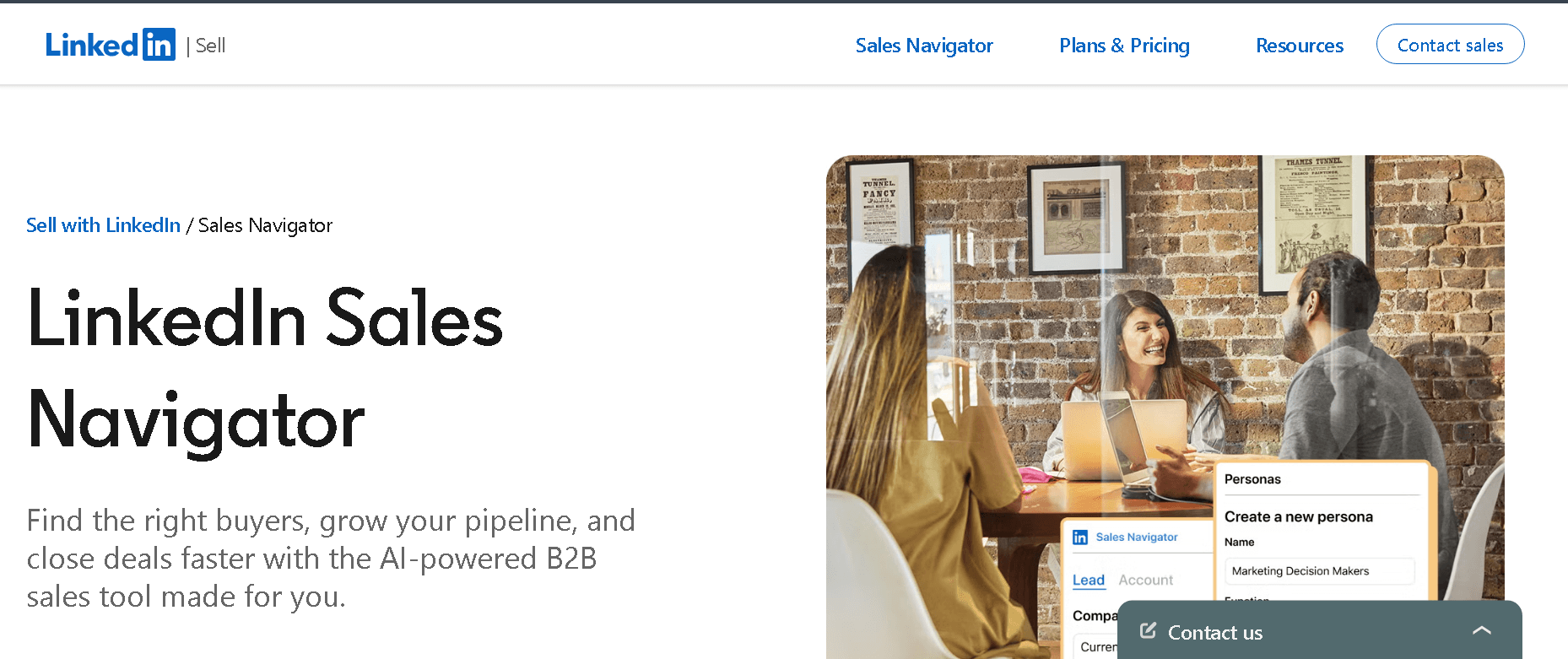
Sales Navigator taps directly into LinkedIn’s 1+ billion member network and adapts to your industry, geography, and target buyers to find leads and reach decision-makers. The platform delivers 4x more connections to Director+ leaders compared to standard LinkedIn users.
Key Features
Advanced lead and account search with deep filters (role, industry, seniority, geography)
AI-powered lead recommendations and buyer intent signals
Real-time alerts on job changes, company updates, and engagement activity
“Sales Assistant” AI agent for lead discovery and outreach drafting
Relationship mapping to identify warm paths into accounts
CRM integrations for syncing leads and activity
InMail messaging for direct prospect outreach
Lead and Account IQ insights for faster research and personalization
Use Cases
Enterprise SDR teams use Sales Navigator to find verified buyers at target accounts. Account executives track job changes and company updates for timely outreach.
Pricing
Plan | Monthly | Annual | Key Features |
|---|---|---|---|
Core | $119.99 | $89.99/month | Advanced search, 50 InMails, lead recommendations |
Advanced | $159.99 | $149.99/month | Account IQ, TeamLink, Smart Links, CRM profiles |
Advanced Plus | Custom | Custom | Native CRM sync, automatic data updates |
Best For
Sales Navigator fits B2B teams that rely heavily on LinkedIn prospecting with budgets from $1,080 per year.
What to look for in an AI prospecting platform?
Choosing the right AI prospecting platform requires evaluating four critical dimensions that affect adoption and results directly.
Data quality and coverage
Prospecting results depend on data accuracy entirely. Inaccurate emails and outdated phone numbers waste rep time and damage sender’s reputation. Platforms that fail to verify contact information continuously create more problems than they solve.
Organizations that maintain superior data quality realize up to 30% improvements in sales forecasting accuracy. Look for platforms that verify contacts on an ongoing basis, not just at collection, with strong coverage in your target markets and verticals.
CRM integration and workflow fit
The most common reason AI sales tools fail is adoption. If a platform doesn’t plug into your CRM directly, it’s already a most important obstacle to consistent use. The best platforms sync bidirectionally with Salesforce or HubSpot and push enriched data to sales engagement tools. They surface insights where reps already work. Friction in data flow kills adoption.
Buyer intent and signal detection
Intent signals separate platforms that find contacts from those that find ready-to-buy accounts. The strongest tools track content consumption and website visitor behavior to identify prospects researching solutions actively. Trigger events like job changes, funding rounds and hiring spikes indicate optimal outreach timing.
AI-assisted outreach and email generation
Generic emails get ignored. AI generates personalized messages that reference specific prospect details, but generative AI can produce plausible-sounding content that’s factually incorrect. Human review before sending remains non-negotiable.
How to choose the right AI prospecting tool?
Your team needs to agree on requirements before reviewing specific platforms. The right AI prospecting tool depends on where your pipeline problem lives. Platforms with verified contacts and continuous enrichment solve this problem if data quality is your biggest bottleneck. Cognism’s phone-verified EU mobile data with GDPR-first posture becomes the strongest option if EMEA compliance coverage matters most.
Match tool capabilities to your ICP complexity and average deal size. Startups building lists quickly fit high-volume, low-cost prospecting engines. Enterprise teams managing complex client portfolios need platforms that monitor accounts without multiplying headcount. Think about whether you’re buying another tool or replacing a workflow entirely and how many existing systems the platform can combine.
Prioritization matters more than sourcing. Strong prospecting platforms help reps understand which accounts deserve attention first. They explain why a prospect is relevant rather than relying on generic intent signals. Review how well insights carry into live outreach because prospecting insights only matter if they’re usable during calls.
Conclusion
The right AI prospecting tool from this list depends on your team’s specific bottlenecks and workflow requirements. Data quality, CRM integration and intent detection capabilities matter more than feature lists. Teams extract the most value when they match tool strengths to their actual pain points rather than chase complete platforms they’ll never fully adopt.
Platforms that combine multiple workflows into one system deliver better ROI in the long run compared to stitching together separate tools. Rox demonstrates this approach by replacing several prospecting functions with coordinated AI agents.
Start with your biggest pipeline constraint and pilot one platform that addresses it. Measure results before expanding your stack.
FAQ
What is AI prospecting software?
AI prospecting software uses machine learning to automate discovery, qualification, and prioritization of sales prospects. These platforms analyze firmographic, technographic, and behavioral data to identify high-value accounts, surface buyer intent signals, and generate personalized outreach.
How is AI prospecting software different from a standard CRM?
A CRM stores and organizes data about contacts and deals you already know about. AI prospecting software finds and qualifies new prospects you haven’t participated with, enriches records with verified contact data and intent signals, and generates outreach recommendations. The two tools are complementary.
How do AI prospecting tools handle data privacy and compliance?
Compliance posture varies substantially between platforms. Some maintain GDPR, CCPA, and SOC 2 compliance. Others operate under US privacy frameworks. You need to verify the compliance posture of any platform before committing if you sell into the EU or handle regulated data.
How do AI prospecting tools work?
AI tools analyze CRM data, email engagement history, call transcripts, and business databases. They identify patterns in buyer behavior, engagement signals, and firmographic information to detect which prospects fit your target market. Clean and complete data produces better results.
What are the benefits of AI prospecting tools for your sales team?
AI eliminates time-consuming tasks like list building, data entry, and follow-up reminders. Teams using AI report 2 hours saved per rep daily on manual research. AI also personalizes outreach at scale and increases reply rates while helping reps focus on high-impact conversations instead of administrative tasks.
Will AI prospecting tools replace my sales development reps?
No. AI automates research and prioritization work, but human judgment remains required to qualify complex accounts, navigate buying committees, and build relationships that close deals. The productivity gains come from giving SDRs better information faster, not from removing them from the process.
Similar Articles
We build with the best to make sure we exceed the highest standards and deliver real value.