8 Tools for Automated Sales Emails to Scale Your Outreach
Rox Editorial Team

The average sales rep spends just 28% of their week selling actually. The rest? Administrative tasks, manual follow-ups, and updating CRM records. Modern sales moves too fast for this approach.
Buyers expect instant replies and customized outreach at scale, which is impossible to deliver manually.Automated sales emails have become essential for sales teams looking to scale their outreach without sacrificing quality. These sales automation tools use AI sales automation to handle repetitive tasks and free up your team to focus on closing deals.
In this piece, we’ll explore eight email sales automation platforms that can revolutionize your outreach strategy in 2026.
What Is Email Automation?
Email automation sends targeted messages to prospects and customers based on specific triggers, behaviors, or schedules without manual intervention. Sales automation tools create workflows that respond automatically to actions like form submissions, website visits, or purchase activity instead of crafting individual emails for each contact. This approach delivers the right message at the right moment while scaling personalized communication across hundreds or thousands of contacts.
Better productivity:
Email sales automation eliminates repetitive tasks that consume valuable selling time. Marketing automation improves productivity by approximately 20% and allows sales teams to focus on high-value activities like discovery calls and closing deals. A
utomated workflows run continuously in the background once you set them up. The system immediately sends a product demo email without requiring manual effort when a prospect downloads a pricing guide. This automation extends beyond initial outreach.
AI sales automation tools can nurture leads through multiple touchpoints, assign tasks based on email criteria, and trigger follow-ups based on deal stage progression.
Increased customer experience:
Personalization drives engagement in ways generic broadcasts cannot match. 90% of consumers find personalized content appealing. Automated emails deliver this personalization at scale by responding to individual customer actions rather than following fixed schedules. Someone who abandons their shopping cart receives a timely reminder with relevant product information.
Welcome messages represent this effectiveness well and get 4 times more reads and 5 times more clicks than standard marketing emails. The best AI sales automation software uses behavioral data to determine optimal send times and content for each recipient.
Higher customer retention:
Existing customers are your most valuable revenue source. The likelihood of selling to a current customer reaches 60-70%, compared to just 5-20% for new prospects. 65% of your profits come from existing customers. Automated retention campaigns maintain consistent communication with current customers through tailored content based on their purchase history and engagement patterns.
You boost your company’s value by 30% when you raise customer retention by just 10%. AI tools for sales and marketing identify customers who show early signs of disengagement and trigger re-engagement sequences before they churn.
Increased ROI:
The financial effect of email automation outperforms manual campaigns by a lot. Automated emails achieve 86% higher open rates and 196% higher click-through rates than standard promotional messages. They generate 320% more revenue per email.
B2B marketers using successful lead-nurturing programs report an average 20% boost in sales opportunities. Automated workflows make up just 2% of total email sends but generate 30% of email-driven revenue. These outreach sales tools deliver measurable returns by ensuring messages reach prospects when they’re most likely to participate and convert.
4 Benefits of Automated Emailing Services
Automated emailing services deliver measurable advantages beyond simple email sending capabilities. Sales automation tools transform how teams approach prospect communication by removing bottlenecks that slow down deal velocity. An AI powered sales platform gives you access to features that manual processes cannot replicate at scale.
Time compression represents one of the operational benefits that matter most. An outreach sales engagement platform executes multi-step sequences in minutes that would otherwise require hours of manual work. Your team sets parameters once and the system handles subsequent communication across hundreds of prospects at once. This capability becomes especially valuable when you have outbound sales tools managing complex nurture campaigns across multiple buyer personas.
Decision making improves when you deploy email sales automation. The software tracks every interaction and gives you analytical insights into which subject lines generate opens, which call-to-action buttons drive clicks, and which sequences convert prospects into qualified leads. These metrics inform strategy adjustments with up-to-the-minute data analysis rather than relying on quarterly reviews of outdated performance data.
Consistency in messaging emerges as a critical advantage. AI tools for sales and marketing ensure every prospect receives the same level of attention whatever the territory size or rep workload. A sales team in California delivers follow-up quality similar to one in New York and maintains brand standards across all customer touchpoints. This uniformity prevents prospects from slipping through communication gaps that often occur in manual outreach.
8 Tools to Automate Email Campaigns
Tool | Key Features | Pricing |
|---|---|---|
Autonomous AI agents for research, personalization, multi‑channel outreach, CRM updates | Starter: Free (1,000 actions) Core: $50/mo (5,000 actions) Enterprise: Custom | |
HubSpot Sales Hub | Email sequences, meeting scheduler, document tracking, workflow automation | Free: $0 Starter: $20/seat/mo Professional: $100/seat/mo Enterprise: $120/seat/mo |
Omnisend | Ecommerce email + SMS, 350+ templates, AI content & product recommendations, prebuilt automations | Free: $0 Standard: $16/mo Pro: $59/mo Custom: Quote |
Brevo | Email/SMS/WhatsApp, visual automation builder, transactional messaging, AI send‑time optimization | Free: $0 Starter: $9/mo Standard: $18/mo Professional: $499/mo |
GetResponse | Unlimited emails & automations, AI content, landing pages, webinars, ecommerce integration | Free: $0 Starter: $19/mo Marketer: $59/mo Creator: $69/mo Enterprise: Custom |
Drip | Tag‑based segmentation, visual workflow builder, website tracking, advanced personalization | Starter: $19/mo Growth: $39/mo Scale: $89/mo (pricing rises with contacts) |
MailerLite | AI content assistant, subject line optimizer, workflow automations, drag‑and‑drop editor | Free: $0 Starter: $15+/mo Growth: $39+/mo Premium: Custom |
Mailchimp | AI email copy & subject lines, Send‑Time Optimization, Predictive Segmentation | Free: $0 Essentials: $13/mo Standard: $20/mo Premium: $350/mo |
Mailercloud | AMP interactive emails, real-time inbox placement monitoring, behavior-based automation, AI subject line suggestions | Free: $0 (12,000 emails/mo) Starter: $10/mo (unlimited sends) Premium: Custom |
1. Rox
Rox positions itself beyond traditional email sales automation by deploying autonomous AI agents to each customer account. It operates as a complete revenue operations platform that treats your CRM as an active co-worker instead of a passive database, rather than functioning as a standalone outreach sales tool.
Rox assigns dedicated AI agents to monitor accounts, research prospects, draft personalized outreach and update CRM records without manual input. This agentic approach distinguishes it from conventional sales automation tools that schedule emails.
The platform integrates with Salesforce, HubSpot, Gmail, Microsoft Outlook and Slack to create a unified system where AI handles research and routine tasks while sales reps focus on relationship building. Users report saving eight hours per week on average alongside a 35% increase in customer activity.
Key Features
The platform’s AI agents run across accounts and execute research, monitor buying signals and generate personalized messages. Rox offers multi-channel outreach automation spanning email and LinkedIn, intelligent lead scoring with entity resolution, automated meeting preparation with briefings, call recording and transcription, conversation summaries with stakeholder mapping and trigger-based workflows activated by events like meeting transcripts.
The Command interface lets you coordinate multiple agents with natural language and direct them to prep for renewals or launch prospecting sequences. Teams that implement Rox report 20-30% improvement in response rates and 1.5-2x increase in meeting bookings.
Pros and Cons
Pros:
Cuts prep time by 90%, letting reps focus on closing deals.
Secure, warehouse-native architecture with SOC 2 Type II compliance.
Cons:
Action-based metering is opaque, making budgeting tricky.
Best for enterprises with data warehouses and Salesforce; limited for small teams.
The Core plan’s 5,000 monthly actions last just two to three weeks for active 10-person teams.
Pricing
Plan | Price | Features |
|---|---|---|
Starter | Free | 1,000 actions, 10 agents, 10 accounts, basic data enrichment |
Core | $50/month | 5,000 actions, 100 agents, 100 accounts, premium data enrichment, email + apps |
Enterprise | Custom | Unlimited agents, unlimited accounts, advanced integrations, priority support |
Best For
Rox fits Global 2000 companies, enterprise sales teams and RevOps leaders who manage complex revenue motions with Salesforce deployments and data warehouse infrastructure.
2. HubSpot Sales Hub
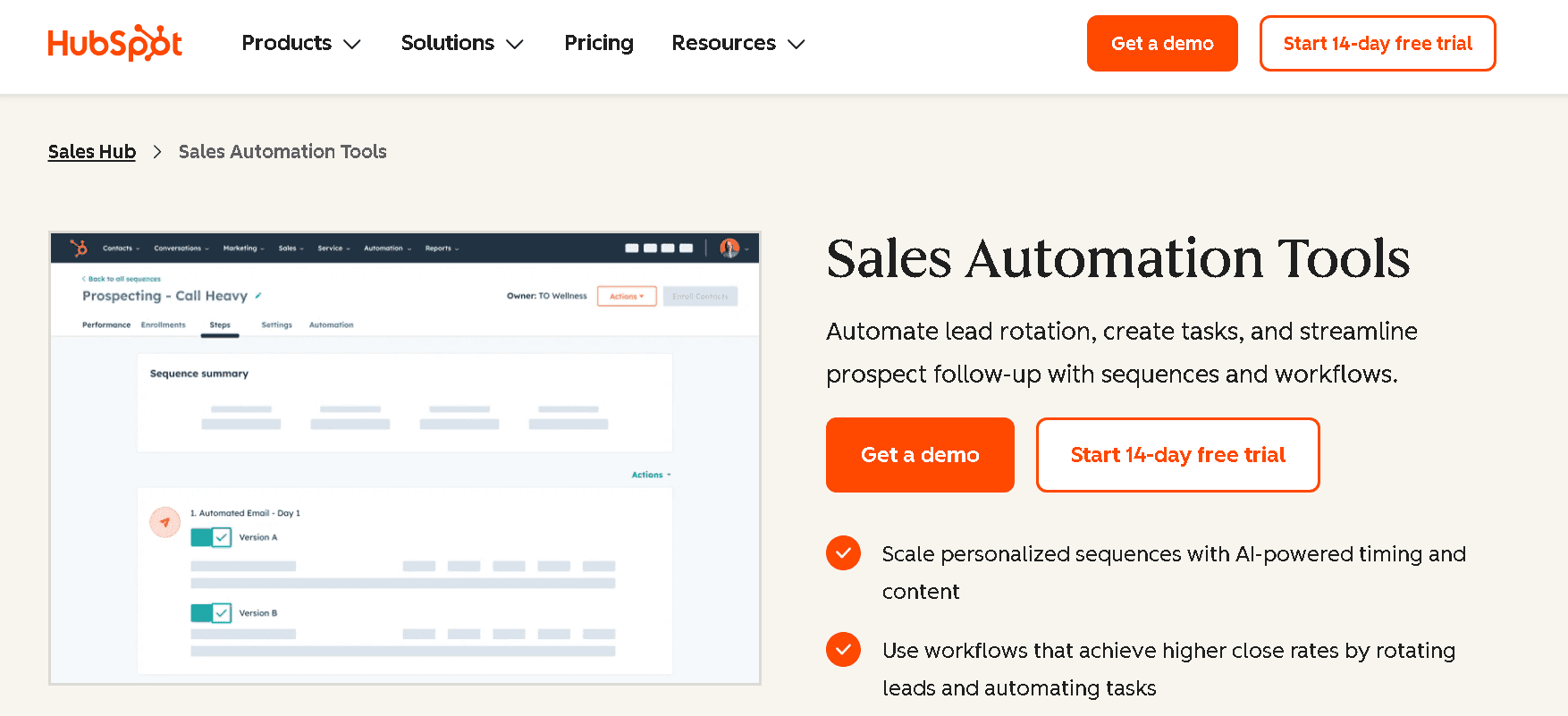
HubSpot centralizes information and automates routine tasks to streamline fragmented sales workflows. The platform provides contact and lead management, email tracking, pipeline management, reporting and task automation. I
ntegration with HubSpot Marketing Hub creates continuous data flow between teams and delivers full attribution from marketing channel to closed revenue. Users describe the interface as easy-to-use and report becoming administrators within three months despite no prior HubSpot experience.
Key Features
Email sequences automate multi-step outreach with personalized messages and task reminders. Sales professionals can schedule meetings through calendar sync tools, track document engagement live and monitor email opens and clicks.
The platform offers customizable dashboards for performance tracking, forecasting tools for revenue projections and workflow automation that triggers actions based on customer behaviors. Smart CRM enrichment auto-populates company information and firmographic data. Integration capabilities span 1,600+ marketplace apps.
Pros and Cons
The platform excels at marketing-sales alignment and offers a generous free tier with unlimited contacts. Users praise the easy-to-use interface and best-in-class reporting with multi-touch revenue attribution. In spite of that, sequences remain email-only without conditional branching or multi-channel automation.
The platform cannot identify anonymous website visitors and creates a blind spot for high-intent prospects. The calling feature provides simple click-to-call functionality rather than power dialing capabilities. Pricing jumps from $20/seat to $100/seat represent a 5x increase.
Pricing
Plan | Price | Key Features |
|---|---|---|
Free | $0 | Contact management, 1 pipeline, email tracking (200 notifications/month) |
Starter | $20/seat/month | Email tracking, meeting scheduler, 500 calling minutes |
Professional | $100/seat/month ($500 minimum) | Sequences, forecasting, custom reports, playbooks ($1,500 onboarding fee) |
Enterprise | $120/seat/month ($1,200 minimum) | Predictive scoring, conversation intelligence, advanced permissions ($3,500 onboarding fee) |
3. Omnisend
Omnisend specializes in ecommerce email and SMS marketing, serving over 150,000 brands worldwide. The platform launched in 2014 as Soundest in Lithuania, rebranded in 2017 and added SMS capabilities in 2018. By 2019, it became a top-five marketing app on Shopify.
The platform merges with Shopify, WooCommerce and BigCommerce through one-click installations that sync product catalogs, order data and customer behavior. Users report the setup process as smooth with helpful migration assistance.
Omnisend receives 4.7 stars on the Shopify App Store and 4.6 stars on G2.
Key Features
The platform provides 350+ customizable email templates with a drag-and-drop content builder. A Product Picker inserts store items into emails with price updates. Built-in discount code generation syncs with connected stores.
AI tools generate email content, personalize product recommendations and build segments from simple descriptions. Pre-built automation workflows handle cart abandonment (87% conversion rate reported by one user), welcome series and browse abandonment. Bowy Made generates 70% of total revenue from automations with a 52% average open rate.
SMS campaigns deliver 6-7% click-through rates with 1:121 ROI for some users. Dynamic segmentation updates based on purchases, opens, clicks or location. Web push notifications and signup forms (including Wheel of Fortune) collect subscriber information.
Pros and Cons
Pros:
Ecommerce-focused with platform integrations
24/7 live chat and email support on all plans
Generous free plan with full feature access
35% cheaper than competitors like Klaviyo
Cons:
Contact-based pricing scales as lists grow
Limited template customization options
Reporting granularity restricted on Standard plan
Pricing
Plan | Price | Features |
|---|---|---|
Free | $0 | 250 contacts, 500 emails/month, full feature set, Omnisend branding |
Standard | $16/month | 500 contacts, 6,000 emails, live chat support, 30% discount for 3-month prepay |
Pro | $59/month | Unlimited emails, $59 SMS credits, advanced reporting, priority support |
Custom | Custom quote | High-volume needs, enterprise features |
4. Brevo
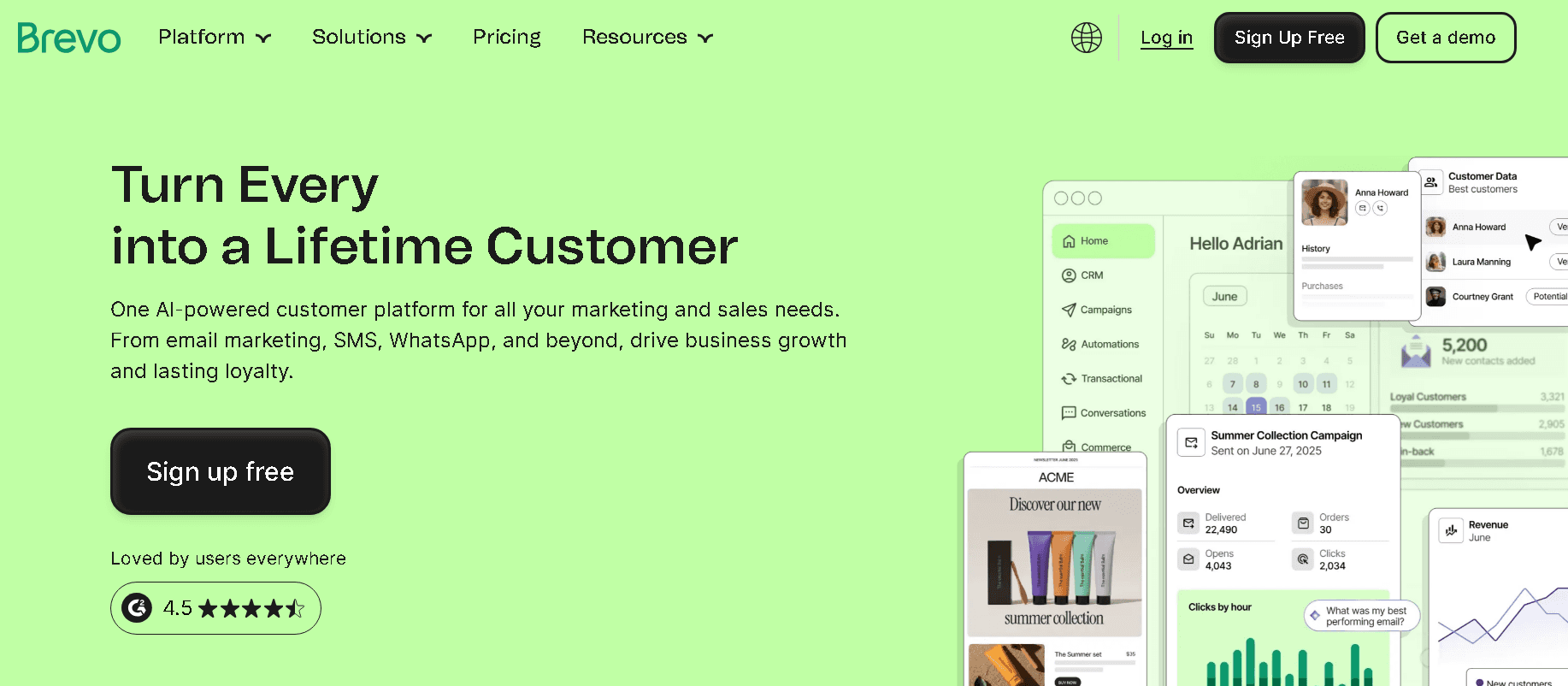
Sendinblue rebranded to Brevo in May 2023. This change reflected the platform’s development from an email marketing tool into a detailed customer engagement suite. The platform serves 600,000+ customers worldwide and offers multichannel communication through email, SMS, WhatsApp, live chat, and built-in CRM capabilities.
Brevo stands out because its pricing depends on email sends rather than contact list size. This makes it especially economical for businesses with large databases that email infrequently. The free plan requires no credit card to set up.
The dashboard organizes campaigns, automations, contacts, and reports in a clean interface that’s easy to navigate.
Key Features
Brevo has a drag-and-drop email editor with 47 responsive templates sorted by purpose. The visual automation builder uses flowchart-style layouts for multi-step workflows that customer behavior triggers.
Transactional email and SMS features come standard in all plans with immediate delivery tracking. Advanced segmentation groups contacts by demographics, behavior, and engagement patterns. A/B testing capabilities cover subject lines, content variations, and send times.
The platform has contact scoring based on engagement and purchases, AI-powered send time optimization, and web tracking for behavioral triggers. The platform integrates with 150+ tools like Shopify, WordPress, Stripe, and Zapier.
Pros and Cons
Pros:
Pay-as-you-go pricing model based on sends, not contacts
Free CRM in all plans
Visual automation builder with unlimited workflows on Standard plan
Strong deliverability with SPF and DKIM authentication
Cons:
Free plan limited to 300 emails daily
Template library smaller than competitors
Landing pages available only on Business tier
Brevo logo removal costs extra $12/month on Starter
Pricing
Plan | Price | Key Features |
|---|---|---|
Free | $0 | 300 emails/day, 100K contacts, automation for 2K contacts |
Starter | $9/month | 5K emails/month, no daily limit, basic reporting |
Standard | $18/month | Marketing automation, A/B testing, landing pages |
Professional | $499/month | 150K emails, WhatsApp, contact scoring, AI segmentation |
5. GetResponse
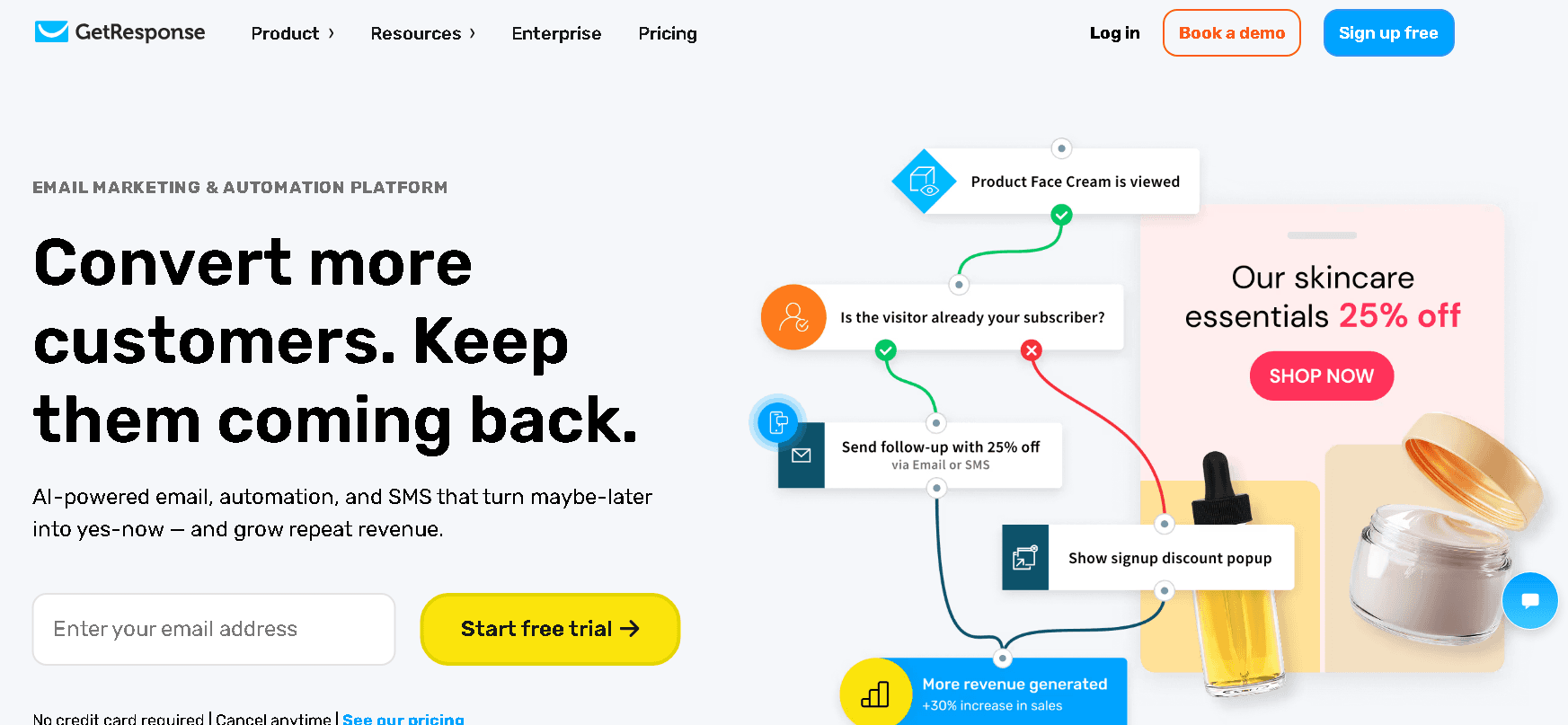
GetResponse started in Poland in 1998 and now serves over 350K customers with email marketing that remains affordable as businesses grow. The platform achieves a 99% deliverability rate in more than 160 countries and works with over 150 integrations.
GetResponse works as an all-in-one marketing platform that combines email automation, landing pages, webinars and AI-powered content creation. Companies see strong results:
Eveline Cosmetics generated $13,000 from a single automated campaign, and Würth Group increased turnover by 72% through targeted automation.
Key Features
The platform offers unlimited emails, automations and landing pages for paid tiers. AI tools generate email copy and recommend optimal send times. They also create complete campaigns that include landing pages and sequences.
Prebuilt automation templates handle welcome emails and abandoned cart recovery. They also manage product recommendations based on purchase history. The drag-and-drop workflow builder stacks conditions and actions for complex sequences.
Ecommerce features include Shopify and WooCommerce integrations with promo codes and revenue tracking. Other features include webinars for up to 100 attendees, SMS marketing, web push notifications and an AI course creator.
Pros and Cons
Pros:
Beginner-friendly with advanced automation capabilities
All-in-one platform that consolidates multiple marketing tools
Built-in sales funnels and landing pages
Solid ecommerce features with cart recovery
24/7 responsive customer support
Cons:
Template library feels outdated
Starter plan limited to 1 custom automation
No built-in CRM for pipeline management
Pricing
Plan | Price | Key Features |
|---|---|---|
Free | $0 | 500 contacts, 2,500 emails/month, 1 landing page |
Starter | $19/month | 1,000 contacts, unlimited emails, 1 automation workflow |
Marketer | $59/month | Unlimited automations, sales funnels, up to 5 users |
Creator | $69/month | Webinars (100 attendees), courses, paid newsletters |
Enterprise | Custom | SMS marketing, dedicated support, transactional emails |
6. Drip
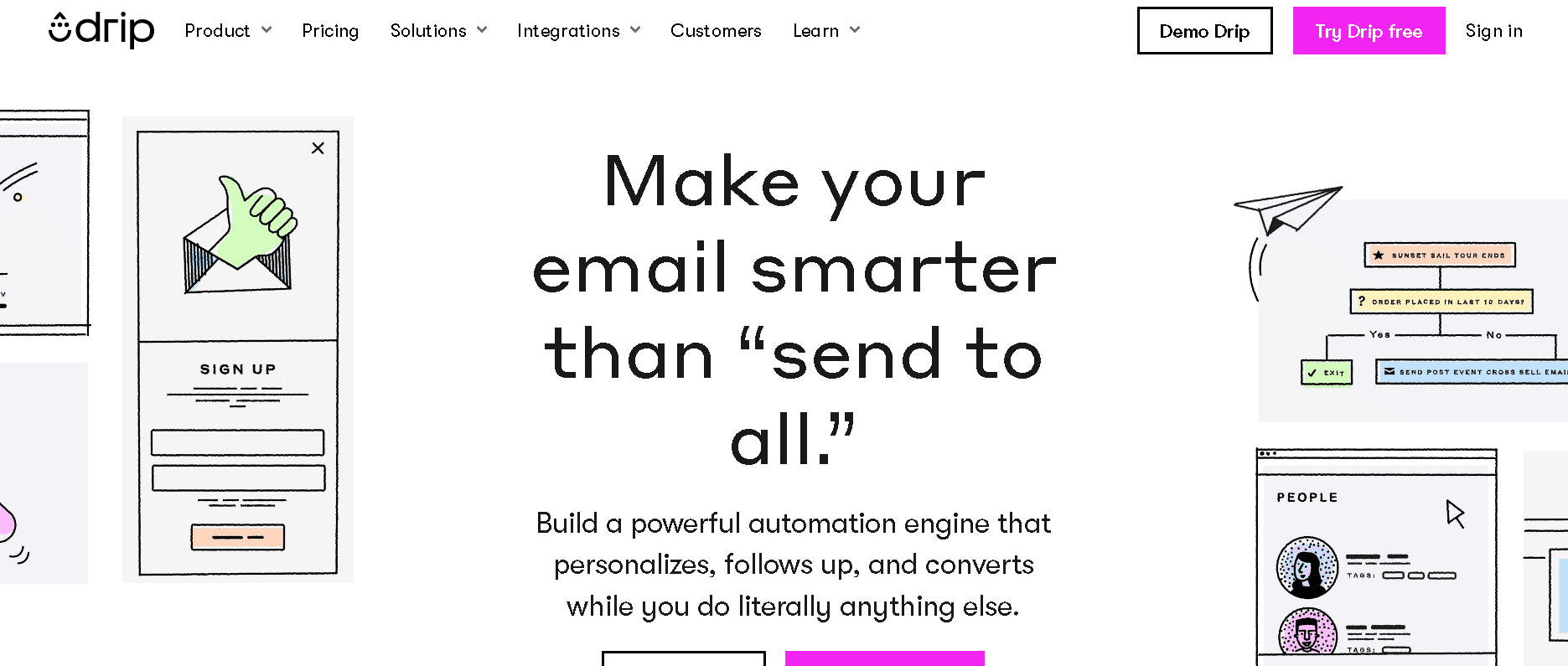
Drip functions as an ecommerce CRM that treats every unique email as an individual contact rather than organizing subscribers into traditional lists. The platform launched in 2013 and targets B2C businesses selling digital or physical goods online, including creators, ecommerce brands, travel companies and education providers.
Drip powers everything through a tagging system that makes unlimited segmentation possible, unlike conventional email marketing platforms. The visual workflow builder stands out as the platform’s signature feature and allows users to construct complex automation sequences through an easy-to-use interface.
Drip customers using segments earn 5x more revenue than those who don’t.
Key Features
The workflow builder supports Liquid templating for advanced personalization and conditional logic. Events capture actions with timestamps and custom metadata, which makes time-based segmentation possible like identifying customers who purchased between specific dates.
A JavaScript library provides website tracking and powers the toaster widget to capture leads. Link tracking appends codes to email URLs and identifies which subscribers currently browse your site while making dynamic content display possible.
Built-in lead scoring, auto-resend for unopened broadcasts and content snippets maintain organization. Integrations span Shopify, WooCommerce, Magento and dozens of other platforms.
Pros and Cons
Drip delivers strong automation capabilities at fair pricing with excellent support and 99.8% deliverability. You can manage multiple domains under one account and access all features whatever plan tier you choose. Custom email templates support only single editable sections, though.
The platform creates confusion between Campaigns and Workflows since both handle the same functions. A/B testing lacks setup that feels natural, reporting navigation proves difficult and advanced features require coding knowledge. The visual workflow builder could offer more drag-and-drop flexibility.
Pricing
Plan | Price | Contacts |
|---|---|---|
Starter | $19/month | Up to 500 |
Growth | $39/month | Up to 2,500 |
Scale | $89/month | Up to 5,000 |
Pricing increases with subscriber count and reaches $1,899/month for 170,000 contacts. All tiers include complete feature access without locks.
7. MailerLite
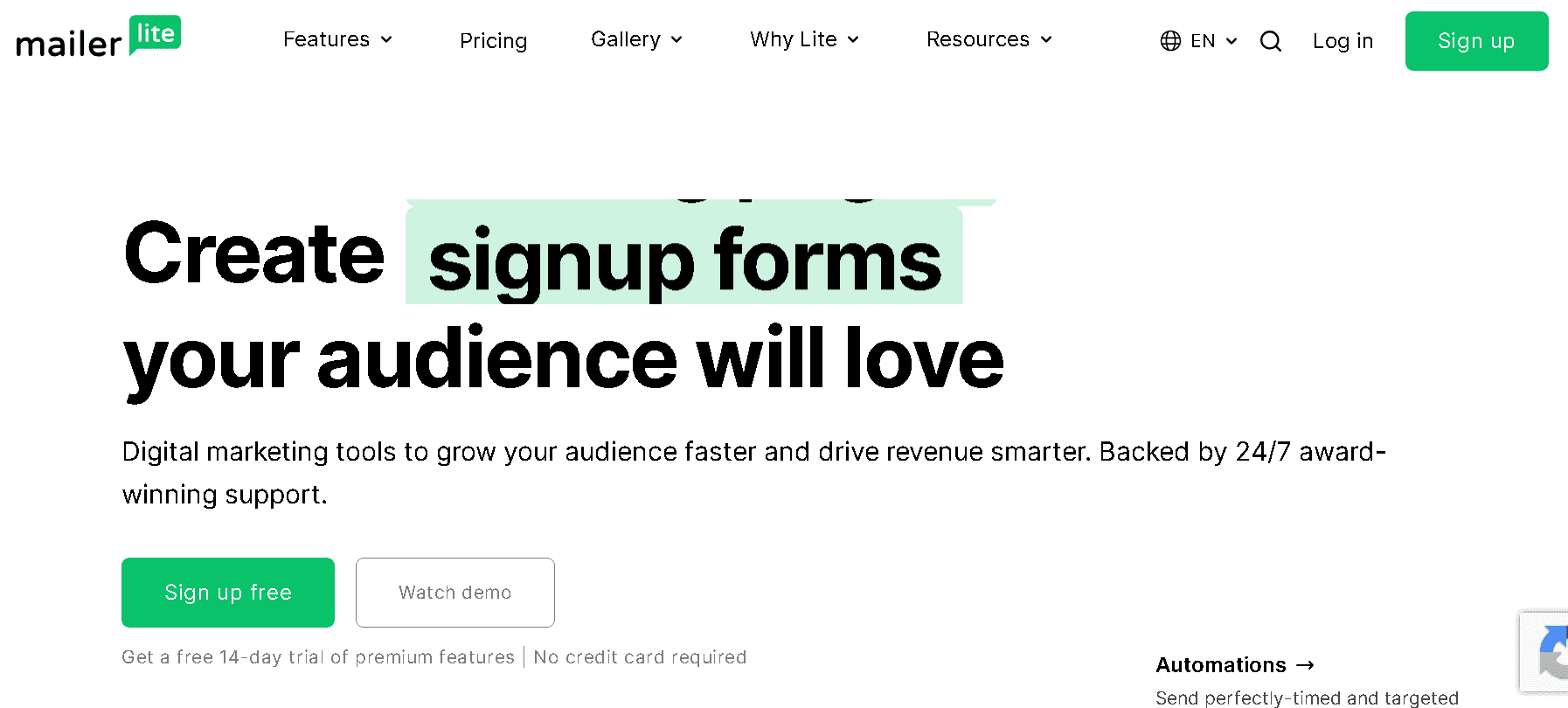
MailerLite is a fast-growing contender in email marketing, known for its simplicity and cost-effective plans. Unlike Mailchimp, MailerLite keeps a generous free plan with up to 1,000 subscribers and 12,000 monthly emails. Its platform emphasizes automation and personalization without complex pricing tiers.
AI-powered content tools were added in 2025, allowing users to generate email copy, design templates, and optimize subject lines. Automation workflows remain accessible across all paid plans, with multi-step campaigns and e-commerce integrations supporting advanced outreach.
Key Features
The AI content assistant helps draft email copy tailored to your audience and brand style. The AI subject line optimizer generates multiple alternatives and predicts engagement potential. Workflow automations include triggers based on subscriber behavior, website activity, or purchases.
A drag-and-drop editor offers 100+ responsive templates, and the platform integrates with 1,000+ apps, including Shopify, WordPress, and Zapier. Advanced segmentation and personalized campaigns help target high-value subscribers effectively.
Pros and Cons
MailerLite shines with a clean, beginner-friendly interface and strong deliverability rates. Its free plan is more generous than many competitors. However, some advanced features, like multi-step automation triggers, are restricted to higher-tier plans.
Customer support is friendly and available via live chat and email, though phone support is not offered. Reporting features are solid but not as granular as enterprise-focused platforms.
Pricing
Plan | Price | Key Features |
|---|---|---|
Free | $0 | Drag-and-drop editor, basic automations, 100+ templates, 12,000 monthly emails |
Starter | $15+/month | All Free features + AI content assistant, advanced automation, unlimited emails |
Growth | $39+/month | All Starter features + priority support, e-commerce integrations, advanced segmentation |
Premium | Custom | All Growth features + dedicated account manager, advanced reporting, multi-step AI workflows |
There is no information about MailerLite’s overview, features, pricing, pros, cons, or any other details. I would need factual keypoints that contain information about MailerLite to write this section and follow your guidelines accurately.
Could you please provide the factual keypoints for MailerLite so I can write this section properly?
8. Mailchimp
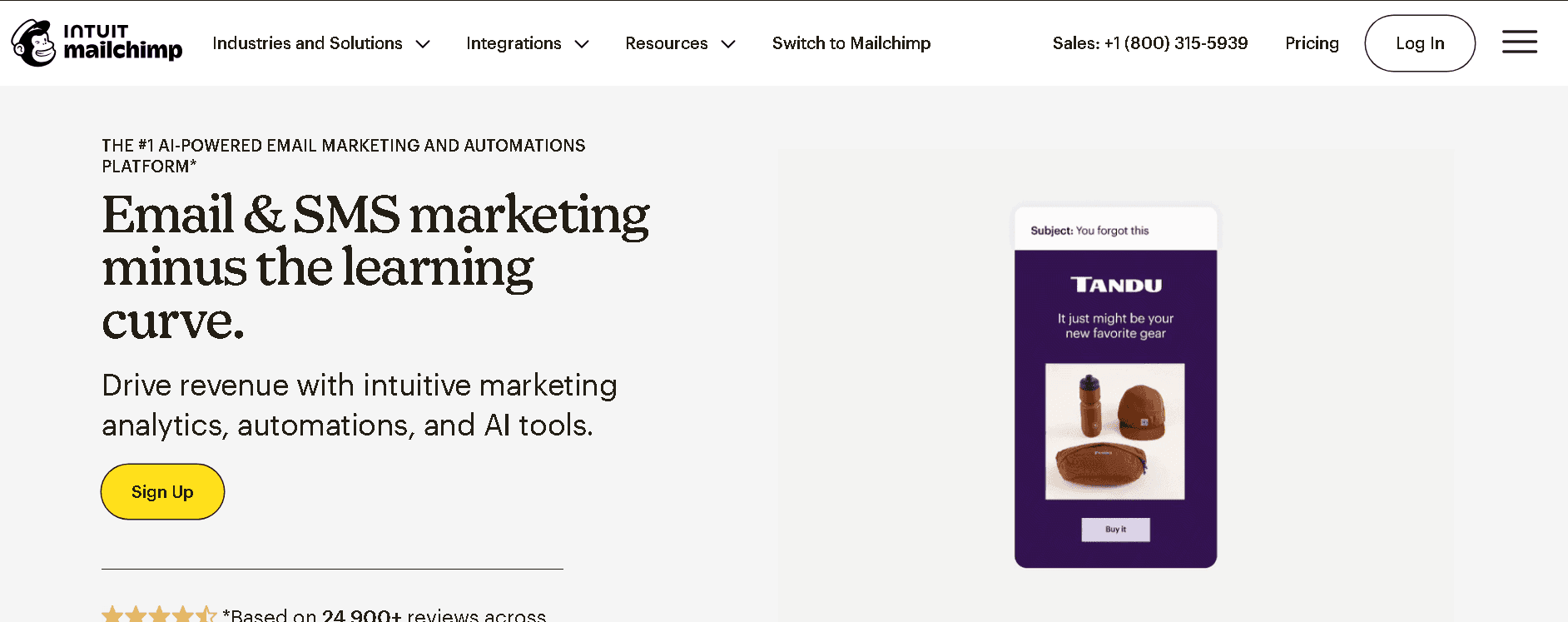
Mailchimp remains the most recognizable name in email marketing, but Intuit’s 2021 acquisition for $12 billion triggered substantial changes. The free plan dropped from 2,000 contacts to just 250 contacts and 500 monthly sends in January 2026. Automation workflows moved exclusively to paid tiers.
Intuit Assist now powers the platform’s AI capabilities and handles content generation, subject line optimization and workflow creation.
Marketing Automation Flows replaced the Classic Automation Builder in June 2025 and shifted toward AI-generated multi-step campaigns.
Key Features
Write with AI generates email body copy based on campaign goals and brand voice. The AI subject line generator analyzes past performance and suggests five variations per campaign. Send-Time Optimization predicts optimal delivery windows for individual contacts. Predictive Segmentation identifies high-value subscribers. The drag-and-drop builder offers 260+ templates, and the platform integrates with 1,600+ apps.
Pros and Cons
The interface delivers genuine beginner-friendliness with strong deliverability. Notwithstanding that, Mailchimp charges for unsubscribed and cleaned contacts you cannot email and creates 20-40% cost inflation. Customer support relies heavily on chatbots. Phone access is restricted to Premium subscribers.
Pricing
Plan | Price | Contacts | Features |
|---|---|---|---|
Free | $0 | 250 | 500 sends/month, no automation |
Essentials | $13/month | 500 | Basic automation, A/B testing |
Standard | $20/month | 500 | AI tools, dynamic content |
Premium | $350/month | 10,000 | Phone support, unlimited users |
Mailercloud

Mailercloud launched as an all-in-one email marketing platform built for businesses that want professional deliverability tools without the professional price tag. The platform serves startups, SMBs, and SaaS teams worldwide, combining campaign creation, automation, and real-time inbox monitoring under one clean dashboard.
The free plan covers 1,000 contacts and 12,000 emails per month with no credit card required. Paid plans start at $10/month with unlimited sends contact-based pricing that stays predictable as your list grows.
Key Features
Mailercloud includes a drag-and-drop email builder with 400+ mobile-responsive templates. The built-in Inbox Tracker monitors inbox placement in real time across Gmail, Yahoo, and Outlook a deliverability feature most platforms at this price don’t include natively.
AMP email support lets subscribers interact with forms, carousels, and polls directly inside their inbox without visiting an external page. Behavior-based automation workflows handle onboarding sequences, follow-ups, and re-engagement campaigns automatically.
Advanced segmentation groups contacts by behavior, demographics, or custom conditions. AI-powered subject line suggestions and A/B testing help optimize campaign performance over time.
The platform integrates with Shopify, WooCommerce, Zapier, and more.
Pros and Cons
Pros:
Generous free plan with 12,000 emails/month
Built-in inbox placement monitoring across major email clients
AMP emails for interactive in-inbox experiences
Affordable paid plans starting at $10/month with unlimited sends
Cons:
Smaller native integration library than larger platforms
No built-in SMS or multi-channel capabilities
Plan | Price | Features |
Free | $0 | 1,000 contacts, 12,000 emails/month |
Starter | $10/month | Unlimited sends, core features |
Premium | Custom | High-volume & enterprise needs |
Examples of Successful Automated Email Management
Real companies achieve measurable results when automated sales emails execute individual-specific outreach at scale. Case studies reveal specific tactics that boost response rates and revenue growth in different industries.
Cold Outreach Emails
Ambition cold-emailed 578 prospects and achieved a 12.6% total response rate. The company implemented persistent follow-up sequences across six weeks. The campaign generated 73 new leads by targeting VPs of sales and sales operations. Marco Massaro sent 500 cold emails with individual-specific pitches and secured a 13.4% response rate. He ended up closing a $15,000 consulting project.
A freelance graphic designer abandoned generic mass emails. She sent 20 highly individual-specific messages daily and achieved 85% open rates and 30% reply rates. This approach secured three long-term contracts worth over $50,000 each within three months. Each email included specific observations about the prospect’s website and a Loom video that demonstrated design improvements. LeadFuze scaled to $30,000 monthly revenue within one year using a four-email sequence. The sequence featured case studies and value-add content.
Post-Meeting Follow-Ups
Automated follow-up tools eliminate manual recap creation after sales calls. Microsoft Copilot generates meeting summaries and drafts follow-up emails by extracting participant details and action items automatically. Apollo provides similar functionality and creates meeting summaries. It syncs everything to CRM systems.
Salesforce showed effective post-event follow-up by including four CTAs. These CTAs were tailored to different buyer experience stages.
Conclusion
Selecting the right email automation platform depends on your specific requirements and team structure. Some tools excel at ecommerce workflows, while others shine in enterprise sales environments with complex CRM integrations.
Not every platform will fit your outreach strategy, and that’s expected. The key is identifying which features affect your sales velocity and choosing the right one. The right tool changes how your team manages outreach, whether you need autonomous AI agents like Rox or straightforward email sequences.
Start by evaluating your current bottlenecks and test platforms that address those pain points. Your perfect automated sales email solution exists within this list.
Frequently Asked Questions
What is Automated Sales Emails?
Automated sales emails send messages based on triggers you define, such as form submissions, website visits, email clicks, or purchases. You set the rules once and the platform handles delivery to the right person at the right time.
What’s the best tool to automate sales emails?
Saleshandy’s AI Sequence Copilot builds full campaigns from website context and prospect data when you need cold outreach. ActiveCampaign’s predictive sending and conditional content are the most advanced when it comes to email marketing. Klaviyo’s predictive AI forecasts purchase timing and churn risk if you run an ecommerce business. MailerLite offers the best free plan with automation, landing pages and website builder that supports 500 subscribers.
How can I save time on outreach while still engaging prospects?
AI handles 70-85% of typical outreach tasks including lead generation, message drafting, follow-up scheduling and reply categorization. Outreach automation boosts productivity by 60%. Your team can focus on discovery calls and closing deals.
What features should I look for in a tool that manages email sequences?
Prioritize email deliverability first. Then look for sender rotation, behavior-based segmentation, A/B testing and clear analytics.
How do AI-powered sales email tools improve efficiency?
Email automation generates 320% more revenue and delivers $36 to $42 for every $1 spent. AI analyzes recipient data to personalize content, subject lines, send times and product recommendations.
Similar Articles
We build with the best to make sure we exceed the highest standards and deliver real value.