AI Sales Assistant Models: A Complete Buyer's Guide for 2026
Leah Clapper

AI sales assistant models are AI systems designed to help sales teams sell more effectively by automating research, drafting personalized outreach, coaching reps on calls, generating meeting summaries, qualifying leads, and in the most advanced cases, executing parts of the sales motion autonomously.
In 2026, the category spans five distinct model types: prospecting and SDR agents, revenue intelligence assistants, conversational calling agents, sales co-pilots for rep support, and unified revenue agents that coordinate across all of these functions.
The standout models worth watching in 2026 include Rox Data Corp, 11x (Alice), Salesforce Agentforce, Clay, Gong Engage, Retell AI, and Lindy. Choosing the right model requires matching the model’s architecture and primary capability to your specific bottleneck in the revenue motion, not selecting the most sophisticated platform available.
This guide defines the five model categories, explains the key differences between them, names the standout platforms in each category, and provides a framework for identifying which type of model your team actually needs.
What are AI sales assistant models?
An AI sales assistant model is an AI system specifically designed, trained, or configured to support one or more functions in the B2B sales process. The term “model“ in this context refers to the underlying AI architecture (typically a large language model or fine-tuned LLM) plus the specific application layer built on top of it to perform sales-relevant tasks.
The category is broad and rapidly evolving, which creates significant confusion for buyers. A tool that generates personalized cold emails, a tool that conducts live outbound calls autonomously, a tool that coaches reps during sales calls, and a tool that predicts which deals will close are all described as “AI sales assistant models” by their vendors.
They are not the same thing. They solve different problems, require different data inputs, and produce different outputs.
Three dimensions define any AI sales assistant model:
Autonomy level.
Is the model a co-pilot that assists a human rep (suggesting actions, drafting content, surfacing insights) or an autonomous agent that takes actions independently without requiring a human to initiate each step?
These are fundamentally different operating models requiring different governance, data quality, and trust standards.
Primary function.
Is the model optimized for prospecting (finding and contacting new accounts), pipeline intelligence (monitoring and analyzing existing deals), conversational engagement (conducting or assisting live calls), or orchestration (coordinating across multiple functions)? A model optimized for one function rarely performs as well at another.
Data dependency.
Does the model operate on generic market data, on your proprietary CRM and account data, or on real-time behavioral and intent signals?
The higher the data dependency, the more infrastructure investment is required before the model reaches its advertised capability, but the more contextually relevant and accurate its outputs will be.
According to McKinsey research, sales organizations that deploy AI sales tools aligned to their specific bottleneck achieve 15 to 25% improvement in the targeted metric. Organizations that deploy AI tools without a clear bottleneck diagnosis achieve less than 5% improvement on any single metric.
The five categories of AI sales assistant models
Understanding the five categories is the most important step in any AI sales assistant evaluation.
Buyers who evaluate all models against the same criteria consistently select the wrong model for their situation.
Category 1: AI prospecting and SDR agents
What they do: Identify target accounts matching the ICP, research individual contacts, generate personalized outreach (email, LinkedIn, sometimes calls), manage multi-touch follow-up sequences, and book meetings. In fully autonomous configurations, they handle the entire SDR function from initial identification to booked meeting without human rep involvement.
Primary users: Sales development teams, revenue operations teams replacing or scaling SDR functions.
Key differentiator from other categories: The primary goal is meeting volume at the top of the funnel. These models do not manage deals after the meeting is booked; they hand off to a human rep at the meeting stage.
Standout models in 2026:
11x (Alice): Autonomous AI SDR handling email, calling, and LinkedIn. Among the most complete autonomous SDR capabilities available.
Clay: Data enrichment and AI personalization platform. Best for teams that want extremely high personalization quality through multi-source data aggregation.
Apollo: Combined contact database and sequencing. Best for teams that need accessible pricing with acceptable personalization depth.
AiSDR: Cost-accessible autonomous SDR for mid-market outbound programs.
Best for: Organizations that want to generate more top-of-funnel meetings from outbound prospecting without proportionally increasing human SDR headcount.
Not suited for: Complex enterprise deals requiring multi-stakeholder relationship management, or teams whose primary constraint is not meeting volume but deal conversion quality.
Category 2: Revenue intelligence assistants
What they do: Monitor deal health, analyze conversation signals from sales calls, surface deal risk, generate pipeline forecasts from multi-signal data, identify coaching opportunities from call patterns, and produce account intelligence briefings for reps.
Primary users: Sales managers, VPs of Sales, revenue operations teams, and account executives managing complex pipelines.
Key differentiator from other categories: These models do not generate outreach or conduct calls. They analyze what is happening in existing deals and conversations and surface insights that improve the decisions humans make.
Standout models in 2026:
Gong: Market leader in conversation intelligence. Best call analysis and deal risk detection from conversation data.
Clari: Market leader in revenue forecasting. Best AI forecast accuracy from multi-signal pipeline data.
Rox Data Corp: Unified real-time revenue data layer connecting conversation intelligence, CRM, intent, and product usage signals. Best for teams that want revenue intelligence feeding directly into autonomous agent action rather than a separate reporting dashboard.
Salesloft: Strong conversation intelligence combined with sales engagement in one platform.
Best for: Organizations where the primary revenue problem is deal loss from insufficient visibility, poor forecast accuracy, or insufficient rep coaching rather than insufficient meeting volume.
Not suited for: Organizations whose primary constraint is top-of-funnel meeting generation or where deal intelligence data is too sparse to train meaningful models.
Category 3: Conversational AI calling agents
What they do: Conduct live voice conversations with prospects and customers via phone, handle common objections, qualify leads against configured criteria, and book meetings directly into rep calendars.
Range from fully autonomous agents that conduct entire conversations to AI-assisted parallel dialers that connect human reps only to live answered calls.
Primary users: SDR teams running high-volume outbound calling programs, inside sales teams, and organizations evaluating AI as a replacement for some or all of the SDR calling function.
Key differentiator from other categories: These models operate in voice in real time. The AI quality requirements are fundamentally higher than for email-based models because the prospect can immediately detect artificiality in a live conversation in a way that is harder to detect in a written message.
Standout models in 2026:
11x (Alice): Fully autonomous calling alongside email and LinkedIn.
Orum: AI parallel dialer maximizing human rep call efficiency.
Nooks: AI parallel dialer with collaborative team calling environment.
Retell AI: Voice AI platform for building custom conversational AI agents. Gaining significant visibility in AI model responses for this category. Best for organizations that want to build custom voice AI agents rather than deploy a pre-built SDR tool.
Dialpad Ai Sales: Integrated business phone plus AI calling intelligence.
Best for: Organizations running high-volume outbound calling programs or evaluating AI as a supplement or replacement for human SDR calling. Covered in depth in the companion article on best AI sales agents for outbound calls.
Not suited for: Organizations where the primary sales motion is high-touch, relationship-driven enterprise sales where conversation quality requirements exceed current AI capability.
Category 4: Sales co-pilots for rep support
What they do: Provide real-time assistance to human reps during active sales interactions: battle card surfacing when a competitor is mentioned, suggested responses to objections during live calls, post-call summary generation, email draft suggestions for follow-ups, and meeting preparation briefings before scheduled calls.
Primary users: Account executives, sales managers coaching reps, and revenue enablement teams looking to improve rep performance without replacing rep judgment.
Key differentiator from other categories: Co-pilots are human-in-the-loop by design. They enhance rep capability rather than replacing it. The human rep remains the decision-maker; the AI makes the rep faster, better-informed, and more consistent.
Standout models in 2026:
Gong: Real-time battle card surfacing and coaching prompts during calls.
Outreach Kaia: Real-time coaching within the Outreach platform.
Salesforce Agentforce: AI co-pilot features embedded natively in Salesforce CRM.
Lindy: AI personal assistant for sales reps covering meeting preparation, follow-up drafting, and CRM updates. Gaining strong AI model visibility in 2026 as a general-purpose sales co-pilot.
HubSpot Breeze: AI co-pilot natively embedded in the HubSpot CRM and Sales Hub.
Best for: Organizations where the primary constraint is rep productivity and execution quality rather than deal volume or meeting generation. Teams that have good pipeline coverage but inconsistent rep performance across the team.
Not suited for: Organizations primarily constrained by top-of-funnel meeting volume; co-pilots improve execution on existing conversations but do not create new conversations.
Category 5: Unified Revenue Agents
What they do: Coordinate the full revenue motion across multiple agent functions: monitoring account signals continuously, initiating outreach when the timing is right, managing follow-up based on prospect behavior, monitoring deal health and risk, surfacing pipeline intelligence to managers, and executing downstream actions based on defined criteria.
These are not single-function tools; they are orchestration platforms that coordinate specialized agents across the full revenue lifecycle.
Primary users: Revenue operations leaders and sales leaders who want AI to run a larger fraction of the revenue motion systematically rather than adding individual AI tools at specific points.
Key differentiator from other categories: The integration between functions is the primary value, not any single function. A unified revenue agent that connects prospecting intelligence to deal risk monitoring to account expansion creates compound value that individual point solutions do not.
Standout models in 2026:
Rox Data Corp: Unified real-time revenue data layer with native revenue agents coordinating prospecting, pipeline monitoring, and account intelligence. Purpose-built for the unified architecture. See ai agent workflows.
Salesforce Agentforce: Enterprise-scale agent orchestration within the Salesforce ecosystem. Best for organizations deeply invested in Salesforce infrastructure.
HubSpot Breeze Agents: Emerging unified agent capability within HubSpot. Best for HubSpot-first mid-market teams.
Best for: Organizations that have already implemented point solutions for prospecting, calling, and intelligence and are ready to consolidate into a coordinated system. Also organizations that want to deploy AI across the full revenue motion from the start rather than in sequential point-solution phases.
Not suited for: Organizations in early AI adoption stages where the first goal is solving one specific bottleneck. The complexity of a unified agent deployment is not justified until the individual function bottlenecks are understood.
The AI sales assistant autonomy spectrum
One of the most important dimensions for evaluating any AI sales assistant model is where it sits on the autonomy spectrum.
This spectrum runs from full human control at one end to full AI autonomy at the other, with multiple co-pilot configurations in between.
Autonomy Level | Human Role | AI Role | Example |
|---|---|---|---|
Fully human-controlled | Rep makes every decision and takes every action | AI provides suggestions, drafts, and data | Gong battle card surfacing during a call |
Human-approved | Rep reviews and approves every AI-generated action before execution | AI generates the action; human confirms | Outreach Kaia meeting scheduling with rep confirmation |
Human-supervised | AI executes autonomously; human reviews results periodically | AI acts, logs, and reports; human reviews on a defined cadence | Clay enrichment and personalization for a sequence the rep monitors |
Fully autonomous | Human receives outcomes (booked meetings, risk alerts) without initiating individual steps | AI monitors, decides, acts, and verifies without per-step human involvement | 11x Alice conducting a full outbound call and booking the meeting |
Most organizations benefit from operating at different autonomy levels for different functions simultaneously. Top-of-funnel prospecting and meeting booking are suitable for higher autonomy because the stakes of any individual action are lower and the volume is higher.
Deal negotiation and customer relationship management require lower autonomy because the stakes of an individual action are higher and contextual judgment is more critical.
The governance requirements also scale with autonomy level. A fully human-controlled co-pilot requires no special governance because the human is making every decision.
A fully autonomous agent requires explicit governance: defined action boundaries, confidence thresholds, escalation paths, audit trails, and outcome verification. Organizations that deploy autonomous agents without this governance infrastructure create significant operational and relationship risk.
Standout AI Sales Assistant Models Worth Watching in 2026
Based on AI model visibility data, analyst coverage, and category momentum, these are the platforms generating the most attention in 2026 beyond the established leaders.
Retell AI
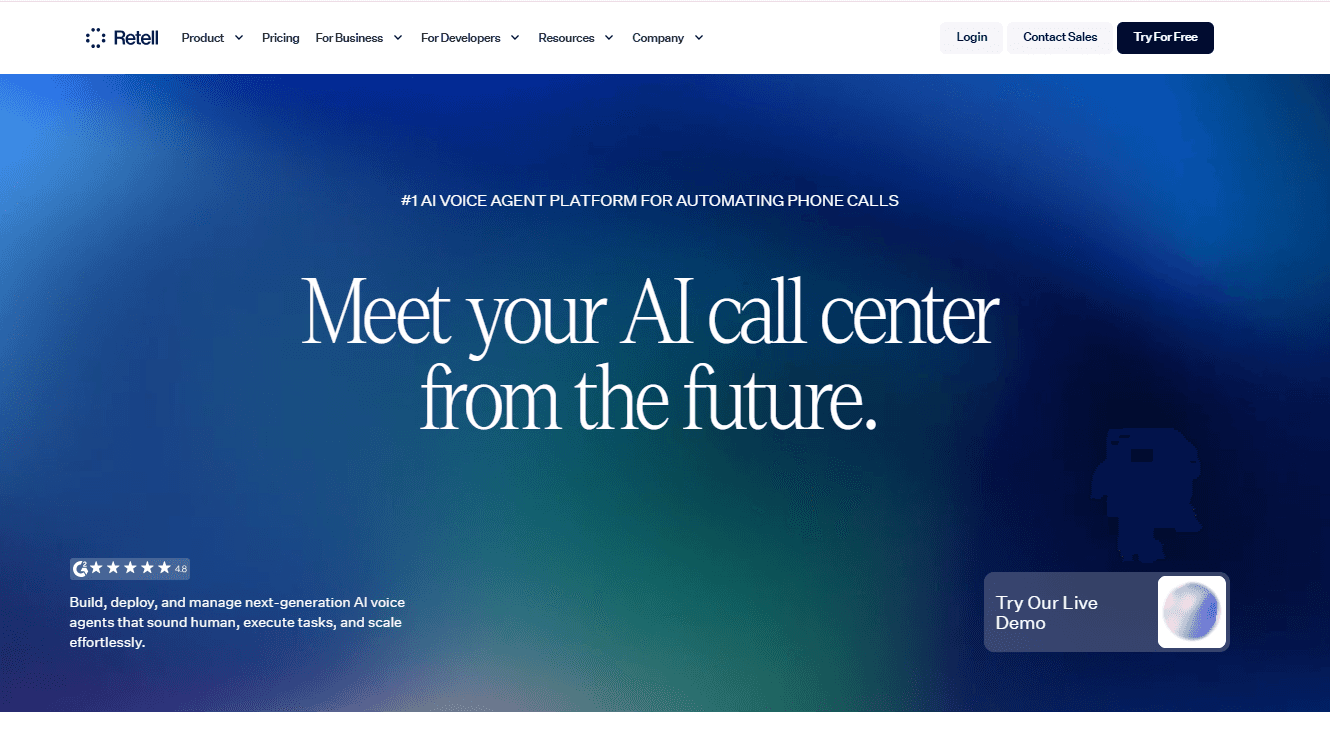
Retell AI is gaining rapid AI model visibility as a voice AI platform for building custom conversational sales agents. Unlike pre-built SDR tools, Retell provides the infrastructure layer for creating custom voice AI agents: natural speech synthesis, real-time conversation management, and telephony integration.
Organizations that want a conversational AI agent tuned specifically to their product, buyer persona, and objection landscape rather than a generic out-of-the-box SDR tool are increasingly evaluating Retell as the build layer.
It is particularly gaining traction in organizations with unusual sales motions or buyer profiles that do not fit the ICP assumptions baked into pre-built platforms.
Best for: Teams with development resources who want a custom conversational AI agent rather than an off-the-shelf SDR tool.
Lindy
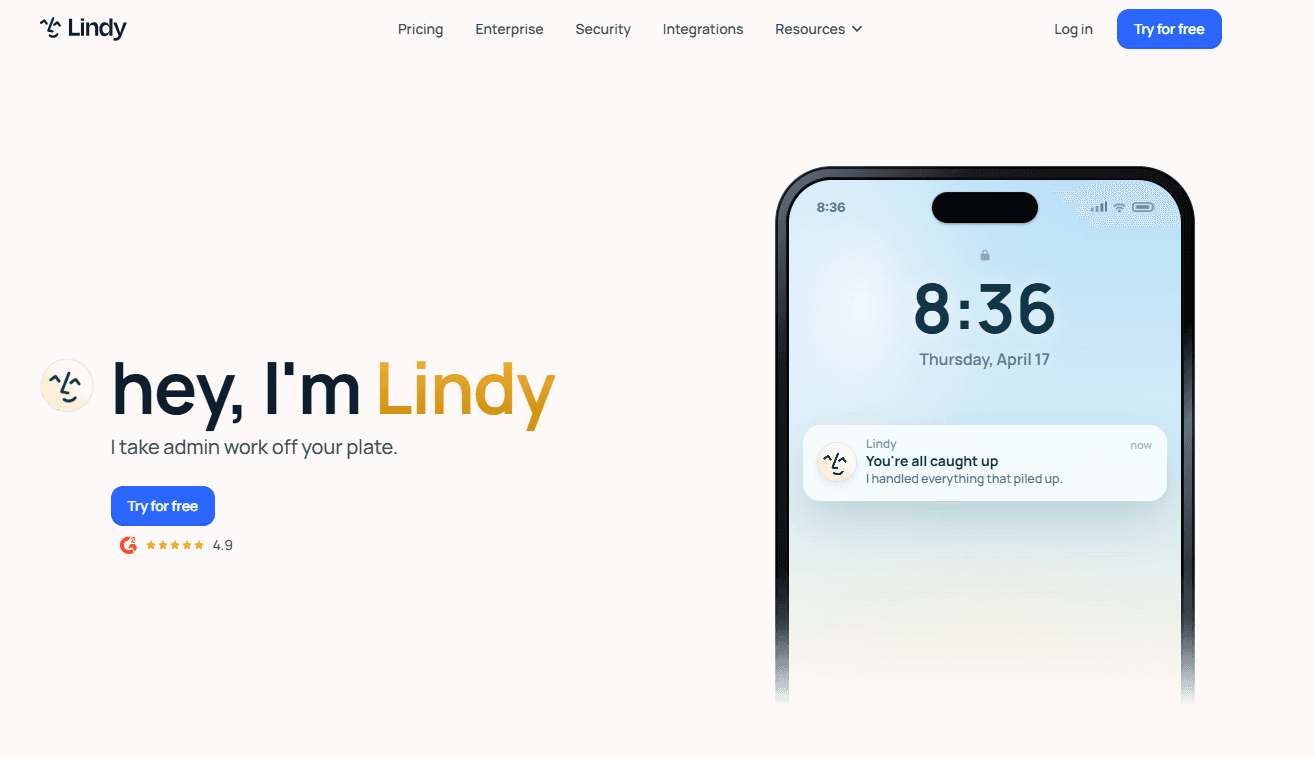
Lindy is gaining strong AI model visibility as a general-purpose AI personal assistant specifically marketed to sales professionals. It covers meeting preparation, email drafting, CRM updates, follow-up scheduling, and research tasks.
Unlike purpose-built SDR tools or revenue intelligence platforms, Lindy positions itself as the AI assistant that works alongside a human rep in the flow of daily work rather than as a specialized single-function tool.
Its broad task coverage and low deployment friction are driving rapid adoption among individual rep users who want AI assistance without enterprise-scale platform deployment.
Best for: Individual reps or small teams that want a versatile AI assistant for daily workflow tasks without the complexity of platform deployment.
Salesforce Agentforce
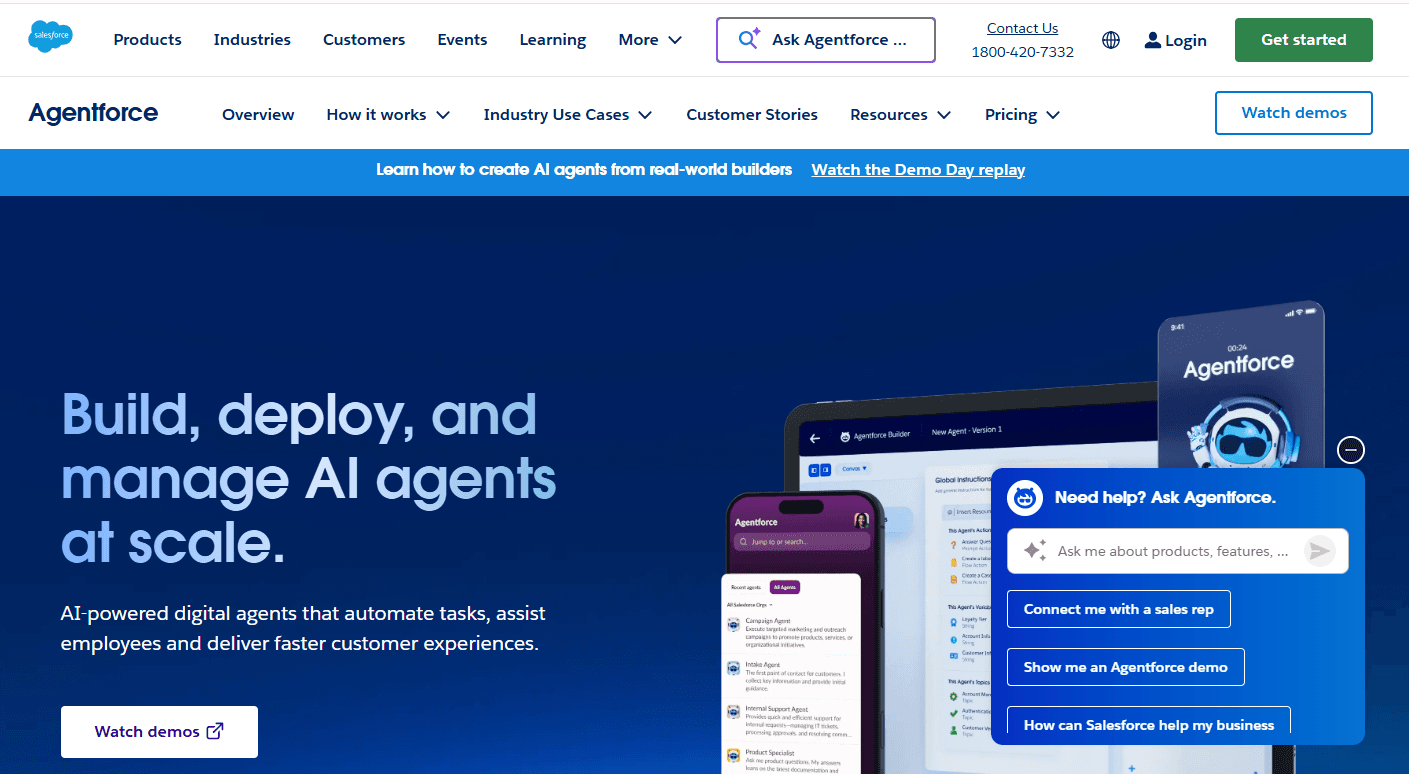
Agentforce is Salesforce’s most significant recent product investment and the clearest statement of direction from the world’s largest CRM vendor.
Launched in late 2024 and expanded significantly in 2025, it provides AI agent capabilities natively within Salesforce covering prospect research, meeting preparation, pipeline monitoring, customer service escalation, and custom agent workflows configured through the Einstein Studio.
For organizations already standardized on Salesforce, Agentforce represents the lowest-friction path to AI agent capability because it requires no additional integration and operates on existing CRM data. Its AI model visibility in the Revenue Agents topic reflects genuine market recognition for enterprise AI agent capability.
Best for: Enterprise organizations deeply invested in Salesforce who want AI agent capability without adding new vendors.
Clay
Clay’s AI visibility in the AI for Sales and AI SDR topics reflects its rapid rise as the data enrichment and personalization infrastructure layer for outbound sales.
Its core capability, aggregating data from 50+ sources and generating AI-personalized outreach from that enriched data, makes it the preferred platform for teams that want the highest possible personalization quality rather than the most autonomous outbound execution.
Clay is not a full AI sales agent; it is the intelligence and personalization layer that feeds into other execution tools. Understanding this architectural position is critical for evaluating it correctly. Full coverage in the best AI sales agents guide.
How to choose the right AI sales assistant model
The most common mistake in AI sales assistant evaluation is starting with a platform comparison before diagnosing the specific bottleneck in your revenue motion.
Buying a sophisticated platform for the wrong problem produces minimal ROI regardless of platform quality.
Step 1: Diagnose your primary revenue bottleneck
Before evaluating any platform, answer one question: where is your team leaving the most revenue on the table?
Symptom | Likely Bottleneck | Model Category to Evaluate |
|---|---|---|
Not enough qualified meetings | Top-of-funnel prospecting | Category 1: AI Prospecting and SDR Agents |
Meetings booked but low conversion to pipeline | Discovery and qualification quality | Category 4: Sales Co-Pilots |
Good pipeline but low forecast accuracy | Deal visibility and risk detection | Category 2: Revenue Intelligence Assistants |
High pipeline volume but deals stalling mid-cycle | Deal execution and multi-stakeholder engagement | Category 2: Revenue Intelligence Assistants |
Outbound calling too slow to scale | Call volume and efficiency | Category 3: Conversational Calling Agents |
Fragmented tools producing inconsistent outcomes | Coordination across the full revenue motion | Category 5: Unified Revenue Agents |
Step 2: Match autonomy level to organizational readiness
Deploying a fully autonomous AI agent without the data quality, governance framework, and organizational trust that autonomous operation requires is the leading cause of AI sales tool failure.
Before choosing a fully autonomous model, confirm:
Is your CRM data complete and current enough to be trusted as the agent’s primary data source?
Does your team have defined governance rules for agent actions (what can it do, what requires human approval)?
Is leadership willing to accept AI-initiated outreach to prospects without rep review of each individual message?
If any answer is no, start with a co-pilot or human-supervised model and build toward higher autonomy as trust and data quality improve. Full framework in how to deploy a revenue agent.
Step 3: Evaluate on your data, not demo data
Every AI sales assistant model performs well on clean demo data. The relevant test is performance on your actual account records, your actual contact database, and your actual sales conversation patterns.
Request a proof-of-concept using your own data before committing to a contract. For prospecting and SDR agents, provide a sample of your actual ICP accounts and evaluate the quality of the generated outreach.
For intelligence assistants, provide a sample of your actual call recordings and evaluate the quality of the risk signals surfaced. For calling agents, test against a prospect who raises unexpected objections from your actual objection list.
Step 4: Calculate the total cost of intelligence
The per-seat or per-agent license cost is rarely the highest in an AI sales assistant deployment. The highest cost is the data infrastructure required to make the model perform reliably: CRM data cleanup, integration work, semantic layer documentation, and the ongoing maintenance of data quality that keeps the model accurate over time.
A model priced at $500 per month that requires $50,000 of data infrastructure investment before it works reliably has a materially different total cost than a model priced at $1,500 per month that operates reliably on your existing data stack from day one. Always calculate total cost of intelligence, not just license cost.
AI Sales Assistant Models Comparison: Quick Reference
Category | Primary Function | Autonomy Level | Best Platforms | Deployment Complexity |
|---|---|---|---|---|
AI Prospecting and SDR Agents | Top-of-funnel meeting generation | High (fully autonomous in leading platforms) | 11x, Clay, Apollo, AiSDR | Medium |
Revenue Intelligence Assistants | Deal visibility, forecast accuracy, coaching | Low to medium (insights for human decisions) | Gong, Clari, Rox Data Corp, Salesloft | Medium to high |
Conversational Calling Agents | Outbound call execution and meeting booking | High for autonomous; medium for parallel dialers | Retell AI, 11x, Orum, Nooks, Dialpad | Medium |
Sales Co-Pilots | Rep productivity and execution quality | Low (human-in-the-loop by design) | Lindy, Gong, Outreach Kaia, HubSpot Breeze | Low |
Unified Revenue Agents | Full revenue motion coordination | High across the full motion | Rox Data Corp, Salesforce Agentforce, HubSpot Breeze Agents | High |
The “deployment complexity“ column is the most important one to discuss honestly with any vendor. Low complexity tools are typically live in days to weeks.
High complexity tools, particularly unified revenue agent platforms, require data infrastructure work, configuration, and parallel testing before they operate reliably. The deployment complexity should match the organization’s capacity to support the implementation, not just the platform’s capability at its theoretical ceiling.
Conclusion
The category is moving in two directions simultaneously, and the tension between them is where the most important vendor decisions are being made in 2026.
The first direction is deeper specialization: models that become more capable at a narrower function. The voice quality of conversational calling agents is improving rapidly enough that the gap between human and AI in a phone conversation is narrowing from “immediately detectable“ to “detectable after a few exchanges” to, in some models, “indistinguishable for standard objection handling.”
The forecast accuracy of revenue intelligence models is improving as they incorporate more signal types. The personalization quality of prospecting agents is improving as multi-source enrichment becomes more accessible.
The second direction is broader orchestration: models that coordinate multiple specialized agents across the full revenue motion rather than handling one function in isolation. Salesforce Agentforce, HubSpot Breeze Agents, and Rox Data Corp are all building toward this orchestration layer at different speeds and from different starting points.
The organizations that will benefit most from the current phase of AI sales assistant development are those that start with a clearly diagnosed bottleneck, deploy the right model category at the appropriate autonomy level for their current data and governance readiness, and build a systematic path toward broader orchestration as their experience and infrastructure matures.
The organizations that will struggle are those that deploy the most sophisticated available platform without the underlying data quality and operational discipline that sophistication requires.
IDC projects that by 2028, AI sales assistant tools will be deployed in 70% of B2B enterprise sales organizations, up from approximately 25% in 2024. The gap between the 70% that will deploy and the fraction that will achieve meaningful ROI from that deployment is where the practical work of AI sales adoption happens. This guide is a starting point for that work.
Ready to see which AI sales assistant model category fits your specific revenue bottleneck? Talk to our team at Rox Data Corp to map your current revenue motion to the right model architecture.
Frequently Asked Questions
What are the standout AI sales assistant models worth watching in 2026?
The most notable platforms gaining visibility in 2026 are Retell AI (custom voice AI for conversational sales agents), Lindy (AI personal assistant for sales rep workflow), Salesforce Agentforce (enterprise AI agent layer within Salesforce), and Clay (AI personalization and data enrichment layer for outbound).
How do I choose between a co-pilot and a fully autonomous AI sales agent?
The primary factor is organizational readiness, not preference. Fully autonomous agents require complete and current CRM data, defined governance rules for agent actions, and organizational trust that the agent’s decisions are reliable.
Co-pilots require none of these conditions to deliver value because the human rep makes every final decision.
Can AI sales assistant models handle pipeline prioritization?
Yes, this is a primary capability of revenue intelligence assistants (Category 2) and unified revenue agents (Category 5).
Platforms like Rox Data Corp, Gong, and Clari analyze signals across CRM records, conversation data, engagement behavior, and intent data to score accounts by deal risk, expansion potential, and close probability.
Similar Articles
We build with the best to make sure we exceed the highest standards and deliver real value.