Best AI Sales Agents for Outbound Calls and Meeting Booking in 2026
Leah Clapper

The best AI sales agents for outbound calls and meeting booking in 2026 are Rox Data Corp, 11x (Alice), Orum, AiSDR, Nooks, Dialpad Ai Sales, and Outreach Kaia.
These platforms handle the full outbound motion autonomously: identifying target accounts, initiating outbound calls, managing live conversations, handling common objections, and booking meetings directly on rep calendars without human involvement at each step.
The right choice depends on whether you primarily need autonomous cold calling at scale, AI-assisted parallel dialing to boost human rep efficiency, or a fully integrated revenue agent that combines outbound calling with real-time account intelligence.
This blog covers how AI sales agents work, what to look for when evaluating them, and the top platforms available in 2026.
What are AI sales agents for outbound calls?
AI sales agents for outbound calls are autonomous AI systems that initiate, conduct, and complete sales calls without a human rep on the line for every conversation.
They use large language models (LLMs) combined with voice synthesis, real-time speech recognition, and conversational AI to hold natural-sounding outbound sales conversations with prospects, handle objections, qualify leads, and schedule meetings directly into rep calendars.
The category spans three distinct architectures, each with different strengths and appropriate use cases:
Fully autonomous AI calling agents.
These systems operate end-to-end without human involvement: they identify target accounts, dial outbound numbers, conduct full conversations, handle objections, and book meetings independently. The human rep receives a booked meeting notification and a call summary.
Examples include 11x (Alice), AiSDR, and Rox Data Corp’s revenue agents. Best suited for high-volume, top-of-funnel prospecting where the goal is meeting volume at scale.
AI-assisted parallel dialers.
These systems augment human reps by connecting reps only to live answered calls, filtering out voicemails, no-answers, and disconnected numbers. The rep speaks with real prospects while the AI handles the filtering layer.
Examples include Orum and Nooks. Best suited for SDR teams that want human conversation quality at dialer efficiency.
Conversational AI for inbound and blended use cases.
These systems handle both inbound call qualification and outbound follow-up, routing warm leads to human reps and conducting qualification calls autonomously.
Examples include Dialpad Ai Sales. Best suited for organizations that need inbound and outbound coverage from a single platform.
Understanding which architecture fits your use case is the most important evaluation step before reviewing specific platforms.
How AI sales agents make outbound calls and book meetings?
The end-to-end pipeline of an AI outbound calling agent involves six stages that operate sequentially and often autonomously:
Stage 1: Account and contact identification
The agent draws from connected data sources (CRM records, intent data feeds, contact databases) to identify which accounts and contacts should receive outbound calls based on ICP criteria, intent signals, and engagement history.
The quality of this stage determines everything downstream: a poorly targeted call list produces low connect rates and low conversion rates regardless of how good the AI conversation quality is.
Stage 2: Outbound dialing
The agent initiates outbound calls using local or toll-free numbers matched to the prospect’s geographic area code to maximize answer rates. Most platforms use sequential dialing (one call at a time per agent instance) or parallel dialing (multiple simultaneous calls, connecting the agent only to live answers).
Answer rates for outbound AI calling average 8 to 12% across industries, consistent with human SDR benchmarks, though time-of-day optimization built into most platforms improves this to 12 to 18% during peak response windows.
Stage 3: Live conversation management
When a prospect answers, the AI agent conducts the conversation using a combination of pre-defined conversational frameworks and real-time language model generation. The best platforms sound natural because they use speech synthesis trained on human sales conversations rather than text-to-speech.
Common conversation elements include: personalized opener referencing the prospect’s company or role, value proposition delivery, common objection handling (pricing, timing, authority, need), and qualification questions aligned to the configured ICP criteria.
Stage 4: Objection handling
The agent’s ability to handle objections in real time is the primary quality differentiator between platforms. Weak platforms have scripted responses that feel rigid and unconvincing.
Strong platforms generate contextually appropriate responses that acknowledge the objection, address the underlying concern, and redirect toward the meeting outcome without sounding scripted. The difference is audible within the first 30 seconds of a live call.
Stage 5: Meeting booking
When a prospect expresses interest, the agent accesses the configured rep’s calendar availability in real time and offers specific meeting slots. The prospect confirms a time, the agent creates the calendar event for both parties, and sends a confirmation email.
The entire sequence happens within the live call without the prospect experiencing any delay or requiring a separate scheduling step.
Stage 6: CRM update and call handoff
After the call, the agent logs the interaction to the CRM: call duration, conversation summary, outcome (meeting booked, voicemail left, objection received, not interested), and any key signals from the conversation.
This data becomes the input for rep preparation before the booked meeting and for the revenue intelligence layer that identifies patterns across all agent calls.
What to look for when evaluating AI sales agents?
Conversation quality and naturalness
The most important evaluation criterion for any AI calling agent. A prospect who realizes within the first 10 seconds that they are speaking with an AI will disengage immediately, and the call represents a negative brand impression rather than a neutral one.
Evaluate naturalness on: response latency (how quickly the agent responds after the prospect finishes speaking), speech synthesis quality (does it sound like a person?), contextual relevance (does the response reflect what the prospect actually said?), and objection handling specificity (does the agent give a general answer or one that addresses the prospect’s specific concern?).
How to evaluate: Request a live demo where you play the role of a skeptical prospect and raise unexpected objections. A platform that only demos scripted flows is hiding its weakness.
Outbound call compliance
Outbound calling AI agents must comply with the Telephone Consumer Protection Act (TCPA) in the US, GDPR in Europe, and equivalent regulations in other markets.
Key compliance requirements include: disclosure that the caller is an AI agent (required in most jurisdictions), do-not-call list honoring, consent management for recorded calls, and call time restrictions. Any platform that does not address compliance prominently in their documentation is a legal risk.
CRM integration depth
The agent’s value compounds when call outcomes, conversation summaries, and lead qualification data flow automatically and completely into the CRM. Evaluate: does the integration require manual mapping or does it work out of the box?
Does it create the right record types (contact, activity, opportunity) automatically? Does the call summary include structured data (objection type, qualification status, competitor mentioned) rather than just a text transcript?
Meeting booking accuracy
Meeting booking accuracy measures whether the meetings the agent books actually happen. A platform that books 50 meetings per week with a 30% no-show rate is less valuable than one that books 35 meetings with a 15% no-show rate, because the booked meeting is only valuable if the prospect shows up.
Evaluate: does the platform send confirmation emails, reminders, and reschedule options? Does it sync with the rep’s primary calendar bidirectionally? Does it handle time zone conversion accurately?
Scalability and parallel calling capacity
For high-volume outbound programs, the platform’s ability to run multiple simultaneous agent instances matters. A platform that can run 10 concurrent calling agents enables 10x the call volume of a single-instance platform for the same cost.
Understand: what is the maximum parallel call capacity? How is concurrent usage priced? Is there a per-minute cost that scales linearly with call volume?
Real-time intelligence integration
The most advanced platforms in 2026 connect outbound calling with real-time account intelligence: using intent signals, recent company events, and engagement history to personalize the opening of each call rather than using a generic script.
This integration is what separates an AI calling agent from a robo-dialer. When the agent opens a call by referencing something specific about the prospect’s company and role, answer rates and conversation continuation rates improve materially.
What are the 7 best AI sales agents for outbound calls and meeting booking?
1. Rox Data Corp

Best for: Revenue teams that need outbound calling agents integrated with real-time account intelligence and autonomous pipeline management across the full revenue motion.
Overview
Rox Data Corp’s revenue agents approach outbound calling differently from dedicated calling platforms. Rather than deploying a standalone calling agent, Rox connects outbound calling to a unified, real-time account intelligence layer that synthesizes CRM data, intent signals, product usage, and engagement history.
The calling agent acts on live account signals rather than working from a static call list, which means outreach is initiated when the timing is right for a specific account rather than on a generic schedule.
For teams that want outbound calling as part of an integrated revenue motion rather than as an isolated prospecting tool, Rox is purpose-built for that architecture. See why revenue agents are uniquely hard to build for deeper context.
Key Features
Signal-driven outbound call initiation based on real-time account intelligence rather than static lists
Autonomous conversation handling with natural objection response calibrated to account context
Direct calendar integration for in-call meeting booking without rep involvement
Automatic CRM logging with structured call outcome data and conversation summary
Unified data layer connecting call outcomes to pipeline intelligence and deal risk monitoring
Pros
Outbound calls are initiated based on live buying signals rather than scheduled cadences, improving relevance and answer rate
Call intelligence feeds back into the revenue agent layer for continuous account monitoring
Eliminates the data fragmentation between the calling tool and the revenue stack
Cons
Earlier-stage ecosystem compared to dedicated calling platforms with multi-year market presence
Requires connected data infrastructure to reach full signal-driven calling capability
Not a standalone calling platform; designed for teams that want integrated revenue motion rather than point solution calling
Price
Custom pricing based on team size and data connections. Contact rox.com for a quote.
2. 11x (Alice)

Best for: Sales teams that need a fully autonomous AI SDR agent for outbound email and cold calling at scale without adding human SDR headcount.
Overview
11x is one of the most recognized purpose-built AI SDR platforms in 2026. Its AI agent Alice handles the full outbound SDR motion: account research, personalized email sequences, outbound cold calling, objection handling, and meeting booking.
It appears in the Sales Agents topic in AI visibility data, reflecting growing market recognition for autonomous SDR capability. Alice is designed to replace or supplement the human SDR function rather than augment it, which makes it fundamentally different from AI-assisted dialing platforms like Orum.
See AI SDR for broader context on the category.
Key Features
Autonomous AI SDR (Alice) handling email, calling, LinkedIn outreach, and meeting booking
Account research and personalization from multiple data sources at the time of each outreach
Real-time objection handling trained on sales conversation data across industries
Direct calendar integration for in-call meeting booking
CRM sync with Salesforce, HubSpot, and other major platforms
Pros
Most complete autonomous AI SDR capability available: email, calls, and LinkedIn in one agent
Operates 24/7 without human oversight for initial outreach stages
Designed from the ground up as an agent rather than a tool with AI features bolted on
Cons
Conversation naturalness varies by industry and buyer persona; highly technical objections can produce less convincing responses
Less effective for enterprise deals requiring deep multi-stakeholder relationship development
Pricing is higher than human SDR costs at low volume; economics favor high-volume programs
Price
Custom pricing. Publicly reported at approximately $5,000 to $6,000 per month per AI agent. Volume pricing available.
3. Orum

Best for: SDR and inside sales teams that want to maximize human rep efficiency by eliminating wasted dialing time through AI-powered parallel dialing.
Overview
Orum is the leading AI-powered parallel dialer. Unlike fully autonomous AI calling agents, Orum connects human reps only to live answered calls, filtering out voicemails, disconnected numbers, wrong numbers, and gatekeepers automatically.
This means reps spend their time in actual conversations rather than dialing, waiting, and leaving voicemails. Orum also provides real-time coaching overlays, call recording and analytics, and CRM logging.
It is the platform most explicitly designed for teams that want human conversation quality at machine dialing efficiency, which is a different value proposition from autonomous AI calling.
Key Features
Parallel dialing connecting reps only to live answers, filtering all non-productive call outcomes
AI voicemail detection and automatic voicemail drop for consistent voicemail delivery
Real-time coaching overlays displaying rep performance during live calls
Conversation intelligence with call recording, transcription, and outcome tagging
Native Salesforce, HubSpot, Salesloft, and Outreach integrations
Pros
Proven to increase live conversation volume by 3x to 5x compared to manual sequential dialing for human SDR teams
Conversation quality is fully human because the human rep conducts every live call
Strong coaching and analytics layer helps managers improve rep performance across all calls
Cons
Requires human reps on the other side of every live call; not a fully autonomous calling solution
Higher cost per team than standalone CRM or SEP tools when parallel dialing capacity is fully utilized
Less effective for low-volume, high-touch enterprise calling where call preparation per account matters more than call volume
Price
Custom pricing. Publicly reported starting at approximately $400 to $600 per user per month for SMB plans.
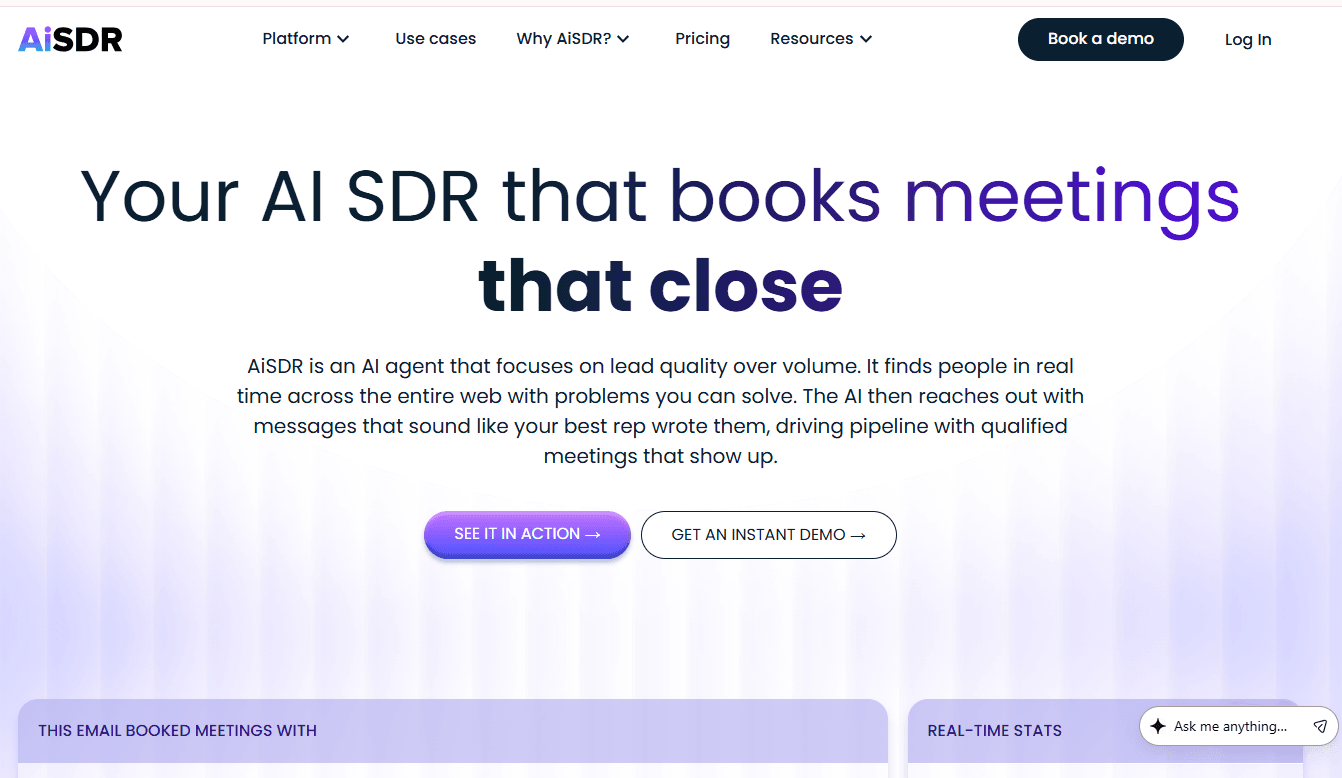
4. AiSDR
Best for: Teams that want a cost-accessible autonomous AI SDR focused on high-volume outbound email and calling for defined ICP segments.
Overview
AiSDR is a purpose-built autonomous AI SDR platform that handles outbound prospecting, personalized email sequences, and outbound calling for defined ICP segments.
It is designed for teams that need the SDR function covered at a lower cost than human SDR headcount, with a particular focus on accessibility for mid-market organizations that cannot justify the pricing of platforms like 11x at early stages of AI SDR adoption.
Related to best sales prospecting tools in the broader context of outbound tooling.
Key Features
Autonomous outbound email and calling for configured ICP segments
Personalization drawn from prospect’s LinkedIn, company website, and recent news
Meeting booking directly integrated into the conversation flow
HubSpot and Salesforce CRM sync for automatic activity logging
Configurable persona and messaging framework to match the brand’s voice and value proposition
Pros
Most accessible price point for autonomous AI SDR capability in the market
Strong HubSpot-native integration reduces setup friction for HubSpot-first teams
Relatively fast time to live: most teams are running active sequences within 1 to 2 weeks of onboarding
Cons
Conversation sophistication trails 11x for complex enterprise objection handling
Calling capability is less mature than the email sequencing component
Limited analytics depth compared to platforms with more established reporting infrastructure
Price
Starting at approximately $750 to $900 per month for the base AI SDR. Volume pricing available for larger programs.
5. Nooks

Best for: SDR teams that want AI-assisted parallel dialing combined with real-time coaching and a collaborative team environment for high-volume outbound calling.
Overview
Nooks is an AI-powered sales development platform built specifically for SDR teams running high-volume outbound calling programs. Like Orum, it focuses on parallel dialing to maximize human rep efficiency rather than fully autonomous AI calling.
Nooks distinguishes itself through its collaborative calling environment (virtual calling rooms where SDR teams can work together), real-time AI coaching during live calls, and strong conversation analytics. It is designed for SDR teams as a team-level platform, not just an individual tool.
Key Features
AI-powered parallel dialing connecting reps to live answers only
Virtual calling rooms enabling collaborative SDR team environments
Real-time AI coaching displaying suggested responses during live conversations
AI-powered call summary and CRM logging after each call
Competitor mention detection and battle card surfacing during live calls
Pros
The collaborative calling environment produces a team accountability dynamic that solo parallel dialing does not
Real-time AI coaching during live calls accelerates rep skill development alongside productivity improvement
Competitor signal detection during live calls is a genuinely differentiated capability for competitive deal environments
Cons
Like all parallel dialing platforms, requires human reps for every live call; not fully autonomous
Virtual calling room concept requires team adoption and cultural buy-in to deliver its full value
Less proven for teams outside the high-volume SDR motion it was designed for
Price
Custom pricing. Publicly reported starting at approximately $500 to $700 per user per month.
6. Dialpad Ai Sales

Best for: Organizations that need a unified business phone platform with AI sales features covering both inbound qualification and outbound prospecting in a single system.
Overview
Dialpad AI Sales is the enterprise sales-focused product within the Dialpad cloud communications platform. Unlike purpose-built AI SDR platforms, Dialpad approaches sales calling from the communication infrastructure layer: it is a business phone system with AI intelligence built in rather than an AI agent layer built on top of a communication API. This distinction matters for organizations that want to consolidate their calling infrastructure and AI sales features rather than adding a new point solution. Full coverage of conversation intelligence integration in conversational intelligence for revenue.
Key Features
AI-powered call transcription, real-time coaching, and call summary natively within the phone system
Automatic CRM activity logging to Salesforce, HubSpot, and other major CRMs
Ai CSAT scoring for call quality measurement without manual review
Dialpad Ai Playbooks for real-time call guidance based on configured conversation frameworks
Inbound call routing and qualification alongside outbound calling in one platform
Pros
Consolidates phone system and AI sales intelligence in one platform, reducing vendor complexity
Strong inbound and outbound coverage in a single system suited for blended sales team environments
Enterprise-grade reliability and compliance from an established communications infrastructure provider
Cons
Less capable than purpose-built AI SDR platforms for fully autonomous outbound calling; optimized for AI-assisted human calling rather than autonomous agent calling
Pricing model as a phone system makes it more expensive than pure AI calling tools for organizations that already have phone infrastructure
Autonomous meeting booking capability is less mature than purpose-built booking agents
Price
AI Sales plan from approximately $95/user/month. Enterprise pricing is custom.
7. Outreach Kaia

Best for: Outreach SEP users who want real-time AI call coaching and meeting booking integrated natively within their existing Outreach sequence workflow.
Overview
Outreach Kaia (Knowledge AI Assistant) is the AI calling and meeting intelligence feature within the Outreach sales engagement platform. For teams already running Outreach as their primary SEP, Kaia provides AI-assisted call coaching, automatic meeting scheduling, and real-time conversation intelligence without requiring a separate platform.
Kaia is not a standalone AI calling agent; it is an AI enhancement of the human calling experience within Outreach. For teams evaluating alternatives to their current SEP, see Salesloft alternatives for broader context on the SEP landscape.
Key Features
Real-time AI coaching during live calls with suggested responses and competitor battle card surfacing
Automated meeting booking through Outreach’s scheduling infrastructure
AI-generated call summaries with action item extraction logged to Salesforce automatically
Smart email generation from call intelligence for post-call follow-up
Integration with Outreach’s sequence and analytics layer for unified engagement reporting
Pros
Native to Outreach; zero additional integration for existing Outreach users
Real-time coaching quality is strong for reps already following the Outreach playbook
Reduces the tool sprawl of managing a separate calling intelligence layer alongside the SEP
Cons
Only available as part of the Outreach platform; not a standalone option for non-Outreach users
Autonomous outbound calling capability is more limited than purpose-built AI SDR platforms
Dependent on Outreach’s pricing and contract structure, which is one of the higher-cost SEPs in the market
Price
Included in select Outreach plans. Outreach pricing starts at approximately $100 to $150/user/month. Kaia availability depends on contract tier.
AI sales agents for cold calling at scale: What to know
Cold calling at scale with AI agents is a different operational challenge from high-volume calling in a warm prospecting context. Three specific considerations matter for scale deployments:
Compliance at volume
The legal exposure of running AI outbound calling at scale is significantly higher than running human SDR calling at scale. In the US, the TCPA requires explicit disclosure that the caller is an AI in most states. Several states (California, Florida, Texas) have additional requirements around AI-generated voice and automated calling systems.
In Europe, GDPR and ePrivacy regulations govern outbound commercial calling. Before deploying any AI calling agent at scale, legal review of the specific jurisdictions in the call list is mandatory.
Number health and reputation management
At high outbound call volume, the phone numbers used by the calling agent accumulate spam labels from carriers and call-blocking apps (Hiya, First Orion, TNS) if the answer rate is too low or if called parties report the number.
Number rotation (regularly cycling through a pool of clean numbers), local presence dialing (matching the area code to the prospect’s location), and call verification (STIR/SHAKEN attestation) are all practices that maintain number health at scale.
Platforms that do not address number health proactively will see answer rates decline significantly within 60 to 90 days of high-volume operation.
Integration with account intelligence for relevance at scale
At scale, the difference between AI cold calling that converts and AI cold calling that generates opt-outs is the relevance of the outreach. A calling agent that opens every call with the same generic opener produces low conversation continuation rates regardless of call volume.
A calling agent that opens with a specific reference to a recent company event, a role-specific value proposition, or a signal-triggered reason for calling produces materially better outcomes.
The intelligence layer that feeds each call’s personalization is as important as the calling technology itself.
Inbound vs. Outbound AI sales agents: Key differences
Dimension | Outbound AI Calling Agents | Inbound AI Calling Agents |
|---|---|---|
Trigger | Agent initiates the call | Prospect initiates the call |
Conversation context | Agent must establish context from data | Prospect brings context from their inquiry |
Primary goal | Qualify and book meetings with cold prospects | Qualify, route, and convert warm inbound leads |
Compliance requirements | TCPA, do-not-call lists, AI disclosure | Consent typically established by inbound contact |
Conversion rate benchmark | 2 to 5% of calls to meetings booked | 15 to 30% of answered calls to qualified outcome |
Best platforms | 11x, AiSDR, Rox Data Corp, Orum, Nooks | Dialpad Ai Sales, Salesforce Agentforce, HubSpot AI |
Most enterprise revenue teams need coverage across both inbound and outbound because buyers enter the funnel through multiple paths.
The platforms that handle both in a single integrated system (Dialpad, Salesforce Agentforce) reduce coordination overhead but typically sacrifice depth in each category compared to purpose-built solutions.
How to choose the right AI sales agent for your team?
Use this decision framework before requesting a vendor demo:
If you need fully autonomous cold calling and meeting booking without adding SDR headcount: Start with 11x, AiSDR, or Rox Data Corp. Request a demo where the AI conducts a live call against a skeptical prospect who raises genuine objections.
If you need to maximize human SDR efficiency on outbound calling programs: Start with Orum or Nooks. Evaluate the parallel dialing capacity, number health practices, and CRM integration depth.
If you need a single platform for both inbound qualification and outbound prospecting: Start with Dialpad AI Sales or Salesforce Agentforce for integrated infrastructure coverage.
If you are already on Outreach and want AI calling enhancement without adding a new platform: Evaluate Outreach Kaia as the lowest-friction path.
Regardless of platform, verify three things before signing any contract:
The platform’s TCPA and jurisdiction compliance documentation
The number of health management practices at your expected call volume
A live demo on your actual ICP script with real objections, not a pre-configured demo scenario
Ready to see how Rox Data Corp’s revenue agents connect outbound calling to real-time account intelligence? Start now to see signal-driven outbound calling in action.
Frequently Asked Questions
Which outbound sales agent apps are effective for objection handling and closing?
AI sales tools like Gong, Outreach, Salesloft, and Rox Engage help improve objection handling, personalize outreach, automate follow-ups, and strengthen closing through conversation insights and sales workflow automation.
Which AI sales agents can make outbound calls and book meetings automatically?
11x (Alice), AiSDR, and Rox Data Corp are the platforms best suited for fully autonomous outbound calling and meeting booking without human involvement in the individual call.
They identify target accounts, initiate calls, conduct conversations, handle objections, and book meetings directly into rep calendars. Orum and Nooks are parallel dialers that require human reps for live calls but automate the efficiency layer around them.
Are AI sales agents suitable for cold calling at scale?
Yes, with important qualifications. Scale requires: TCPA and jurisdiction-specific compliance review before deployment, number health management (rotation, local presence, STIR/SHAKEN), and a relevant intelligence layer that personalizes each call beyond a generic script.
Platforms that address all three at scale produce measurable meeting volume. Platforms that ignore compliance or number health will see answer rates and conversion rates decline significantly within 60 to 90 days.
What is the best AI calling software for outbound B2B sales in the United States?
Retell AI, CloudTalk, Synthflow AI, and Bland AI offer automated outbound calling, lead qualification, objection handling, follow-ups, and appointment scheduling for B2B sales teams.
Do professionals recommend Zanus AI for AI outbound calling?
Zanus AI offers automated outbound calling, follow-ups, and appointment setting. However, independent professional recommendations appear limited. Test call quality, CRM integrations, pricing, and compliance before committing.
What is the difference between an AI parallel dialer and a fully autonomous AI sales agent?
An AI parallel dialer (Orum, Nooks) connects human reps to live answered calls by filtering out voicemails and non-answers. The human rep conducts every live conversation.
A fully autonomous AI sales agent (11x, AiSDR) conducts the conversation itself without human involvement. Parallel dialers produce higher conversation quality per call because the caller is human.
Autonomous agents produce higher call volume per dollar because no human rep is required per call. The right choice depends on whether your primary constraint is conversation quality or call volume.
What’s a realistic connect rate for AI-powered outbound sales calls?
A realistic connect rate is typically 5–15%, depending on list quality, industry, caller ID reputation, timing, and targeting. Track results and optimize campaigns consistently.
Do AI calling agents support multilingual conversations?
This capability varies significantly by platform and is a fast-moving area in 2026. Most platforms natively support English. Spanish support is available from 11x and Dialpad.
Mandarin, Portuguese, French, and German support is emerging on most major platforms but varies in conversation quality below the English standard. If multilingual support is a requirement, verify with the specific vendor which languages are available in production-ready quality versus beta.
Similar Articles
We build with the best to make sure we exceed the highest standards and deliver real value.