Conversational Intelligence for Revenue: Boost Sales with AI Insights
Leah Clapper

Nearly two-thirds of sales teams are missing their quotas, and sales costs can consume 15–30% of total revenue. That’s why conversational intelligence for revenue has become essential for sales organizations.We’ve seen companies using conversation intelligence tools achieve a 20% increase in customer satisfaction scores and gain applicable information from every customer interaction.
In this piece, we’ll explore what conversation intelligence software is, how sales conversation intelligence platforms accelerate revenue, and which conversation intelligence solutions deliver the best results for your team.
What Is Conversational Intelligence for Revenue?
Conversation intelligence software captures, transcribes, and analyzes customer interactions across calls, emails, and meetings automatically. It transforms unstructured communication into useful insights.
This AI-powered technology helps revenue teams understand customer needs, track pain points, and extract intelligence from every conversation.
The software records business conversations and uses artificial intelligence to deliver coaching insights, deal intelligence, and next-step recommendations. Sales managers no longer spend countless hours listening to calls.
Conversation intelligence platforms flag relevant moments like pricing questions or competitor mentions instead.
How Conversation Intelligence Works?
The process unfolds in three distinct stages. The platform captures information from phone and video conversations with accurate transcription, storing recordings in your CRM for easy access at the first stage. The tool listens and records the interaction whether you’re on Zoom, Teams, or phone.
AI models analyze conversations using natural language processing at the second stage. The technology transcribes audio into text while understanding context, sentiment, and intent. It grasps the structure of language rather than recognizing words in isolation. Technical jargon and industry acronyms are captured with high accuracy.
Insights surface live at the third stage. The AI scans conversations and flags key moments, objections, competitor mentions, and buying signals. AI agents then generate summaries, update CRM fields, and suggest customized follow-ups. Managers and reps access dashboards showing talk-to-listen ratios, conversation etiquette, and performance metrics.
Conversation Intelligence vs Conversational AI
These terms sound alike but serve opposite purposes. Conversational AI creates systems that mimic human dialog, such as chatbots or virtual assistants like Siri and Alexa. These tools use natural language processing to understand and respond to human language. They manage routine questions and provide automated support.
Conversation intelligence analyzes human-to-human interactions on the other hand. It doesn’t talk to your customers. It listens to the conversations your team is already having instead. The goal is insight extraction for decision-making and sales enablement, not live dialog with customers.
Conversational AI makes interactions easier in the moment, while conversation intelligence analyzes conversations to improve future decision-making and interactions.
How conversation intelligence drives revenue growth?
Sales organizations that implement conversation intelligence software see measurable financial returns between 5x to 15x within the first year. This ROI comes from three main revenue mechanisms that change how teams sell.
The largest revenue gains come from close rate improvement. Conversation intelligence platforms surface winning behaviors from top performers and make those patterns visible throughout the team through coaching insights.
Teams see 15% higher win rates, with conservative modeling showing a 3-5% point close rate improvement in year one. A team closing 20% of qualified opportunities that moves to 24% on $3 million in qualified pipeline generates $120,000 in incremental revenue.
Deal size expansion is the second mechanism. Better discovery questions and objection handling increase average contract values by 5 to 15%. The third driver is pipeline velocity. Faster follow-ups and earlier risk detection compress sales cycles.
Teams using conversation intelligence shorten sales cycles by 19% and allow reps to work more deals at once.
What are the key features of sales conversation intelligence platforms?
Selecting the right conversation intelligence platform requires understanding which features affect meaningful revenue. Modern sales conversation intelligence software combines multiple AI capabilities to transform raw conversations into structured data that improves team performance.
AI-Powered Call Recording and Transcription
Conversation intelligence platforms record and transcribe calls with high accuracy automatically. They convert spoken words into searchable text. The software captures phone and video conversations on Zoom, Teams and telephony systems. Speech recognition technology generates transcripts.
Speaker identification separates who said what during multi-party calls and allows managers to analyze individual rep performance. Automated summaries highlight call moments that matter. Sales leaders can understand how calls went, whether reps followed sales scripts, and how they tackled objections without listening to entire recordings.
Up-to-the-Minute Conversation Analytics
Live sales assistance delivers value during active calls immediately. The software offers up-to-the-minute insights through cue cards with relevant context or monolog alerts. Reps can capitalize on the right moment and involve buyers more effectively.
Keyword alerts track terms during conversations and generate live notifications to capture data points like competitor mentions, pricing discussions or specific objections. Talk-to-listen ratio measurements, sentiment analysis and moments of hesitation give managers concrete metrics to assess conversation quality and buyer engagement.
CRM Integration and Activity Tracking
Native integrations log call data, transcripts and meeting summaries into CRM records without manual entry. The platforms update fields like deal stage, next steps and activity history automatically. Auto-tagging classifies calls based on identifiers such as quotes, appointments set or purchases made.
Sales and marketing teams can access the right data with proper context. Conversation data syncs to Salesforce, HubSpot and other CRM systems. This creates a single source of truth for customer interactions.
Revenue Signals and Deal Health Monitoring
Advanced filters applied to calls and transcripts unearth meaningful patterns that indicate deal risks or opportunities. The software analyzes conversation patterns and detects early warning signals. It flags stalled deals, missing stakeholders or declining engagement.
Buying signals surface when prospects express strong interest or move toward decisions automatically. Reps can accelerate deals at the right moments.
Automated Coaching and Performance Scorecards
AI scorecards assess rep performance by analyzing conversation transcripts against customizable criteria aligned to sales methodologies like MEDDIC or SPICED. The platforms highlight specific improvement opportunities based on actual conversation data.
They pinpoint where reps need support with objection handling, discovery questions or closing techniques. Coaching workflows automate based on call data. Performance metrics track talk ratios, engagement trends and coaching effectiveness throughout the team.
What are the best conversation intelligence software solutions for revenue teams?
Three platforms dominate the conversation intelligence space for enterprise revenue teams. Each brings distinct strengths to different organizational needs.
Rox Conversation Intelligence
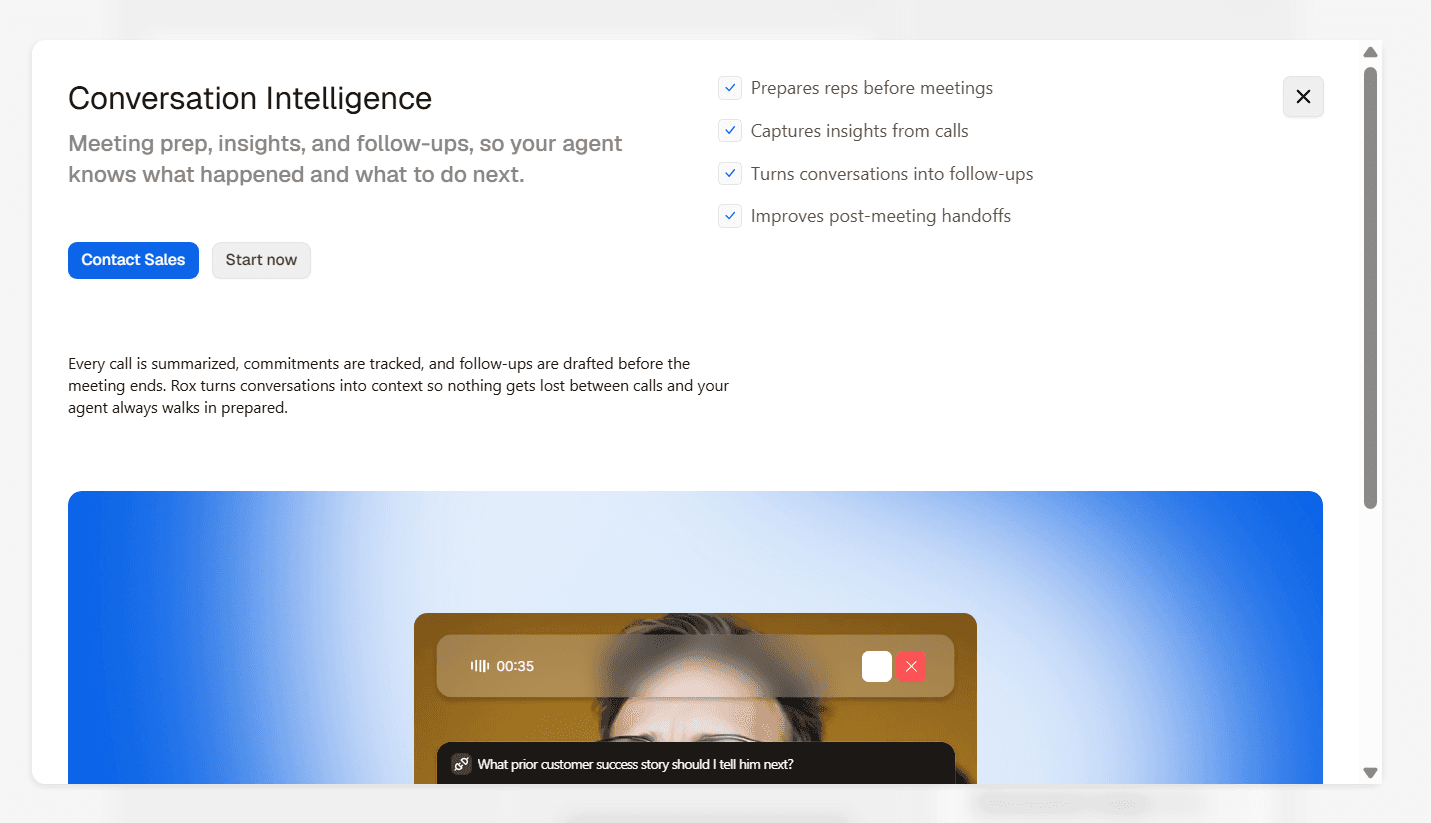
Rox operates as a revenue operating system built for the applied AI era. The platform unifies fragmented data into a single source of truth. Agent swarms work continuously across accounts and monitor signals while reps are offline. This boosts productivity by 50% during work hours.
Sales teams using Rox save 8+ hours weekly on administrative tasks and achieve 35% higher customer engagement. They generate 2x ROI on sales pipeline. Over 35 enterprise sales teams have adopted the platform, including MongoDB, Confluent, and Ramp.
You can start using Rox for free during the public beta.
Gong for Revenue Intelligence
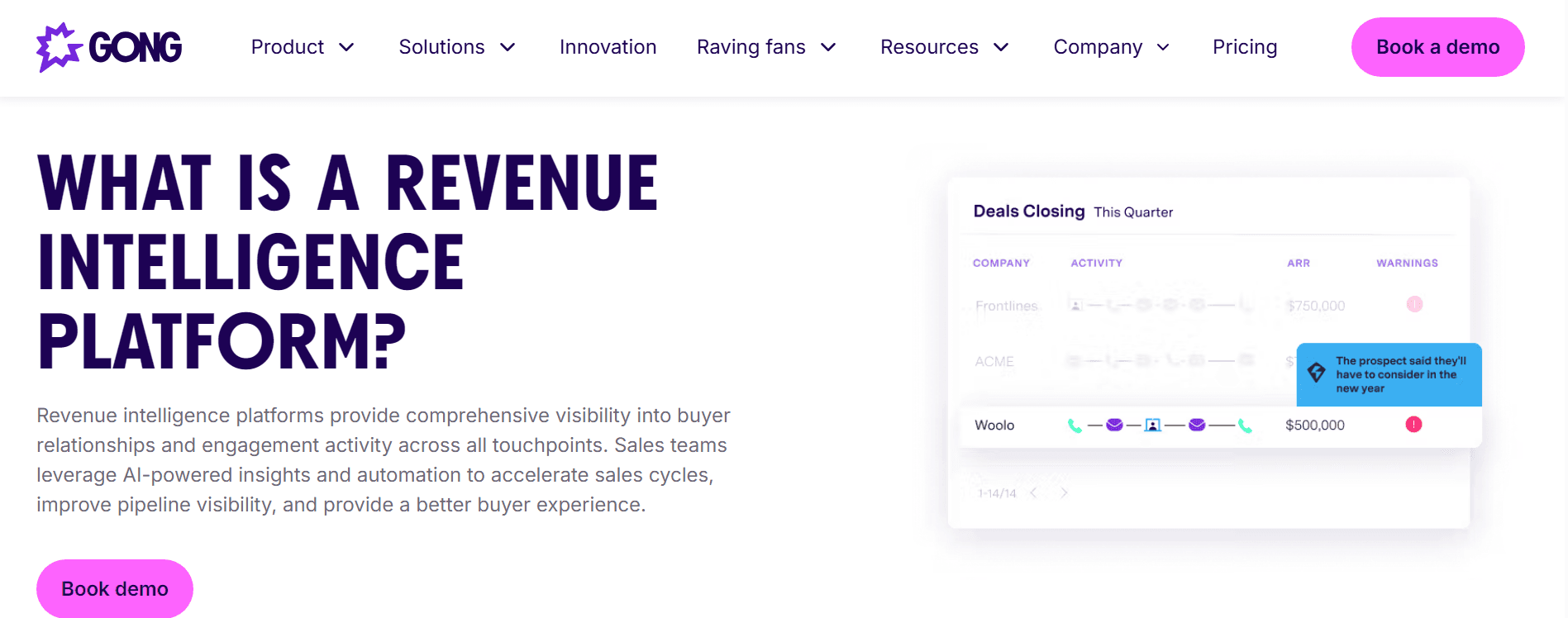
Gong captures 70% of its user base from mid-market sales organizations. This makes it the platform of choice for teams moving beyond simple call recording into territory where conversation data shapes deal management and forecasting. Managers break down talk-to-listen ratios and surface objection-handling patterns.
They flag deal risks without reviewing every call minute. AI text summarization rates at 90% on G2. Users describe summaries as daily time-savers that capture action items and discussion points. The search functionality earns praise for helping users locate specific calls or jump to transcript sections using keywords or timestamps.
Integration with Salesforce, HubSpot, dialers, and calendar tools keeps conversation data flowing into existing workflows without manual entry.
Chorus by ZoomInfo
Chorus draws 64% of users from mid-market companies and 25% from enterprises. The platform has strong adoption in software, IT services, and marketing sectors. Call recording rates at 94% on G2. This reflects how central this capability is to the platform’s experience.
Users access AI-generated summaries with action items and jump to relevant sections without sitting through entire recordings. The integration ecosystem connects with Salesforce, HubSpot, Microsoft Teams, and Zoom. This makes conversation data available across organizations beyond just sales teams.
How to implement conversation intelligence to boost sales performance?
Successful conversation intelligence rollouts follow a structured 12-week implementation framework. Before you launch, complete this critical sentence: “At the time we implement this, we want the team to be better at _________”. Fill this blank with specific goals tied to measurable outcomes, such as uncovering why competitors win deals or reducing new hire ramp time.
Conversation intelligence becomes just another underutilized dashboard without clear objectives tied to KPIs your team already tracks, which is why many sales leaders pair their intelligence reports with an online presentation maker like Decktopus AI to communicate insights and progress clearly to stakeholders.
The first phase spans weeks 1 through 4. Pilot testing is the focus. Start with a single high-performing or highly coachable team rather than rolling out company-wide. These early adopters identify technical challenges and become internal champions for broader adoption.
Complete technical integration with your CRM during this phase and establish baseline metrics for comparison. Assess your existing sales data, processes, and technology stack at the same time to determine integration requirements with tools like Salesforce or HubSpot.
How Rox conversational intelligence work for revenue team?
Rox takes a fundamentally different approach to conversational intelligence for revenue. It deploys an Agent Swarm that operates across your accounts without interruption. These AI agents work as extensions of your revenue team and monitor customer signals while managing workflows even when reps are offline.
The platform captures conversation insights and translates them into immediate action. It recognizes engagement signals and potential risks, then surfaces them so reps can respond without manual analysis. Managers gain access to detailed performance insights that enable more effective coaching. The platform emphasizes opportunities live and provides clear next steps after every call. This eliminates hours of manual analysis.
The Voice Command Mode powered by Cartesia’s Sonic and Ink models allows reps to conduct instant prospect research, identify target opportunities, generate email campaigns, receive pre-meeting briefs, and recap meetings through simple voice commands. This hands-free interface maintains deal intelligence without breaking focus.
Rox unifies disparate data sources into a single knowledge graph built natively on Snowflake. The system combines CRM data, marketing systems, support tickets, finance records, product usage, and open web sources into one revenue operating system. AI agents extract entities, relationships, and context across accounts and opportunities from this unified foundation.
Start using Rox to access these agentic workflows during the public beta phase.
Conclusion
Conversational intelligence has moved from optional to essential for revenue teams facing quota pressure and rising sales costs. The technology delivers measurable returns through improved close rates, expanded deal sizes, and accelerated pipeline velocity.
Teams implementing these platforms see 5x to 15x ROI while saving hours on administrative tasks, so the value is clear.
Not all platforms deliver equal value. We’ve seen how Rox’s Agent Swarm approach stands apart by working continuously across your accounts. The platform monitors signals and manages workflows even when your team is offline. It unifies fragmented data into applicable information that drives immediate results.
You can start using Rox for free during the public beta and experience how agentic workflows transform your revenue operations.
FAQ
Why Revenue Teams Use It?
Sales teams adopt conversation intelligence software to improve forecasting accuracy, identify deal risks early, automate CRM updates, and learn about customer conversations. The platforms provide live, practical insights that help businesses make decisions based on facts rather than guesswork.
What is conversational intelligence?
Conversation intelligence uses AI-powered tools to analyze and extract practical insights from business conversations. The software captures interactions and transcribes them. Natural language processing identifies key moments, customer sentiment, and pain points.
What are revenue intelligence tools?
Revenue intelligence tools represent a broader category that combines conversation intelligence, CRM activity, deal progression tracking, and forecasting to provide complete pipeline visibility. Revenue intelligence uses AI and data analytics to uncover risks, opportunities, and trends in the sales pipeline.
What is conversational business intelligence?
Conversational business intelligence is different entirely. It lets users ask questions about data in simple English and uses natural language processing to query dashboards and analytics. Users don’t deal with complicated interfaces. They simply ask questions and receive relevant responses immediately.
Similar Articles
We build with the best to make sure we exceed the highest standards and deliver real value.

Get started today
See how the Rox agent can put your pipeline generation, deal management, and account expansion on autopilot.