8 Best RevOps Tools That Power Enterprise Growth for 2026
Rox Editorial Team

The best RevOps platforms solve a problem most B2B teams face: the average sales team runs eight to twelve tools that create data silos instead of eliminating them. Revenue data becomes fragmented as a result. Forecasting suffers and growth stalls.
But organizations with unified revenue operations platforms grow up to 19% faster due to alignment between sales and marketing functions. We’ve compiled the top eight revops tools for 2026 that deliver integrated revenue management software, automation, and useful insights to power enterprise growth.
What are RevOps tools?
RevOps tools are software solutions that unify sales, marketing, and customer success data into a centralized platform. They serve as the technological backbone that simplifies operations across all revenue-generating departments.
CRMs focus on managing customer data and supporting sales interactions. RevOps software covers the full revenue generation lifecycle from lead to cash, including proposals, billing, payment collection, and renewals.
These platforms eliminate the fragmentation problem that plagues most revenue teams. They centralize data from multiple sources into a single source of truth and automate manual processes that slow down sales cycles.
Teams get live visibility into pipeline health and revenue forecasts. So teams no longer struggle with inconsistent account data, manual data entry, or disconnected marketing automation workflows that lead to inaccurate reporting.
The modern RevOps tech stack operates across six distinct layers.
Layer 1 is the CRM foundation. Salesforce and HubSpot dominate at growth-stage companies. RevOps owns the CRM architecture, including object model, field definitions, automation rules, and integration health.
Layer 2 handles outbound execution and intelligence, combining data enrichment, intent signals, AI-driven personalization, and multi-channel sequencing.
Layer 3 focuses on forecasting and analytics, using AI to surface pipeline risk and flag deals that are slipping.
Layer 4 covers attribution, connecting marketing activity to pipeline outcomes.
Top 8 RevOps Tools for 2026
Rox
What It Does
Rox operates as a revenue operating system built on autonomous AI agents that manage the whole customer lifecycle. Traditional CRMs require constant manual data entry, but Rox combines disparate data sources into a unified revenue data model within your existing data warehouse.
The platform deploys AI agents called Swarms that automate core revenue processes, from capturing up-to-the-minute intelligence to executing tailored outreach. These agents work within your Salesforce or HubSpot environment. They monitor accounts, research prospects, update CRM fields and automate communication without human intervention.
The system combines transactional data, analytical data shared by enterprise customers and unstructured data from meeting recordings into a central data lakehouse. Rox offers Amazon Redshift data share options for enterprises with data pipelines, where compute resources remain separate from customer data. This maintains strict security and compliance.
The architecture addresses a critical pain point. Sales teams spend valuable time navigating between fragmented tools instead of focusing on revenue-generating activities.
Key Features
Rox assigns dedicated AI agents to each customer account. These agents monitor buying signals, organizational changes and churn risks continuously. The agents perform autonomous prospecting and identify new leads. They schedule meetings without requiring manual intervention. Call transcription capabilities transform meeting recordings into structured insights and automated CRM actions.
The platform integrates with Salesforce, HubSpot, Gmail, Microsoft Outlook, Slack and others. It maintains SOC 2 Type II compliance with AES-256 encryption for data in transit and at rest. The system enriches contact and company records using third-party data providers. It queries them programmatically to return results into your workspace. Customer data processed through Rox is never used to train generalized machine learning models.
Pricing
Rox uses an outcome-based pricing model measured in Agent Actions rather than charging for underlying data processing. The Starter plan is free and has 10 agents for discovery purposes. The Core plan costs $50 per month for 5,000 Agent Actions and 100 agents, suitable for teams handling larger task volumes.
Enterprise deployments operate on custom pricing, with mid-tier starting points around $750 monthly. Agent Actions refresh monthly on your renewal date. Unused actions do not roll over to the next billing cycle. Core plan users can renew early if they reach their action limit before month-end.
Best For
Rox serves Global 2000 enterprises and AI-native B2B companies running complex client portfolios. The platform fits CROs and RevOps leaders implementing full-scale AI transformations, especially in financial services, professional services, private equity and software industries.
Customers include Ramp, MongoDB and New Relic. Teams that don’t deal very well with high preparation times, fragmented data and manual CRM maintenance get the most value. The platform requires Salesforce or HubSpot as a foundation. This makes it unsuitable for teams on other CRMs or those without systems in place.
Clari
What It Does
Clari functions as a Revenue Orchestration Platform that manages enterprise revenue complexity. The platform brings every team member and workflow into a single system. It captures revenue reality around how deals are won and lost.
This guides teams and AI Agents to deliver predictable performance each quarter. Point solutions address isolated problems. Clari arranges revenue differently by powering AI with context from every signal, cadence and workflow.
The system combines Revenue Cadences, AI Agents and automated actions. This standardizes execution for teams of all types. Revenue Cadences bring structure and governance. They optimize consistent end-to-end execution and ensure the right actions happen on time, lined up to your goals.
Purpose-built workflows guide humans and AI agents on where to focus, how to execute and how to deliver results. These AI Revenue assistants operate with deep Revenue Context. They understand who did what, when and with what outcome. Context embeds directly into revenue workflows your teams already use. AI can cooperate, guide, automate and execute successfully.
Key Features
Clari’s forecasting engine uses AI-driven predictions. It pulls from CRM, rep activity and historical data to project outcomes. The platform delivers pipeline inspection with up-to-the-minute visibility into stage changes, deal movement and rep activity. This flags risk early. Revenue analytics dashboards track pipeline coverage, conversion rates and attainment rollups.
The platform eliminated revenue leak areas. This resulted in a 30% increase in opportunities created and a 10% win rate increase in the first year of deployment. Clari delivered 398% ROI at enterprise scale. Forecast accuracy improved 12 times.
Better strategic planning and execution followed. Organizations achieve 95% forecast accuracy. Some maintain forecasts within 3-4% every quarter for two years while growing bookings over 70% year-over-year.
Native Salesforce integration provides bi-directional sync that supports deep reporting, though it depends on strong CRM hygiene. Activity tracking automatically logs emails, meetings and rep actions into CRM. Deal timeline views provide visual history of deal activity, buyer engagement and progression.
Pricing
Clari operates on custom pricing that commonly starts around $75 per user monthly. The platform delivers an out-of-the-box solution with no extra platform fees for integrations or continuous support. You get AI deal scoring, AI-driven forecasting, continuous connection integrations, unlimited customizations and premier success support included.
Best For
Clari suits enterprise sales organizations with complex pipelines. Sales cycles are long, deals involve multiple stakeholders and layered forecasting is required. The platform performs especially when you have Enterprise SaaS operations.
It forecasts recurring revenue across large customer bases. B2B tech and IT services benefit as well. The platform brings together SDR, AE and CS activity data to improve deal execution.
Gong
What It Does
Revenue intelligence platforms capture front-line conversations to better understand deals, teams, and market dynamics. Gong operates as a conversation intelligence platform that records and analyzes sales interactions across Zoom, Google Meet, and Microsoft Teams. The system joins calls as a bot and transcribes conversations. It provides advanced metrics to help sales teams close deals.
The platform addresses a fundamental problem: sales leaders make decisions based on gut feel instead of reality. Gong analyzes conversations across channels and advises on the next best action.
Organizations using the platform report a 16% average increase in win rates and reduced sales cycle length. Gong revealed that one team’s win rate reached 55% for deals closing within 90 days. This prompted them to adjust internal sales coverage.
Key Features
Gong Forecast analyzes over 300 unique buying signals to understand deal positioning at any given time. The integrated platform combines customer interaction data from multiple sources and delivers forecast accuracy up to 95%. Upwork’s Director of RevOps confirms their forecast accuracy reached 95%. This allowed them to run a predictable revenue organization.
Deal Boards provide immediate pipeline visibility sorted by risk level. Gong surfaces actual conversation patterns that predict success or failure instead of trusting rep intuition. The platform flags deals lacking contact for 10 days or champions not responding to three emails.
Conversation Intelligence records, transcribes, and analyzes every sales call. Managers create scorecards based on methodologies like MEDDIC or SPIN. Reps receive instant scores showing framework adherence.
Pricing
Gong operates on custom pricing with three components. The annual platform fee ranges from $5,000 to $50,000 depending on team size. Per-user licenses cost $1,200 to $1,600 each year for teams under 25 users and decrease to $800-$1,000 for teams exceeding 100 users. Mandatory professional services for implementation range from $7,500 to $28,500.
Best For
Gong suits mid-market and enterprise sales organizations with 50+ users where complex, high-value deals justify conversation intelligence ROI.
HubSpot Operations Hub
What It Does
HubSpot Operations Hub (renamed Data Hub lately) connects sales, marketing and service tools while keeping data clean throughout your revenue stack. The platform functions as a central nervous system for businesses and syncs data bidirectionally with 90+ applications that include Mailchimp, Google Contacts, ERP systems and eCommerce platforms.
Operations Hub eliminates manual data export/import work by keeping all customer information consistent and current in your HubSpot CRM, unlike tools that create parallel records.
The platform addresses operational challenges for scaling companies: disconnected tools, dirty data and clunky processes. Organizations that invest in Operations Hub report most important benefits, with 94% experiencing increased customer acquisition rates and 93% noting growth in bookings and revenue.
Research shows businesses with high-quality CRM data see revenue boosts up to 83% in the first year.
Key Features
Programmable Automation stands as the crown jewel and allows custom JavaScript or Python code inside workflows. To cite an instance, scripts can check external databases for the nearest sales rep, calculate their workload and assign based on live availability when a lead arrives from a specific zip code.
Data Quality Automation monitors and fixes issues like duplicates and formatting errors without manual intervention. The system capitalizes names, standardizes time formats and fills missing contact information on its own.
Datasets enable non-technical users to pre-curate data for complex reporting without breaking underlying structures. Professional tier has 5,000 credits monthly for AI features that include Data Agent, which answers custom questions by analyzing CRM data.
Pricing
Tier | Monthly Cost | Annual Cost | Core Seats | Additional Seats |
|---|---|---|---|---|
Free | $0 | $0 | 2 | N/A |
Starter | $50 | $600 | 1 | N/A |
Professional | $800 ($720 annual) | $8,640 | 1 | $45/month |
Enterprise | $2,000 | $24,000 | 1 | $75/month |
Onboarding fees range from $1,500 to $3,000.
Best For
Mid-sized businesses that juggle spreadsheets, inconsistent CRM data and broken handoffs between teams learn the most from this platform. The platform suits companies where growth conflicts with organizational practices and causes lost deals or cancelations.
Cognism
What It Does
B2B sales teams targeting European markets face a data compliance challenge that most North American-focused tools ignore. Cognism delivers GDPR and CCPA compliant contact data with verified mobile numbers, buyer intent signals powered by Bombora, and technographic information in EMEA, NAM, and APAC regions. RevOps teams can calculate total addressable market, plan territories, and enrich CRM databases with fresh data for precise lead segmentation and routing through the platform.
Chief Revenue Officer Natalie Furness cited Cognism as one of six RevOps tools she cannot operate without. The platform’s Sales Companion provides tailored access to in-depth account data. Outreach remains current and targeted.
Key Features
Cognism’s Diamond Data represents mobile numbers verified by phone. Connect rates are about 3x the industry average. The platform combines up-to-the-minute CSV and API enrichment with AI-powered search functionality that reduces prospecting time by 74%. Territory planning gains international visibility as RevOps leaders track sales execution and engagement in regions from a unified performance dashboard.
The system enriches CRM records through scheduled and trigger-based workflows. Data quality stays high through controlled governance. Integrations with Salesforce, HubSpot, Salesloft, and Outreach allow continuous data flow. One customer reported 80% data accuracy after evaluation and outperformed competitors. Results included 95% email deliverability rates and 41% positive reply rates.
Pricing
Cognism operates on custom quotes with no prices listed publicly. The Standard tier runs at about $15,000 platform fee plus $1,500 per user a year. The Pro tier costs roughly $25,000 platform fee plus $2,500 per user a year. It adds Bombora intent data and advanced verification features. A credits model applies where one credit reveals each contact record.
Best For
Enterprise sales teams with budgets exceeding $15,000 a year running high-volume outbound into EMEA markets gain maximum value. Organizations prioritizing phone-based prospecting benefit from verified mobile data.
Teams requiring strict regulatory compliance in finance, healthcare, or legal industries find the GDPR-first approach critical.
Forecastio
What It Does
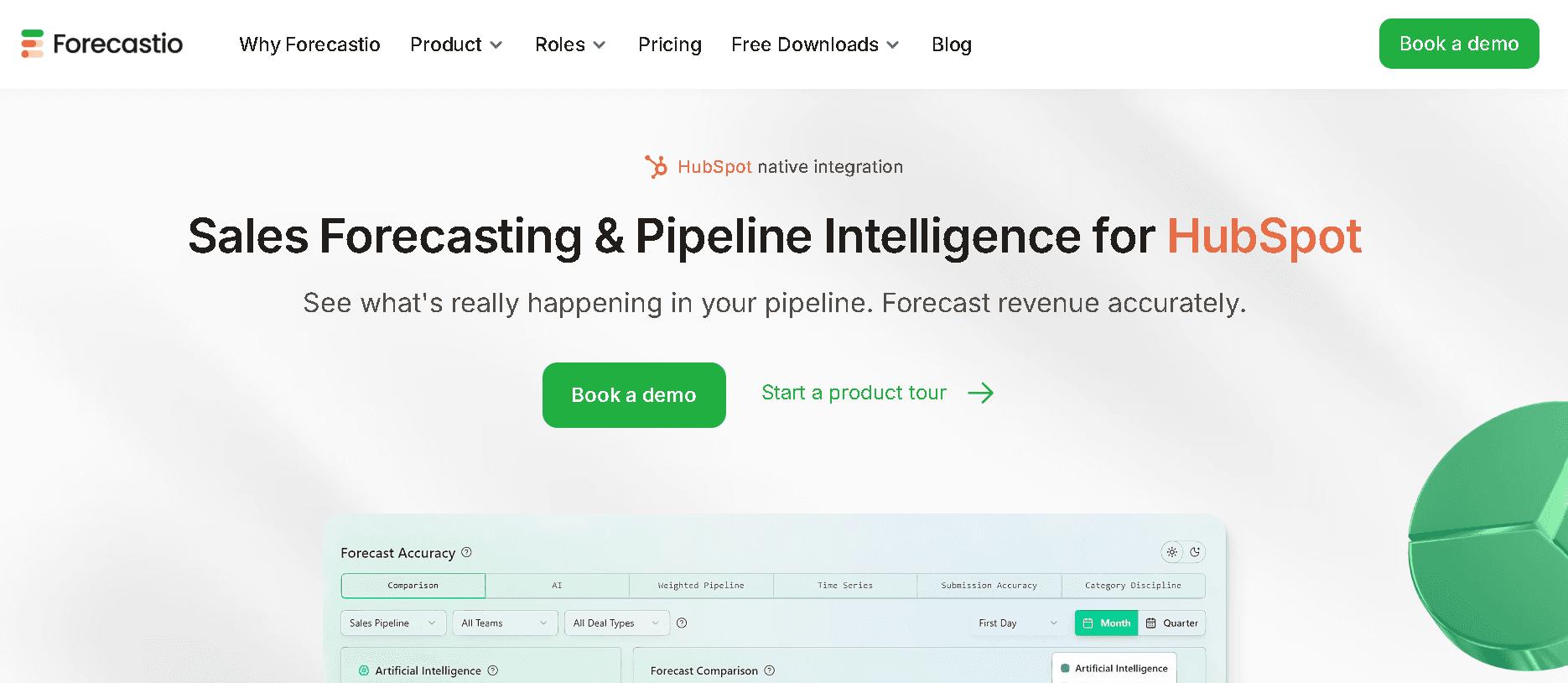
Forecastio operates as an AI-powered sales forecasting platform built for B2B teams using HubSpot. The platform addresses the forecasting gap that HubSpot’s native tools leave open and layers machine learning on top of pipeline data to deliver up-to-the-minute visibility into deal risk, pipeline health, and forecast accuracy.
Generic forecasting solutions require weeks of implementation. Forecastio connects to HubSpot in minutes and starts generating accurate forecasts instantly.
The system combines multiple forecasting methods. AI powered by custom machine learning and time-series forecasting support different sales motions from SMB and PLG to complex enterprise sales. Forecasting models are selected and fine-tuned based on historical HubSpot data, pipeline structure, and deal behavior. Forecastio’s AI predicts not only whether deals will close but also when. Teams achieve 85-93% forecast accuracy.
Key Features
Forecastio updates stage-to-close probabilities from historical conversion rates without manual inputs. AI assigns realistic probabilities to every open deal and gives RevOps cleaner data and more reliable forecasts. The platform monitors accuracy across forecasting methods, pipelines, and individual reps.
You see where errors originate. The system learns from these errors and recalibrates itself. Forecasts become more accurate over time.
Every forecast change is logged with complete transparency. The system tracks who changed what, when, and why. A deal slipped, an amount updated, or a new chance was added you always have the full history.
The audit trail eliminates disputes about numbers and provides clarity and accountability. Deal signals identify risky deals based on configurable parameters like time in stage or close date changes. Teams can prioritize attention and prevent revenue loss.
Pricing
Plan | Monthly Cost | Seats Included | Additional Seats | Key Features |
|---|---|---|---|---|
Sales Forecasting | 2 | $49/seat | AI forecasting, time-series, automated probabilities, what-if scenarios, accuracy tracking, audit trail | |
Forecasting & Pipeline Intelligence | $369 (annual) | 2 | $69/seat | Everything above plus pipeline health, bottleneck detection, slippage tracking, velocity analysis, enhanced deal signals |
Best For
Forecastio suits HubSpot-native sales teams with 5-20 reps whose forecast calls still rely on gut feel and spreadsheets. The platform works especially when you have HubSpot’s native forecasting break due to BDRs, SEs, or overlay roles appearing in forecast hierarchy.
Teams wanting AI forecasting without $30,000+ enterprise contracts from Clari or Gong get maximum value. Organizations prioritizing forecast transparency and accountability benefit from the complete audit trail capabilities.
Openprise
What It Does
Data fragmentation creates the most expensive operational problem in RevOps. Teams manually clean, deduplicate, and reconcile records in CRM and marketing systems. Openprise RevOps Data Automation Cloud solves this by consolidating data processes into a single no-code platform that handles loading, cleansing, attribution, scoring, and lead routing. The system acts as a shared orchestration layer connecting business apps with systems of record. This eliminates the need for 15 separate point solutions.
Key Features
Openprise provides 400+ pre-built connectors supporting data orchestration across the full customer lifecycle. The platform’s AI-agent Factory makes it possible for RevOps teams to build AI-powered solutions without IT dependencies. Multi-vendor enrichment waterfalls boost match rates 30-40% compared to single-vendor approaches.
Sandbox simulation allows teams to design, test, and iterate data automation projects before deploying to production. Great Place to Work achieved a 38% increase in win rates using automated lead routing. Clari replaced two point solutions and saved $80,000+ each year.
Pricing
Professional tier starts at $35,000 per year and supports 250,000+ records per Bot run. Enterprise pricing requires direct consultation. Realistic budgets range from $61,000 to $99,000 per year for most implementations.
Best For
Enterprise RevOps teams managing complex data automation at scale, especially when you have multiple point solutions duct-taped together and operate above 200 employees with dedicated ops functions.
Workato
What It Does
Workato operates as an enterprise iPaaS. It combines integration, automation and API management in one platform. The system uses a recipe-based workflow builder where each recipe has triggers and actions. It supports conditional logic, error handling and data transformations. Workato earned Leader status in the Gartner Magic Quadrant for iPaaS for the eighth consecutive time. The company was positioned furthest in Vision. The platform holds a 4.9/5 rating on Gartner Peer Insights. It earned 45 #1 rankings across G2’s Winter 2026 reports.
Key Features
Workato provides 1,200+ pre-built connectors spanning CRM, ERP and databases. The platform has role-based access control and audit logs that track every recipe change.
Environment separation for dev/staging/production and approval workflows for deployment are also available. Compliance certifications cover SOC 2 Type II and HIPAA. The Connector SDK allows custom development when pre-built options are insufficient.
Pricing
Workato uses custom, sales-led pricing with no published list prices. Costs range from $500 to $5,000+ monthly based on volume. Multiple reviewers describe pricing as lacking transparency and very expensive.
Best For
Mid-market companies with 50-500 employees that automate 10-50 integrations gain maximum value. IT and RevOps teams that manage enterprise-wide integrations across multiple critical systems benefit most.
What should I look for in a RevOps platform?
Selecting the best RevOps platforms requires answering three questions before adding anything to your stack. Does this tool feed data into our CRM automatically, or does it create a parallel record? Does it solve a problem that our current tools already solve, just marketed differently? Will reps actually use it, or will it become shelfware within 90 days?
Start with the CRM foundation. Every other tool decision flows from this. No analytics or AI tool layered on top will give accurate answers if your CRM data is unreliable. Prioritize native integrations over middleware. This eliminates sync delays and configuration complexity that middleware-based integrations introduce. The best revenue operations platforms unite multiple categories into a single system rather than forcing you to manage four overlapping point solutions.
Measure adoption before adding more tools. Adding another tool will not solve the problem if your team is not using what you already have. Review ease of use among automation capabilities and ensure sales reps do not need a two-week bootcamp just to log a call. Adaptability matters because what works for a 10-person startup often buckles under enterprise complexity.
What is the common Revenue Operations Challenges?
Consolidating your RevOps stack from a dozen fragmented tools down to 3-4 integrated platforms is not just a trend; it’s how top-performing teams will operate in 2026. The eight platforms we covered address specific pain points in conversation intelligence, forecasting, data management and automation without spreading resources thin among mediocre capabilities.
The selection process always comes back to three questions: Does it feed data into your CRM automatically? Does it solve a unique problem? Will your team use it?
Build on your CRM foundation first, fix what you already have and add tools only when gaps become undeniable. Your revenue team will thank you for the focus.
Conclusion
Your RevOps stack’s value comes down to three factors: whether your team uses it, whether it feeds clean data into your CRM, and whether it provides visibility needed for better decisions. The platforms with the most features rarely win. The platforms your revenue teams actually adopt do.
Start with your CRM foundation. Every other decision flows from this. Unreliable CRM data renders any analytics or AI layered on top useless. After that, prioritize native integrations over middleware to eliminate sync delays and data gaps. Platforms like Rox unite conversation intelligence, dialing, sequencing and coaching into one system. This creates less fragmentation than four overlapping point solutions.
Measure adoption before adding more tools. Another platform will not solve the problem if your team ignores what you already have. The RevOps world in 2026 remains broad and crowded. Teams extracting maximum value are not buying the most tools. They buy the right ones, implement them with clear ownership and maintain data quality over time.
Start with the category addressing your biggest constraint. Build from there. Make sure every tool earns its place by making your CRM more complete and your revenue motion more predictable.
FAQ
How do RevOps tools integrate with existing tech stacks?
Revenue operations platforms connect to existing systems through native integrations and APIs. They sync data bidirectionally with CRM systems like Salesforce and HubSpot, marketing automation tools, and business applications. This provides a unified view of the customer experience and revenue performance.
What’s the difference between RevOps and traditional sales tools?
RevOps covers the full customer lifecycle and lines up all revenue teams under shared KPIs. Sales Ops focuses on sales execution like CRM admin, pipeline management, and comp design. Traditional sales operations cannot solve cross-functional misalignment between marketing, sales, and customer success.
RevOps treats the entire lifecycle as one continuous process rather than managing each stage separately. It centralizes data and processes so all teams work from a single source of truth.
What is the best RevOps tool?
No single platform suits every organization. Selection depends on your specific constraints, existing CRM, team size, and budget. Teams with complex forecasting needs benefit from Clari. HubSpot-native organizations gain value from Forecastio.
Why companies adopt RevOps tools
Organizations adopt RevOps platforms to eliminate data silos and operational inefficiencies. Companies using integrated revenue operations tools grow up to 19% faster due to better alignment between sales, marketing, and customer success functions. RevOps maximizes existing tool usage before investing in new solutions.
Similar Articles
We build with the best to make sure we exceed the highest standards and deliver real value.