9 Best Lead Scoring Software Tools I Tested in 2026
Rox Editorial Team

67% of lost sales stem from improper lead qualification, yet most sales teams rely on gut feeling rather than evidence-based lead scoring software. That’s money left on the table.
Companies using lead scoring see 138% ROI compared to 78% without it. But choosing the right lead scoring platform isn’t simple. Traditional manual scoring delivers 15-25% accuracy. AI lead scoring software achieves 40-60%.
I tested eight lead scoring tools to help you find the best lead scoring software for your team. Here’s what I found.
9 Best lead scoring tools you must consider in 2026
Rox – Best for Enterprise Revenue Orchestration
Rox takes a different approach from traditional lead scoring software. Instead of assigning static scores based on CRM activities or marketing engagement data, Rox continuously evaluates account health, buying intent, expansion potential, and revenue opportunities using a unified system of context.
Built as a warehouse-native Revenue Orchestration platform, Rox assembles signals from customer interactions, product usage, support systems, call transcripts, operational workflows, and external data sources into a living context graph for every account. This allows autonomous revenue agents to identify high-priority opportunities, surface buying signals, and help teams focus on the accounts most likely to generate revenue.
For enterprise organizations managing complex buying committees and long sales cycles, Rox provides a more comprehensive alternative to traditional lead scoring models that often rely on incomplete CRM data.
Key Features
Context graph for unified account intelligence
Autonomous account prioritization
Buying signal detection
Revenue opportunity identification
AI-powered revenue agents
Expansion and renewal signal monitoring
Multi-source revenue data orchestration
CRM-independent account intelligence
Real-time account health monitoring
Enterprise-grade governance and permissions
Pricing
Custom enterprise pricing based on organizational requirements and deployment scope.
Plan | Pricing |
|---|---|
Starter | Free |
Core | Starts at $50/month |
Enterprise | Custom pricing |
Pros and Cons
Pros
Goes beyond traditional lead scoring models
Unifies signals across the entire revenue lifecycle
Identifies opportunities using richer account context
Helps sales, RevOps, and customer success teams align around shared intelligence
Designed for complex enterprise revenue environments
Cons
More comprehensive than teams seeking basic lead scoring may need
Enterprise-focused platform may be excessive for smaller organizations
Custom pricing requires contacting sales
This format follows the same structure as the other tools in your list while staying aligned with Rox’s official positioning and avoiding the mistake of calling it a “lead scoring tool.”
Salesmate - Best Overall Lead Scoring Software
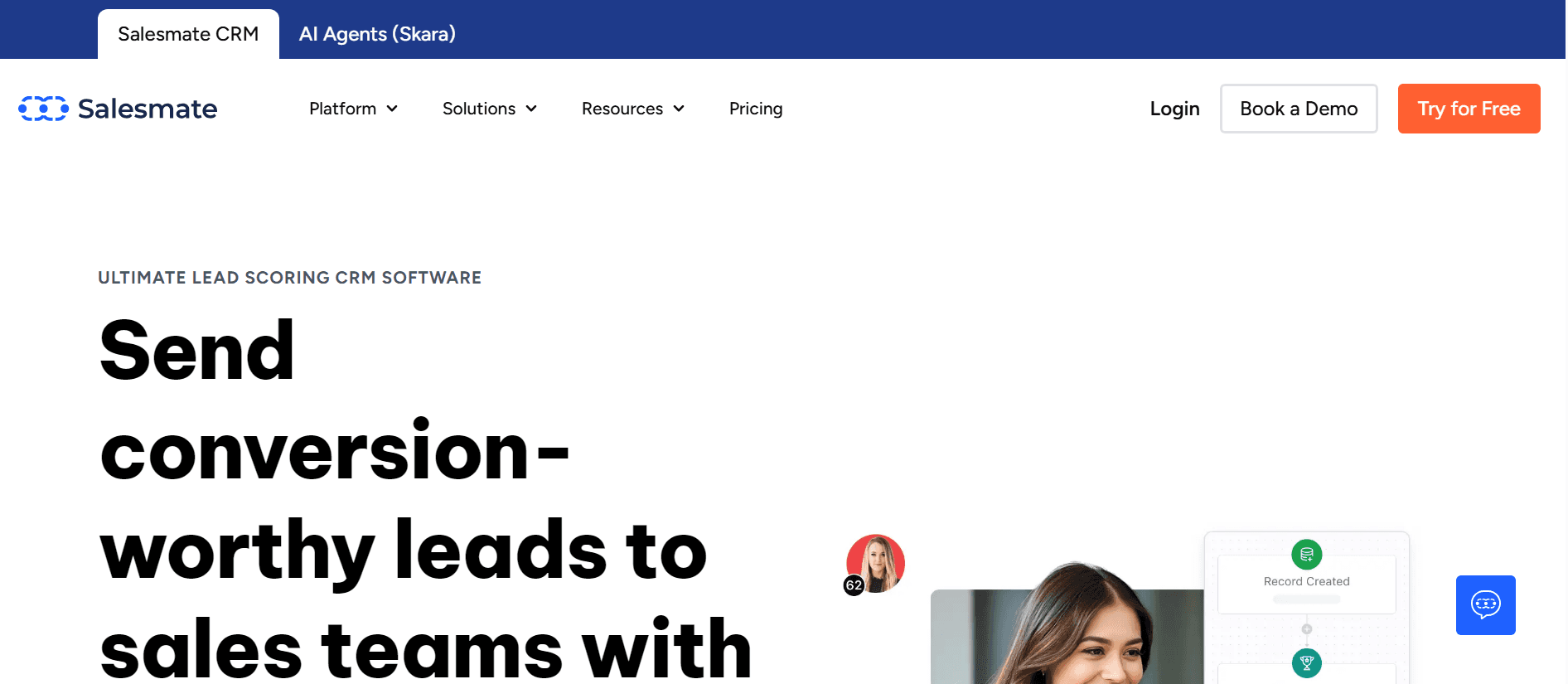
Salesmate launched in 2016 and positions itself as a CRM with built-in lead scoring automation. Salesmate Score works as an automation-backed lead scoring mechanism that assigns numerical values to contacts based on criteria you define.
Key Features
Salesmate integrates lead scoring directly into its CRM platform and eliminates the need for standalone lead scoring software. The system supports both rule-based scoring and traditional level scoring. You can adapt models according to your specific qualification criteria.
The lead scoring feature operates through Automation Journeys, which comes as an add-on to the core CRM. You can design custom scoring models using 60+ triggers, conditions and actions. The score increases when leads match your defined criteria automatically. The deprecating score function decreases scores for inactive prospects.
Salesmate displays the lead score directly on contact profile pictures and makes it visible at a glance. Sales teams can focus on high-potential prospects without digging through data. The system also allows automatic assignment of high-scoring leads to specific sales members for qualification.
Pricing
Plan | Monthly Billing | Annual Billing | Lead Scoring Access |
|---|---|---|---|
Basic | $29/user | $23/user | Not included |
Pro | $49/user | $39/user | Included (10K credits) |
Business | $79/user | $63/user | Included (15K credits) |
Enterprise | Custom | Custom | Included |
Lead scoring functionality requires the Pro plan at minimum, priced at $39 per user monthly when billed annually. The Basic plan lacks sales automation features that include lead scoring, sequences and workflow emails.
Salesmate offers a 15-day free trial with full feature access and no credit card requirement.
Pros and Cons
Pros: The visual automation journey builder handles complex scoring models without technical expertise. Built-in calling and texting features integrate communication tracking into scoring calculations. The mobile app with offline access keeps scoring data available for field teams. Customer support receives consistent praise for responsiveness, with 24/5 email support and live chat.
Cons: The pricing structure becomes expensive for small businesses, especially when advanced features like lead scoring require the $39 Pro tier. Advanced automation features carry a learning curve despite the accessible interface for simple functions. Email support only on Basic and Pro plans disappoints given the premium pricing. Add-on costs for automation credits can increase total expenses as teams scale.
HubSpot Predictive Lead Scoring - Best for CRM-Native Scoring
HubSpot separates itself from traditional lead scoring platforms through its machine learning approach that analyzes thousands of data points to predict conversion likelihood. The platform offers both manual and predictive lead scoring.
The predictive model uses logistic regression algorithms to identify patterns from your existing customer base.
Key Features
HubSpot’s lead scoring system operates within its CRM. This eliminates data synchronization issues common with standalone lead scoring software. The platform creates scores for contacts, companies and deals depending on your subscription level.
The scoring framework divides into three types. Engagement scores measure behavioral actions like website visits, email opens, form submissions and content downloads. Fit scores assess demographic and firmographic properties like job title, company size, industry and revenue. Combined scores merge both engagement and fit criteria into a single qualification metric.
Predictive lead scoring introduces two automatic properties. The “Likelihood to close“ property assigns each contact a percentage probability of converting within 90 days. A score of 22 indicates a 22% chance of closing as a customer in the next three months, to name just one example.
The “Contact priority” property distributes contacts into five tiers: Very High, High, Medium, Low and Closed Won. Each tier contains 25% of your contact base based on their likelihood scores.
Pricing
Plan | Monthly Price | Lead Scoring Type | AI Predictive Scoring |
|---|---|---|---|
Marketing Hub Professional | Starting at $800/month | Manual scoring (up to 5 scores) | Not included |
Marketing Hub Enterprise | Starting at $3,600/month | Manual + AI scoring (up to 25 scores) | Included |
Sales Hub Professional | Starting at $450/month | Company scoring only | Not included |
Manual lead scoring requires Marketing Hub Professional or Sales Hub Professional at minimum. Predictive AI scoring with the Likelihood to close property is exclusive to Enterprise tiers.
Pros and Cons
Pros: The CRM-native architecture keeps all lead scoring data within one ecosystem without third-party integrations. Score updates reflect prospect behavior changes right away. The visual workflow builder connects scores to automated actions without technical skills. AI models improve accuracy over time as they process more conversion data. Multiple scoring systems enable precise segmentation for different buyer personas or regions.
Cons: The black box ML model prevents understanding which specific factors drive each score. Predictive scoring only analyzes data within HubSpot. It misses engagement from external marketing tools, product usage data or customer success insights. The system may perpetuate confirmation bias by scoring new leads based on existing customer patterns alone. This could mean missing outlier opportunities.
Enterprise pricing starts at $3,600 monthly. AI predictive features remain out of reach for smaller budgets. You need at least 100 contacts before Contact priority values appear.
Salesforce Einstein Lead Scoring - Best for Enterprise Teams
Salesforce Einstein Lead Scoring integrates into Sales Cloud and Marketing Cloud Account Engagement. It positions itself as the predictive lead scoring solution for organizations that already operate within the Salesforce ecosystem.
The platform pulls scoring data into customized dashboards that display metrics tailored to your business. These metrics include average lead score by source and conversion rate by source.
Key Features
Einstein analyzes historical CRM data using machine learning algorithms and assigns lead scores without manual input. The system scores leads at least every six hours. Attribute changes trigger rescoring within the hour. This responsiveness matters for time-sensitive record changes like intent data spikes.
The platform refreshes its predictive models every 10 days based on new customer data. This prevents your scoring criteria from becoming outdated. Einstein creates internal categories for text fields that share single meanings but have variable values. A VP of Revenue and VP of Sales often carry similar responsibilities at different companies, so the system groups them into a common category.
Salesforce adds a Lead Score field to contact records. This enables you to trigger automations once values reach specific thresholds. Your admin can choose whether to score all leads together or segment them based on field criteria. Larger companies scored separately from SMBs typically improve accuracy since these segments exhibit different behavioral patterns.
Pricing
Edition | Einstein Lead Scoring Access | Cost |
|---|---|---|
Enterprise | Available as add-on | $50/user/month |
Performance | Included | Standard edition pricing |
Unlimited | Included | Standard edition pricing |
The $50 monthly fee per user includes Mobile and Desktop Apps, Automatic Data Capture, and Lead and Opportunity Scoring. It also includes Predictive Forecasting. Sales Engagement, priced at $50 per user monthly, bundles lead scoring with work queue and guidance features.
Pros and Cons
Pros: Native Salesforce integration eliminates data synchronization problems common with third-party lead scoring platforms. Fast setup uses existing CRM data without complex implementations. Score updates happen without manual intervention and maintain current prioritization. Zero setup requirement means no data transfers to external tools.
Cons: Black box logic prevents understanding which factors influence scores. The system doesn’t factor in sales rep performance or close rates when calculating lead quality. No intelligent lead routing capabilities exist within the scoring feature. Accuracy depends on CRM data quality.
Warmly - Best for Real-Time Signal-Based Scoring
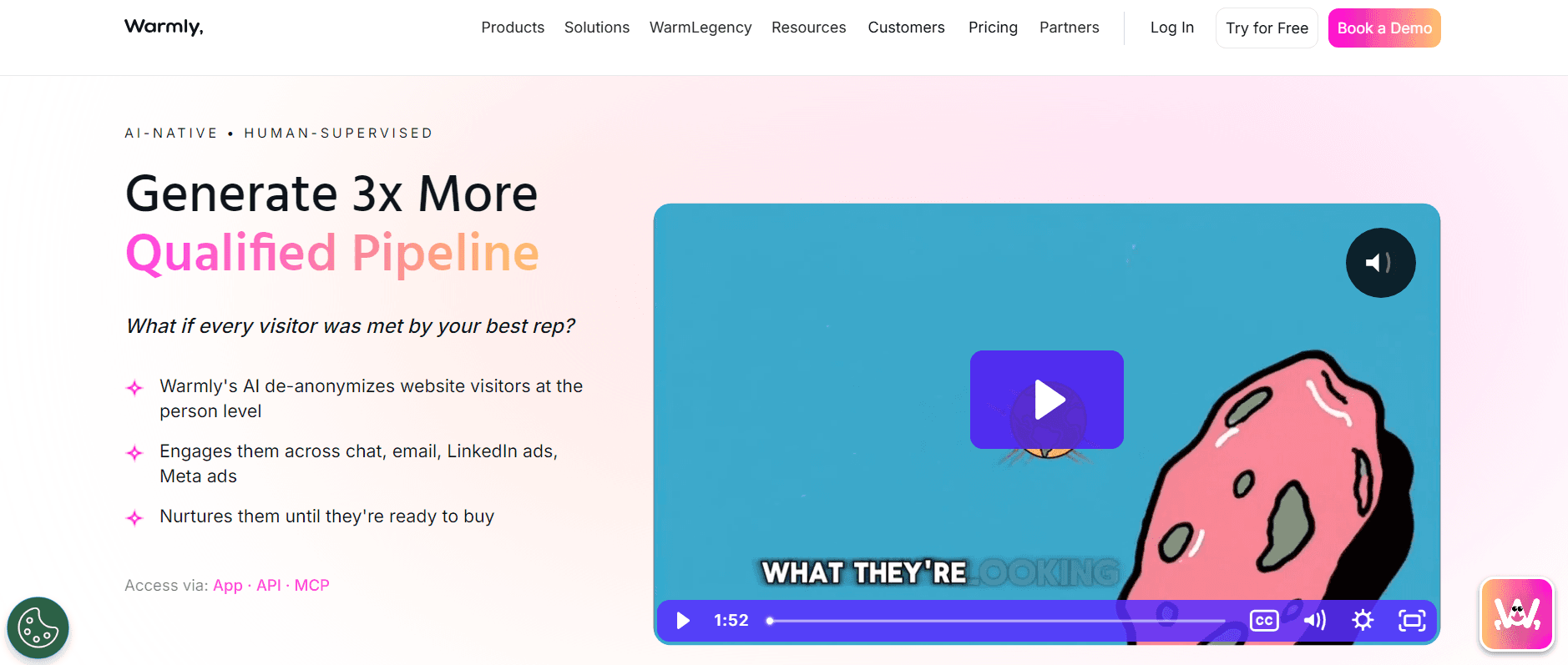
Warmly built its platform around aggregating buying signals rather than relying on CRM data patterns alone. The system combines first-party signals from your website, second-party relationship signals from LinkedIn and social platforms, and third-party intent data into a unified lead scoring framework. This signal-layered approach addresses timing issues that traditional lead scoring software misses.
Key Features
The platform identifies website visitors at both company and person levels and achieves 65% company identification and 15% individual identification rates. Most competitors stop at account-level identification and leave sales teams without specific stakeholder context. Warmly de-anonymizes down to individual visitors and monitors signals at that depth.
Live signal processing updates scores within seconds for first-party data, while third-party signals refresh weekly through integrations like Bombora. The ML model optimizes signal weights based on conversion patterns and eliminates manual adjustment guesswork.
Warmly deploys AI SDR agents that coordinate multi-channel outreach across email, LinkedIn and chat based on intent triggers, going beyond scoring. The system can trigger outbound sequences, ad targeting, Slack alerts or nurture campaigns without human intervention at the time an account hits high-intent thresholds.
The platform’s TAM Agent filtered 18,000 uploaded accounts down to 44 high-intent targets that match ICP criteria and represent 0.24% qualification. Less than 1% of website visitors match ideal customer profiles in practice, which automated scoring identifies before wasting sales time.
Pricing
Plan | Monthly Cost | Features |
|---|---|---|
Free | $0 | 500 warm leads/month, intent signals, account filtering, Slack alerts |
Business | $850 | 25K leads/month, 3 seats, auto-prospect via LinkedIn/email/chat, CRM integration |
TAM Agent | $15,000/year | 50,000 credits annually, enterprise coordination |
Additional seats cost $25 monthly beyond the included three. Setup completes in 20 minutes compared to weeks for enterprise alternatives.
Pros and Cons
Pros: Customers report 200% ROI within six months. Person-level identification provides stakeholder-specific context that account-only platforms miss. Live signal processing makes immediate action on buying intent possible. Autonomous AI agents execute outreach without manual workflows. Transparent scoring shows exactly which signals drive each account’s priority level.
Cons: Person-level data accuracy receives criticism from users who cite data inaccuracy and lead quality concerns. Entry pricing at about $10,000 a year creates barriers for smaller teams. Resolution rates vary by traffic source and geography and typically hit 20-40% for B2B visitors. Higher-tier features require substantial traffic volume to justify costs.
MadKudu - Best for Transparent Lead Scoring Models
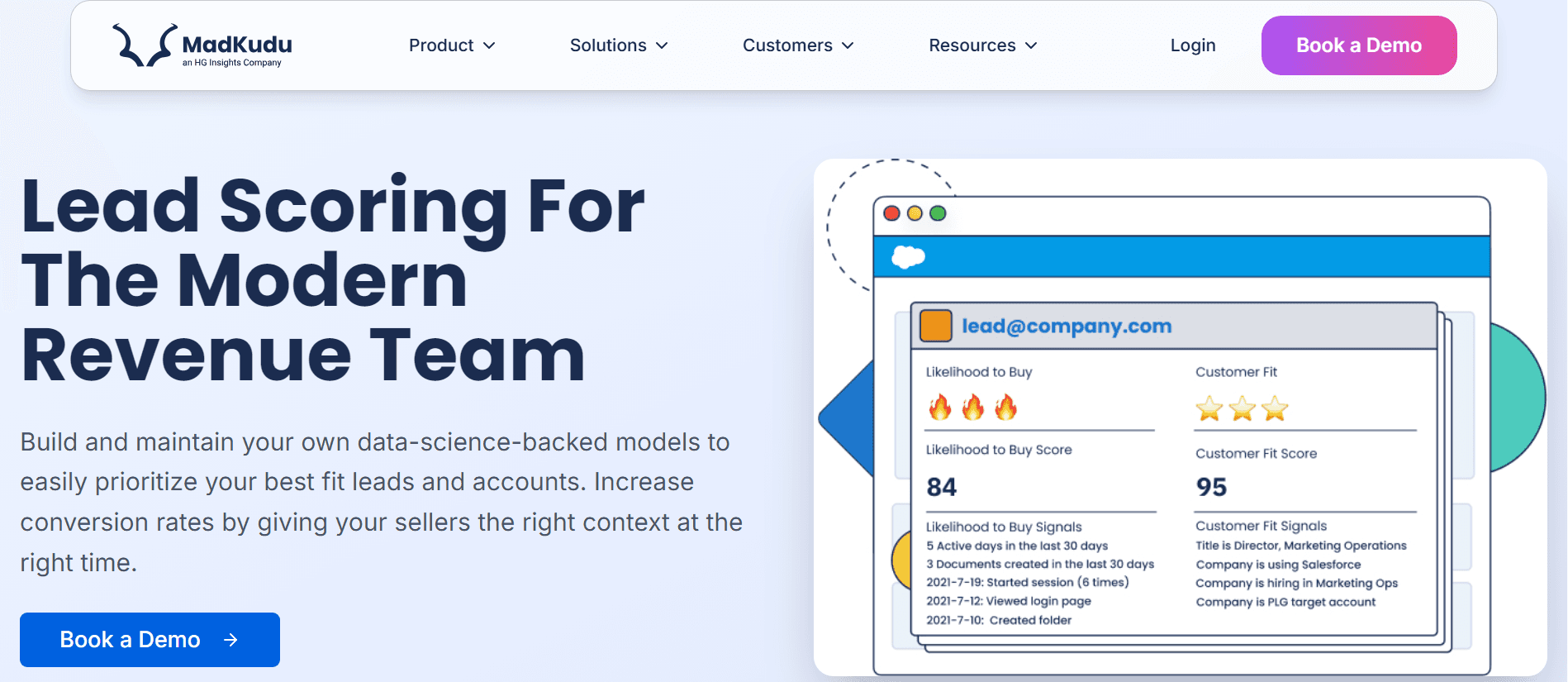
MadKudu addresses the transparency problem that plagues most predictive lead scoring platforms. Black box models give you numeric scores without any understanding of their origins. MadKudu provides explainable reasoning tied directly to patterns your data identifies.
Every lead arrives with both a score and human-readable explanations that show why something ranks as Very Good versus Medium. Sales teams find it easier to trust the scores and act on them.
Key Features
The platform learns from your CRM and analyzes closed-won deals, pipeline progression, spend, and churn data from Salesforce or HubSpot. This training builds the Customer Fit model using firmographics, technographics, and demographics that historically predict success. The system reviews email opens, website visits, and demo requests from marketing automation platforms. Behavioral signals power the Likelihood to Buy scoring.
Product usage data integration separates MadKudu from typical lead scoring software. The platform ingests behavioral metrics from Amplitude, Mixpanel, and Segment to identify conversion thresholds. Leads creating four or more projects might close three times more often, for example. The Insights dashboard surfaces these high-impact patterns during model training and displays correlation graphs, event weights, and suggested rules based on your conversion data.
The Lead Grade system combines Customer Fit and Likelihood to Buy into a single A-E scale. Grade A represents scores from 90 to 100, suggesting your most qualified and engaged prospects. Grades B through E correspond to score ranges of 75-89, 50-74, 25-49, and 1-24 respectively. The system calculates these grades using weighted averages. You can prioritize leads within the same grade based on fit or buying intent.
Pricing
Plan | Monthly Cost | Sales Reps | Lead Scoring Features |
|---|---|---|---|
Growth | $999 | Up to 2 | Configured scoring, LTB predictions, standard enrichment, 3 forms |
Pro | $2,499 | Up to 10 | Customized scoring, LTB predictions, configured enrichment, 10 forms, Slack support |
Enterprise | Custom | Custom | Full customization, dedicated success team |
Deployment costs vary based on lead volume. Small implementations scoring 10K-25K leads monthly range from $20K-$40K annually. Mid-market teams processing 25K-100K leads pay $40K-$100K yearly. Enterprise deployments exceeding 100K leads start at $100K and reach $200K+ for complex implementations.
Pros and Cons
The explainable scoring model builds trust between marketing and sales. It shows which signals drive each score. Companies report saving approximately $2M in headcount by identifying both best and worst leads with accuracy. The platform integrates with major CRM and marketing automation tools including Salesforce, HubSpot, and Marketo. Users rate MadKudu 4.5/5 stars on G2 from 46 reviews.
Enterprise pricing excludes early-stage teams without budget flexibility. No free plan exists. You need financial commitment before testing against your data. The system needs sufficient historical CRM data and product usage signals for accurate predictions.
6sense - Best for ABM and Intent-Based Scoring
Processing over one trillion B2B signals daily, 6sense operates as an AI-powered ABM platform built for intent-based lead scoring and account prioritization. The platform identifies businesses researching specific keywords, products, or services before direct contact and uncovers anonymous buying signals that traditional lead scoring software misses.
Key Features
6sense assigns Intent Scores from 1-100 that measure an account’s readiness to buy. These scores map to predefined buying stages: Target (below 20), Awareness (20-49), Consideration (50-69), Decision (70-84), and Purchase (85+). AI and machine learning track which transactions and interactions matter most as opportunities progress, unlike arbitrary manual scoring. The system calibrates changes without human intervention automatically.
The platform scores in multiple dimensions beyond simple intent. Account profile fit evaluates firmographic and technographic attributes against your ICP. Contact profile fit identifies buying committee members. Account in-market scores reveal active purchase research in your category, and account reach scores calculate win probability based on outreach timing and type.
SearchSense identifies companies searching specific B2B terms and couples this with three intent-data layers: first-party (site visits, CRM activity, webinars), second-party (G2 or TrustRadius behaviors), and third-party (search keywords, content consumption).
Pricing
Company Size | Typical Annual Investment | Features Included |
|---|---|---|
Individual/Testing | Free plan | 50 credits/month, simple search |
Small/Mid-Market | $50,000-$80,000 | Core Sales Intelligence |
Enterprise | $100,000-$300,000+ | Full ABM platform, predictive AI |
TAM size, selected modules, and data volume determine pricing variations. Most companies pay between $60,000 and $300,000 each year.
Pros and Cons
The platform surfaces in-market accounts weeks or months before direct participation and provides earlier pipeline visibility. AI agents coordinate personalized participation across advertising, web, email, and sales channels automatically. Transparent scoring reveals which signals drive each account’s priority level through detailed breakdowns.
The clunky user interface receives criticism for slow data refresh rates. High costs exclude smaller teams from accessing full capabilities. Multiple Salesforce licenses increase total expenses. The system requires meaningful setup and ongoing management to extract full value.
ActiveCampaign - Best Budget-Friendly Lead Scoring Automation
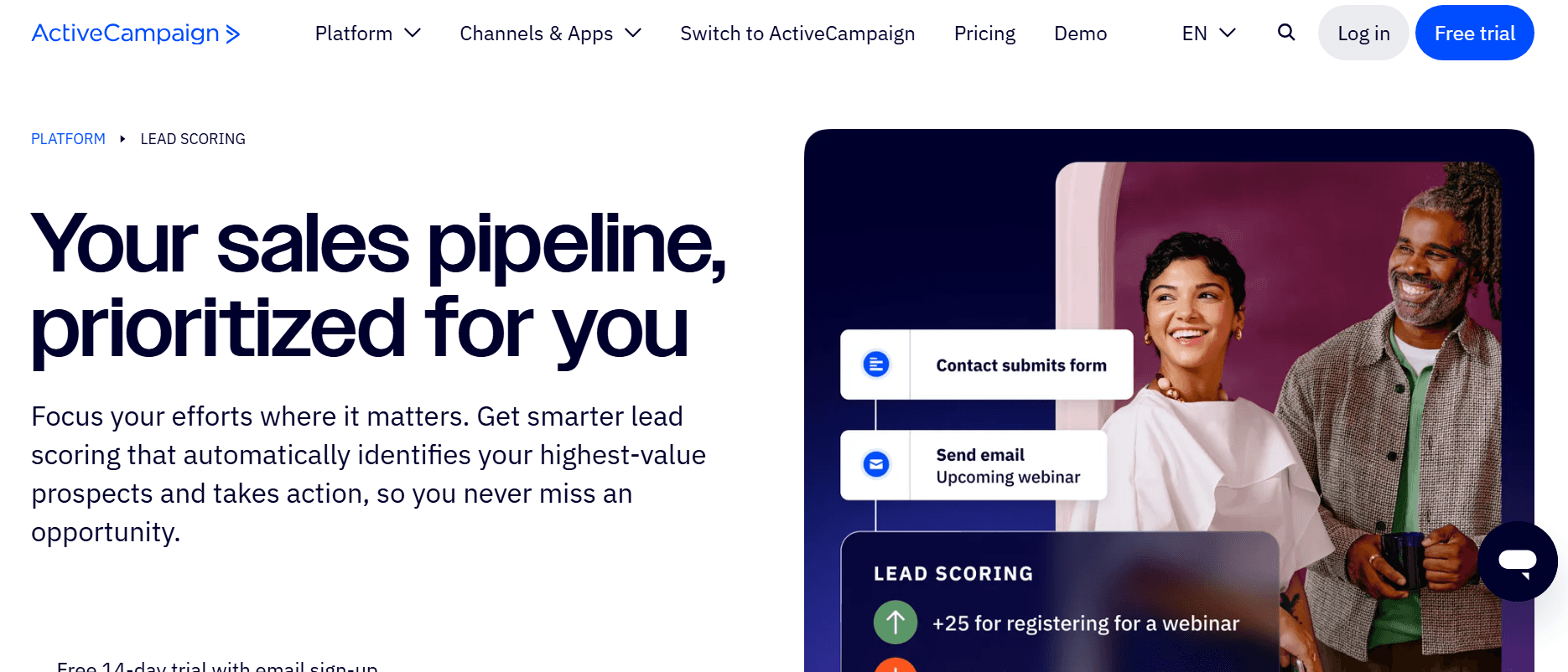
ActiveCampaign blends traditional rule-based scoring with predictive AI capabilities. Lead scoring automation comes at price points available to smaller teams. The contact scoring system assigns numerical values to leads based on conditions you define. Score values have no maximum limit.
Key Features
The platform supports both static and dynamic scoring approaches. Static scoring runs once per contact, whatever the number of times they match your rules. Dynamic scoring executes each time a contact matches conditions. Automations set to run multiple times accomplish this.
Rules can award or subtract points based on demographic fit, behavioral engagement, or firmographic attributes. To cite an instance, assigning 10 points for metropolitan area residence and another 10 points for pricing page views creates a combined 20-point score for contacts matching both criteria. Points can expire after set intervals (1, 3, 6, or 12 months) to maintain relevance.
AI-powered win probability predicts conversion likelihood and refines lead quality assessment beyond manual rules. Scores update immediately as leads engage with emails, visit pages, or complete actions. Automations trigger when contacts reach specific thresholds. The system then creates deal records, assigns sales reps, or launches nurture sequences.
Pricing
Plan | Annual Billing (1,000 contacts) | Lead Scoring |
|---|---|---|
Starter | $15/month | Not included |
Plus | $49/month | Requires Pipelines add-on |
Pro | $79/month | Requires Pipelines add-on |
Enterprise | $145/month | Included |
Pipelines add-on costs $68 monthly. The 14-day free trial gives access to most features.
Pros and Cons
The automation builder handles complex scoring workflows without technical expertise. You get 135+ triggers. Immediate score updates keep prioritization current as prospect behavior changes. Integration with 1,000+ platforms extends data sources. These platforms include Salesforce, Shopify, and HubSpot.
Users report the platform delivers strong engagement rates above industry standards. But the CRM remains too simple for serious sales teams. Reporting feels dated compared to newer platforms. Lead scoring requires paid add-ons beyond advertised plan prices and potentially doubles monthly costs.
Apollo - Best for Outbound Lead Scoring and Data
Apollo combines a massive B2B contact database with AI-powered lead scoring automation. The platform was built for outbound prospecting teams. It houses 230M+ contacts and 30M+ companies, which makes it the largest database among lead scoring tools I tested.
Key Features
Apollo’s auto-scoring assigns numerical values to prospects based on how well they match your ideal customer profile. The AI analyzes your company website and account details to generate scores without manual setup. Each prospect receives one of four ratings (Excellent, Good, Fair, Not a fit) based on their score as a percentage of maximum possible points.
The system uses 65+ filters including firmographics and job roles, along with intent signals like funding rounds and recent hires. You can create custom scores by selecting filters and signals, or rely on Apollo’s default auto-scores. Scores update in real-time as prospects interact with your outreach. The AI model learns from your CRM and sales engagement platform history.
Pricing
Plan | Annual Billing | Lead Scoring |
|---|---|---|
Free | $0 | Not included |
Simple | $49/user/month | Not included |
Professional | $79/user/month | AI scoring included |
Organization | $119/user/month | AI scoring included |
Lead scoring requires the Professional plan minimum. The credit-based system allocates 48,000 credits annually on Professional, with mobile credits costing 8x more than email credits.
Pros and Cons
The extensive database accelerates list building for outbound campaigns. AI scoring eliminates manual setup by analyzing your website and prospect activity. Users report the interface simplifies prospecting workflows.
But data accuracy concerns surface consistently, with real-life email accuracy around 65-70% and bounce rates of 15-25%. Phone number quality receives criticism, despite costing 8 credits each. The restrictive credit system disrupts campaigns when teams exhaust allocations mid-month.
What are the key features to look for Lead Scoring Software?
Selecting the right lead scoring platform requires you to review capabilities that affect qualification accuracy. AI and machine learning integration ranks as the most critical feature and analyzes large datasets to identify conversion patterns and predict lead likelihood automatically.
Smooth CRM integration centralizes lead data and eliminates synchronization issues that plague standalone scoring solutions. Live scoring updates maintain current prioritization as prospects interact with your brand and ensure sales teams act on the latest behavioral signals. Behavioral tracking monitors website visits, email engagement and content downloads.
Detailed analytics and reporting show which factors contribute most to lead quality and enable continuous model refinement. Scalability matters given that your lead volumes and scoring complexity will increase as your business expands. Predictive analytics use historical conversion data to forecast future behaviors rather than just measure past actions.
Security and compliance features protect sensitive prospect data through encryption and access controls. Easy-to-use interfaces reduce learning curves and help teams adopt the platform without technical expertise. If you need guidance selecting lead scoring software that matches your specific requirements, connect with our team for tailored recommendations.
Conclusion
The right lead scoring software depends on your specific requirements and budget. Salesmate delivers the best value overall for teams needing built-in CRM automation. HubSpot and Salesforce suit organizations already invested in those ecosystems.
Warmly excels at up-to-the-minute signal tracking, and MadKudu provides transparent scoring models. 6sense dominates ABM scenarios. ActiveCampaign offers budget-friendly automation, whereas Apollo combines outbound prospecting with scoring capabilities.
The tools I tested vary by a lot in pricing, from ActiveCampaign’s $49 monthly plans to 6sense’s $50,000+ annual investments. Each platform addresses different pain points, so connect with our team for tailored recommendations matching your qualification strategy and business size.
FAQ
What is a lead scoring system?
A lead scoring system ranks potential customers based on behavior, engagement, and fit, helping sales teams prioritize high-quality leads and improve conversion efficiency.
How to calculate lead scoring?
Assign points to actions (email opens, website visits, form submissions) and demographic factors (job title, company size). Sum points to rank leads from cold to hot.
Which is the best lead management software?
Top lead management software includes HubSpot, Salesforce, Zoho CRM, Pipedrive, and Freshsales. The best choice depends on budget, team size, and required automation features.
What is an example of lead scoring?
A lead scoring example: +5 points for opening emails, +10 for website visits, +20 for demo requests, -5 if inactive for 30 days; total score guides sales follow-up.
Similar Articles
We build with the best to make sure we exceed the highest standards and deliver real value.

Get started today
See how the Rox agent can put your pipeline generation, deal management, and account expansion on autopilot.