The CRM is where context goes to die
Karl Henrik Smith
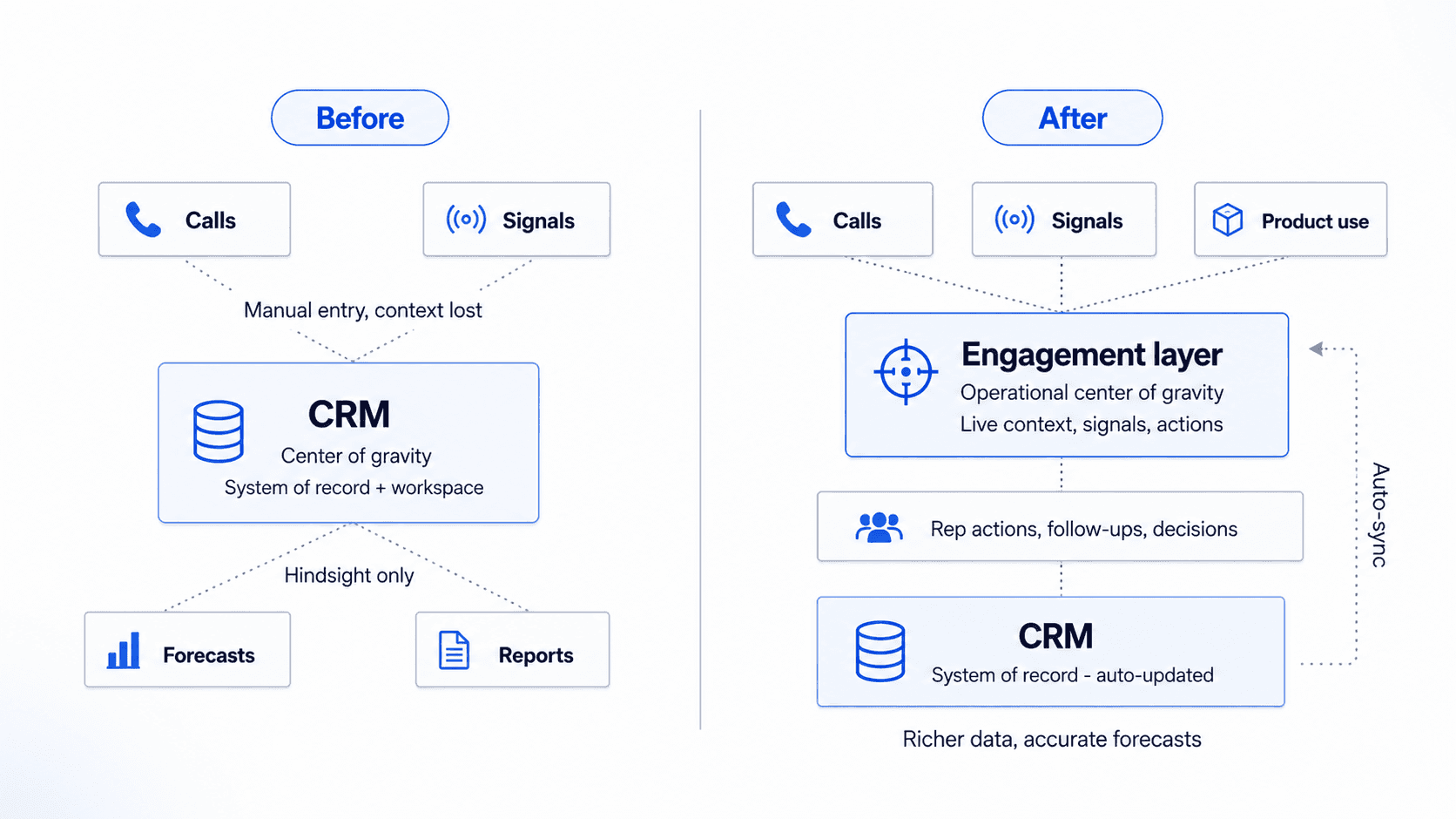
At some point in the last decade, someone decided that the place to run revenue was the same place you report on it. That decision has quietly cost sales teams more time, more deals, and more context than any other single architectural choice in the modern GTM stack.
What’s changed is where the data lives. For most of the last decade, the context that should be driving sales decisions was scattered across systems that couldn’t talk to each other. The shift to the data warehouse changed that. Now, for the first time, the full picture (CRM, conversation transcripts, product usage, billing, signals) can be unified in one place. That’s what makes the engagement layer possible now, and why the companies moving fastest on this are the ones who made the warehouse shift earliest.
The CRM is not broken. It’s doing exactly what it was designed to do: record what already happened, structure it into fields, and make it legible for forecasting. The problem is that none of those things help a rep close the deal in front of them right now. This is not a matter of poor adoption or process discipline, but a structural problem. The CRM optimizes for hindsight, while revenue generation depends on foresight.
Revenue doesn’t live in a database. It lives in the conversation happening this afternoon, the signal that fired this morning, the context that exists nowhere in your CRM because nobody had time to type it in.
The hidden cost of treating the CRM as the center of gravity
The problem isn’t that reps don’t use the CRM. Most do, under duress. The problem is what it costs them to do it.
Every deal update typed in after the fact is context that arrived late, incomplete, or stripped of the nuance that actually mattered:
The tone of the conversation that shifted when pricing came up
The stakeholder who went quiet after the last call
The org change that made the original champion irrelevant
The buying signal that fired in a product session nobody logged
None of that fits in a dropdown field, so none of it gets captured. And the next person who touches that account starts from a worse version of reality than the one the rep was actually working with.
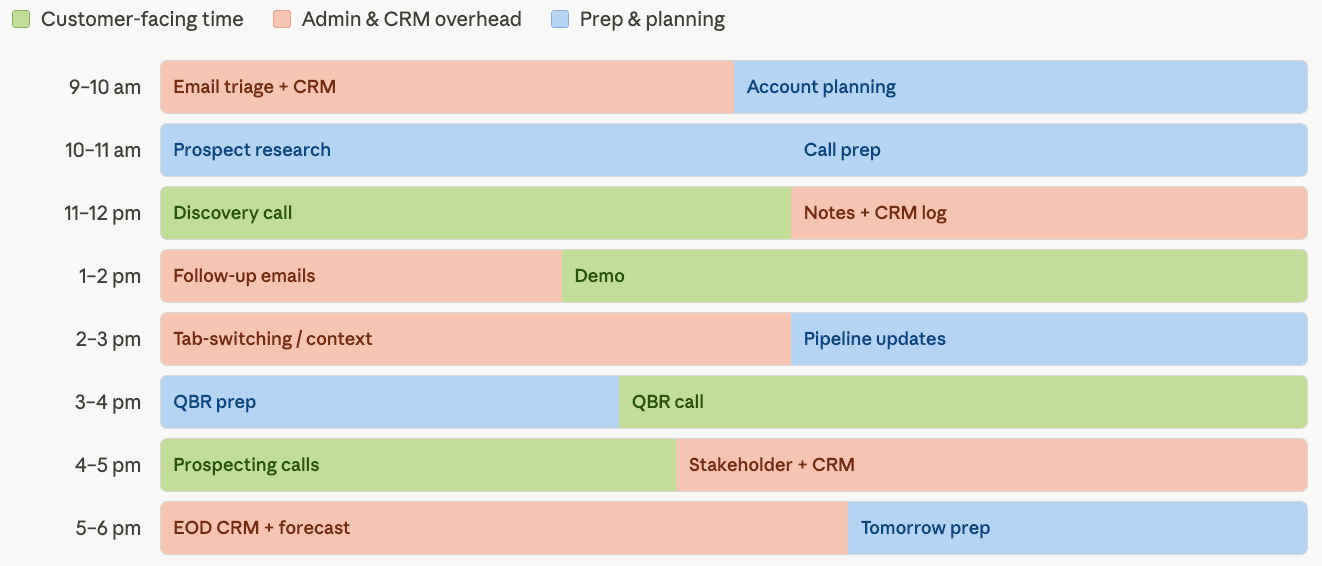
Then there’s the time tax — not the dramatic, easy-to-measure kind, but the distributed and invisible kind:
Logging a call after it ends
Updating a stage before the forecast call
Pulling a contact record across three tabs to find something that should have been in one place
Writing a follow-up from scratch when the context to draft it already exists somewhere
Individually, these take minutes. Across a team, across a quarter, they compound into something that shows up in quota attainment numbers without anyone being able to name the cause.
The result is a system that leadership trusts and reps resent, which means the data flowing into forecasts and pipeline reviews is shaped as much by what reps were willing to enter as by what actually happened. That’s not a people problem. It’s what happens when you ask a recording system to sit at the center of a motion that runs on real-time judgment.
This is what that time tax looks like across a single rep’s day.
A shift in architecture: from system of record to engagement layer
Rather than replacing the CRM, companies are redefining its role within a broader revenue architecture. The CRM remains the system of record, but it is no longer treated as the primary workspace for sales activity. Instead, a new layer is emerging as the operational center of gravity: the engagement layer.
The engagement layer is the environment where sales work actually happens. It is where context is continuously captured and updated, where signals are aggregated across channels, and where actions are initiated based on that context. Unlike the CRM, which relies on manual input and structured fields, the engagement layer operates on live data, integrating communication, activity, and intelligence into a single surface.
This shift enables a fundamentally different model of execution. Rather than requiring sales representatives to translate their work into the system, the system observes and interprets the work as it occurs. Instead of relying on static snapshots of pipeline health, teams have access to dynamic, real-time indicators of momentum, risk, and opportunity.
What changes when the engagement layer does its job
The first thing that changes is the shape of the day itself.
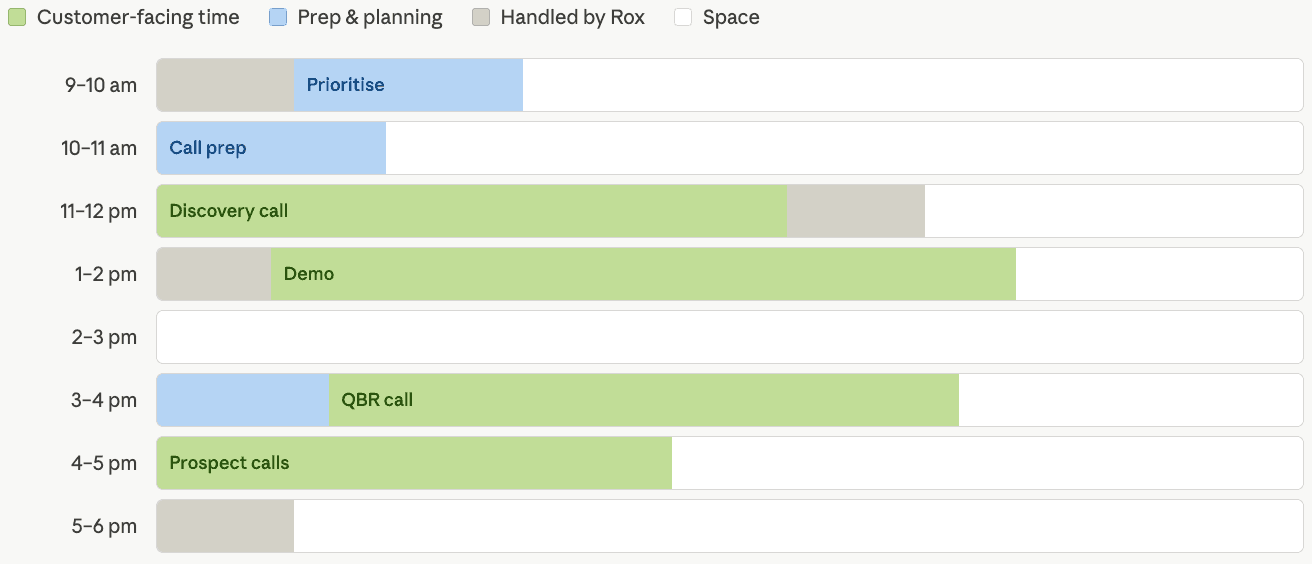
The most immediate change is what disappears. The meeting that used to end with twenty minutes of logging. The Monday morning spent reconstructing last week’s conversations before the forecast call. The frantic Slack message asking a colleague what was said on a call three weeks ago because the notes just say “good discussion.”
When the engagement layer is running, context accumulates automatically. The call happened, the signals were captured, the follow-up was drafted before the rep closed their laptop. The next time someone opens that account (whether it’s the same rep, their manager, or a CSM picking up a renewal), the full picture is already there. Not a summary of what got typed in, but the actual picture.
That space doesn’t stay empty.
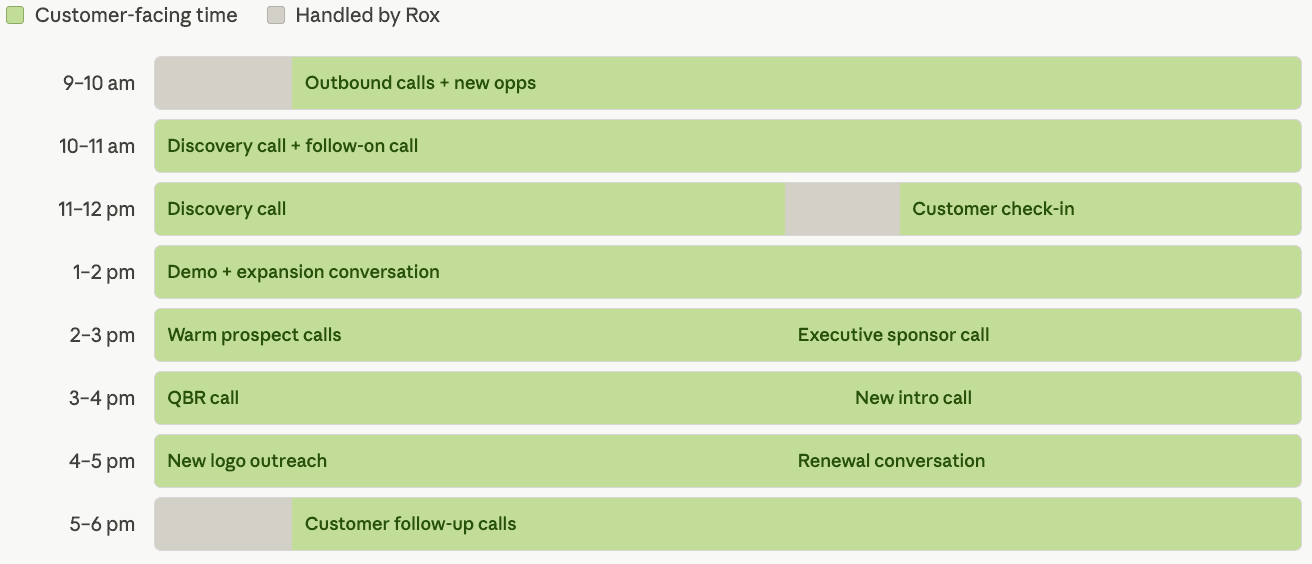
What that unlocks is a different quality of decision-making. When a rep walks into a call knowing exactly where sentiment shifted in the last conversation, which stakeholder has gone cold, and what the account’s usage trend looked like over the last thirty days, they’re operating from a fundamentally different information position than a rep who spent the last ten minutes skimming CRM notes from six weeks ago.
The CRM doesn’t disappear in this model, but gets better (ironically) because it stops being asked to do things it was never built for. Forecasts become more accurate because they’re drawing from richer, more current data. Pipeline reviews become more honest because the underlying records reflect what actually happened rather than what got entered before the deadline.
The system of record does its job, while the engagement layer does everything else.
The bottom line: the system didn’t fail, the center shifted
The persistence of CRM complaints isn’t a mystery. It’s what happens when a system built for one job gets asked to do another. The CRM was designed to give leadership visibility into what already happened. It was never designed to help a rep win the deal in front of them. Expecting it to do both is the root of thirty years of adoption problems, data quality issues, and sales teams that treat their primary system as a burden rather than an asset.
The companies seeing the strongest revenue outcomes right now aren’t the ones who finally cracked CRM adoption. They’re the ones who stopped trying. Not by abandoning the CRM, but by stopping to treat it as the place where revenue happens, and building around it instead.
That shift has an accumulating effect. When reps work in a system that helps rather than audits them, they engage with it differently. When context compounds automatically instead of being entered manually, the data that flows into forecasts and pipeline reviews is more accurate. When follow-ups are triggered by real signals instead of calendar reminders, deals move faster. None of these are necessarily dramatic transformations, but small corrections to a structural misalignment that’s been taxing every revenue team, quietly, for decades.
The CRM isn’t going anywhere. But the companies treating it as the center of their revenue motion are already behind. This is the architecture Rox was built on.
Your reps are spending half their day on work Rox handles automatically. See what their day looks like with Rox.
Similar Articles
We build with the best to make sure we exceed the highest standards and deliver real value.


Get started today
See how the Rox agent can put your pipeline generation, deal management, and account expansion on autopilot.