“Build vs. buy” is the wrong question
Karl Henrik Smith
Here’s a pattern that comes up constantly in 2026. A RevOps leader spins up a Claude project over a weekend, points it at the CRM, and receives something that looks impressive: automated enrichment, meeting prep summaries, a clean dashboard. They show it to the CRO, who in turn calls the VP of Engineering. Within a month, two engineers are dedicated to the project.
Five months later, they have an “auto-SDR” that handles prospecting, enrichment, and outbound at the top of the funnel. On paper, it’s impressive. Then a lead enters the pipeline, and it stops. The system knows how to act, but not what to do next. That gap (between a system that automates tasks and one that orchestrates a full revenue motion) is what the build vs. buy conversation is truly about. Not capability or cost per seat, but what you end up with on the other side.
There’s also a third path teams often try first, which is to connect an AI model directly to every system and query in real time. It’s tempting until the bill arrives and the answers still aren’t reliable, because nothing underneath has been unified and the connections to live systems keep getting throttled. Most teams who go down that road end up back at the same question: build or buy the foundation underneath?
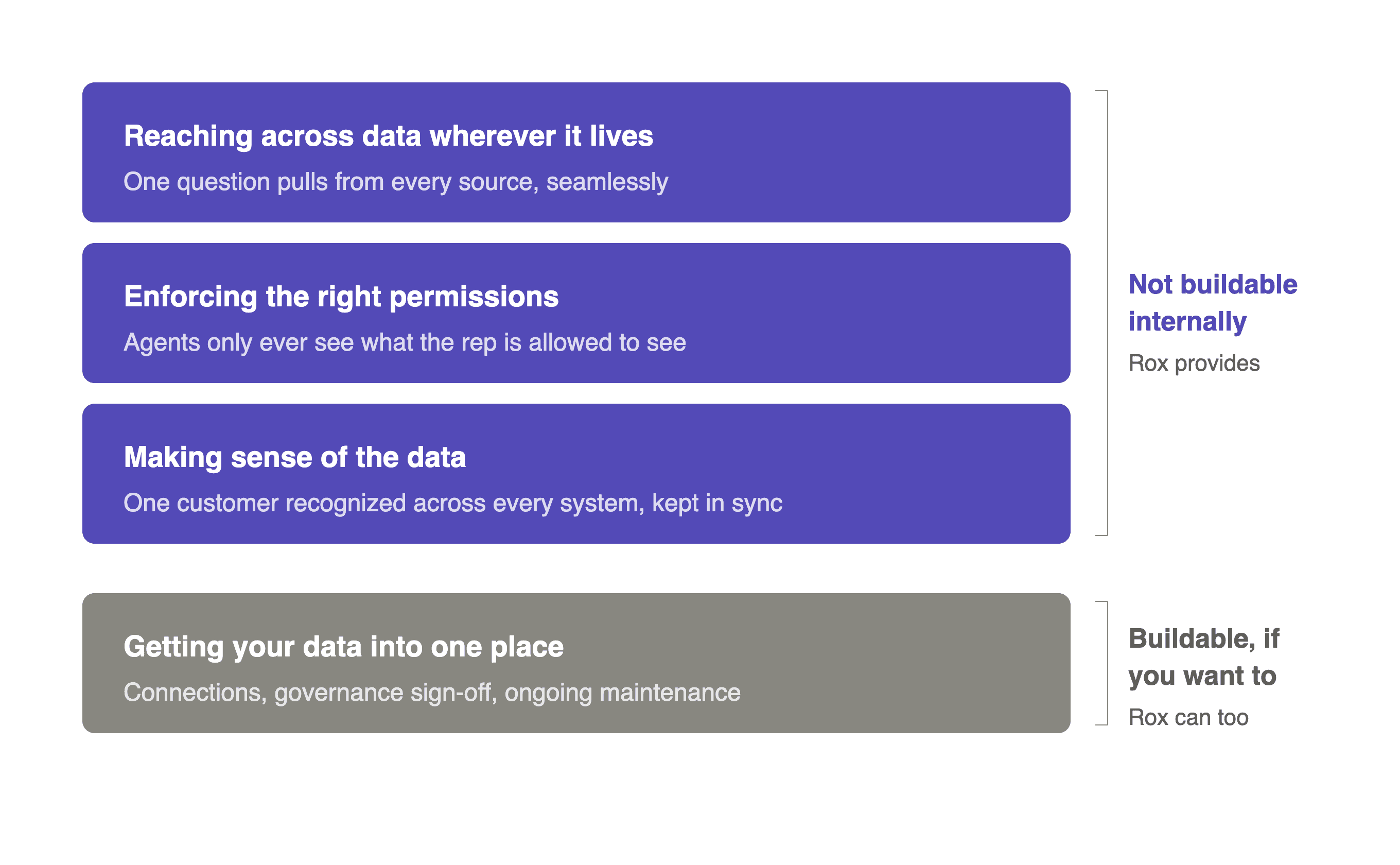
There are four layers to this foundation, and only one of them is something you should build yourself:
The first is getting your data into one place. Pulling everything out of Salesforce, your call recording tool, your email system, and everything else, into a single warehouse. Moving the data is the easy part. The slow part is internal: legal, security, and compliance all need to sign off before anything moves, and those reviews run on their timeline, not yours. Then you build the connections, strip out anything sensitive before it leaves the source, and keep all of it working as those systems change over time. This is the right layer to build internally. Nobody outside the company should own how your data is structured or the signals that are specific to your business.
The second is making sense of that data once it’s together. The same customer shows up differently in every system. There’s one name in Salesforce, another in your call tool, a different legal name in finance’s spreadsheet. Before an agent can answer “what’s going on with this account,” something has to recognize that all of those are the same company, and keep getting it right as the data changes every day. That’s harder than it sounds. And the second half to this is that when an agent updates something, that change can’t just live in its own system. The rep still works in Salesforce, so the update has to show up there correctly as well. Keeping multiple systems in agreement, without changes getting lost or duplicated, is a real engineering project on its own.
The third is making sure agents only see what they’re allowed to see. Every system has its own rules about who can access what, and today most teams manage those rules separately, in spreadsheets, with nobody too sure of who has access to what or why. Before an agent can act on a rep’s behalf, it has to respect exactly the same permissions that rep has, across every system at once. Getting that right is what makes it safe to let agents act autonomously inside a large company. Rox’s Unified Permission Model (two patents pending) is the version of this built for enterprise scale.
The fourth is being able to pull from data that doesn’t all live in the same place. Call transcripts sit in one system, real-time usage data in another, and some data never makes it into the warehouse at all. The agent needs to reach across all of it seamlessly, knowing where to look for what, so that asking a single question about a deal quietly pulls from wherever the relevant data actually lives. This is also what makes it possible to assign one agent per account that holds full context even as reps change, territories shift, and deals get handed off.
A CRO handing autonomous agents the number needs all four working before trusting what comes out. The first is yours to build, while the other three compound from being deployed across hundreds of organizations, which is something no internal build accumulates quickly.
Most common scenarios
“We haven’t started building yet”
The instinct is to treat this as a technical question, when it’s really a timing issue. What internal teams underestimate isn’t the upfront build. It’s everything that follows: the sign-offs before any data moves, the problem of recognizing the same customer across systems that only reveals itself once the data is together, the difficulty of keeping every system in agreement once agents start making changes, and the ongoing maintenance as every connected system shifts over time. None of that shows up in the initial estimate.
The pattern plays out the same way in a lot of organizations. The demo and top-of-funnel automation both work, but the moment things get more complex (i.e. orchestrating across a full pipeline, running multi-touch plays, deciding which accounts matter most this week) the system stalls. Not because the team isn’t capable, but because the problems that matter most require a foundation that takes years to build right.
What Rox brings on day one is that foundation, already built across hundreds of revenue organizations, plus a library of patterns learned from thousands of deal cycles that tells agents not just how to act, but what actually works. That’s years of accumulating work that can’t be replicated from scratch, regardless of how strong your team is.
“We’re already building something internally”
This is the more common conversation in large enterprise accounts, and the more delicate one. Internal teams are building the first layer (getting their data into one place) which is the right call. How your data is structured, your internal integrations, the signals unique to your business should all stay internal. That work is yours and should stay yours.
What the internal build won’t produce is the other three layers. Making sense of the data once it’s together, keeping every system in agreement when agents act, and enforcing permissions uniformly across all of them are problems that take a dedicated team years to solve in production. They depend on systems the team didn’t build and can’t fully control, and none of it is your core business.
The conversation to have is about scope, not competition. The internal team owns the foundation. Rox is the intelligence layer that plugs into it. Same timeline, but the agents running on top of it actually know what to do. Cloud Software Group, a $4B portfolio company running $800M in renewals on Rox today, made exactly that call.
“We’re building and evaluating you at the same time”
This is common in large enterprises. Procurement keeps the internal team running to maintain leverage. RevOps wants to keep options open. The conversation gets framed as a competition between the two.
That framing doesn’t hold up. The internal team and Rox are building different things. The internal team owns getting the data into one place (the warehouse connections, the integrations, the signals specific to the business). Rox owns everything that has to happen on top of that to make agents trustworthy. Those two things plug into each other. Assigning ownership clearly turns a procurement conversation into an architecture conversation, which is easier for everyone and closes faster.
Three objections worth addressing directly
“We already have agents running on our warehouse.”
Those agents are handling individual tasks, like sending an email, updating a record, scoring a lead. That’s valuable, but it’s a different problem than orchestrating an entire revenue motion. A full sales cycle involves dozens of decisions across months: which accounts to prioritize this week, when to reach out, how to adapt when a deal goes quiet, what to do differently at renewal. Task agents handle one step at a time. Orchestration handles the whole sequence, and it’s where the actual revenue impact shows up. Most internal builds reach the former, while few reach the latter.
“We’re already committed to another vendor and they’re building agents.”
The meaningful difference with Rox isn’t the agent, but what the agent can see. Agents built on top of a CRM work from whatever data has been manually entered or synced into that system, which is often incomplete and sometimes weeks out of date. Agents built on a foundation that unifies everything work from the full picture (product usage, billing, emails, call transcripts, outside signals, all connected and kept current). What an agent can do is limited by what it knows. The data foundation is the more important question.
“We tried an AI vendor before and it didn’t work.”
Most early AI tools in the revenue space led with the model: pick a capable one, give it some data, and hope the answers are useful. They weren’t, because the data underneath was incomplete. The model could write a coherent email but had no reliable way to know whether this account was about to churn, the champion had gone cold, or a competitor had just moved in. The model got blamed, when the real gap was the foundation.
Rox spent a year building the context graph before shipping anything else. [See how it works →]
Similar Articles
We build with the best to make sure we exceed the highest standards and deliver real value.