How is Context Captured in Rox

Santhosh Kumar Manavasi Lakshminarayanan
It was the last week of Q4. A $2M deal that had been in "commit" for six weeks just churned.

In the post-mortem there were four different stories in the room.

  • The AE said the champion had left the company.

  • CS said the product missed two features the customer had flagged eight months ago and user sessions started dropping

  • The data team pulled Gong transcripts that showed the customer's tone had shifted in July

  • A note in Salesforce, buried under months of activity logs, predicting exactly this

What I just described isn't a data problem. The data was there the whole time and was being captured, stored and tracked. The problem was context. Without it, every piece of data was just reading fragments of information and hoping the story assembles itself.

The industry's answer to this started with moving data to data warehouses, centralize everything and make it queryable. That was needed, it did make reporting and analytics get better, but something got quietly lost in the move .

Revenue knowledge doesn't live in clean, stable tables. It lives in messy, conflicting, rapidly changing systems. When that data is replicated into a warehouse, the data does but the relationships doesn’t travel missing critical context.

The problem isn't new. CRMs had all the data but became systems of record, not understanding. BI tools made data queryable but not contextual, they answered questions which you knew to ask. It got worse as the wave of AI point solutions each solved only challenges in isolation, with no shared context between them.

The second part of the challenge

This is why we at Rox obsessed about context and built a knowledge graph that encodes the right context and apply proper governance and permissions inherited from real data source.

Knowledge Graph

Warehouses unlocked the potential of accessing all data quickly but we still had to build context.

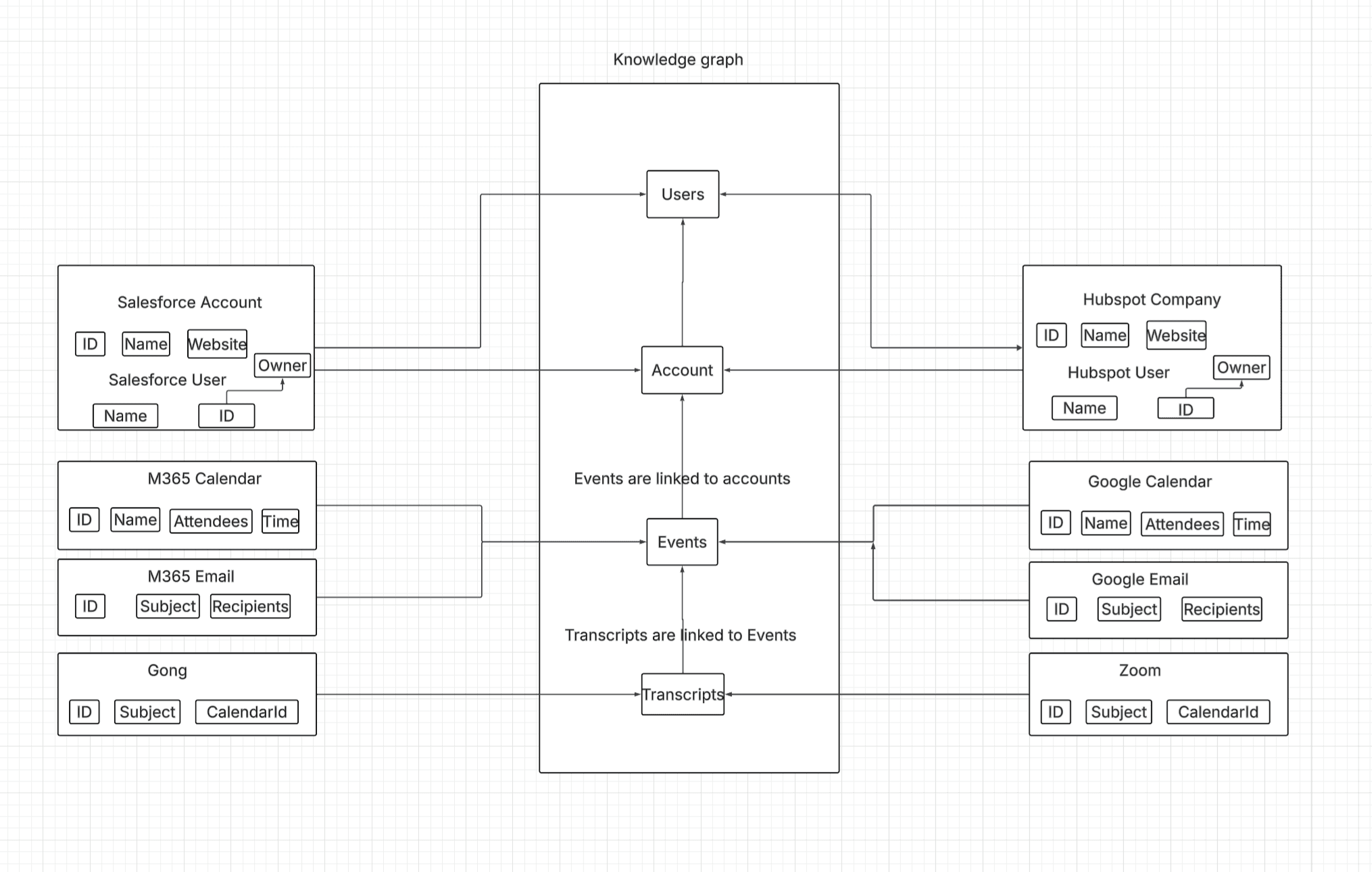
The main challenge is that the same entities are represented differently across sources and aren’t fully resolved, leading to data loss. At the same time, relationships between entities aren’t fully captured, which limits the value you can extract.

Knowledge graphs make that picture explicit and computable. Entities - people, companies, deals, events and conversations are entity resolved across systems and are connected the way they actually relate to each other in the real world and when something changes.

This is not another dashboard. Not a better CRM. Something closer to how a great sales teams actually think. It brings everything known about an account: the relationships, the history, the signals, the gaps.

The power of the knowledge graph is that it resolves entities across system and maintains relationships as well. The resolution is critical. Without it the signals are all disconnected, the detractor who is in salesforce and also had a negative sentiment because of a lack of feature, returned to the product, their average session time in the product just increased 5x because you just built the feature.

Without a knowledge graph, these are separate data points. With it, they become one coherent story.This is the kind of quality signal sales teams love to operate on.
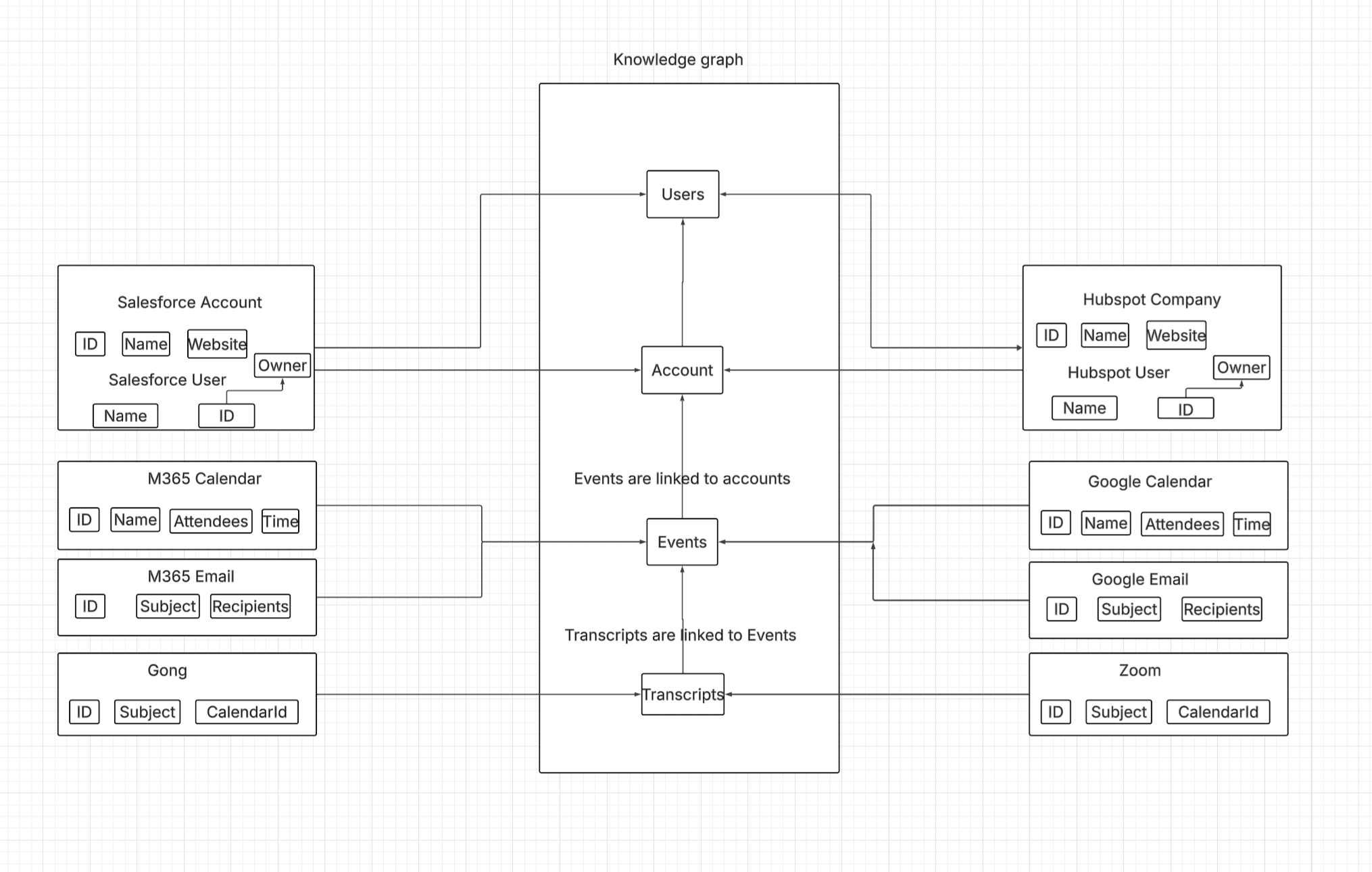
This matters now and didn't matter that much before is also because of the advent of AI agents. Agents are only as good as the context they reason over. Give them raw tables and disconnected systems, you get generic answers. Give them a rich, domain specific picture of your revenue motion, and they can actually think with you.

Governance

Knowledge graphs solve the problem of context but all the governance gets completely lost when the data was taken out of real source systems and into warehouses.

When you bring AI into a revenue workflow, it starts acting on behalf of people: reading data, surfacing insights, taking actions. And the moment an agent acts on behalf of a person, a simple question has to have a clear answer: does this agent see exactly what that person is allowed to see.

In source systems, that question was already answered. Salesforce knows who owns which account. Gong knows which calls belong to which team and workspace. But when that data moved to the warehouse, those rules didn't travel along with it and the trust and governance layer is missing completely. Think of somebody being able to read CEO’s emails or the quota in another sales representatives’ account you are not supposed to see or a paystub email of an employee able to be read by some other employee.

At Rox, we treat governance as a core part of the product and not a compliance checkbox. Every agent, every action, every insight is scoped to what that user is actually authorized to see or do. The context is powerful because you can trust it.

To solve this, Rox is building a governance and permission layer from the ground up.

We started with governance layer first to tighten controls over what should Rox see or fetch.

For all unstructured content Rox ingest or stores from emails, transcripts etc…, a sophisticated, multi layer rule engine determines whether the data should be even ingested or stored by Rox. This rule engine carefully looks at every pieces of information from headers, metadata, subject, attendees etc…

Today the permission layer involves - field level access from systems like CRM coupled on top of controls to share data to user. This solves very primitive set of use cases, but we are

We're at an early and important moment in enterprise AI. Every revenue team is asking whether AI can actually be trusted with their most critical functions: account research, outbound, forecasting . The ones that will get there aren't the ones with the most data. They're the ones who invest in a shared understanding of what's real and the controls to know who should see it.

What we are building next is industry defining permission model - which boils down the typical complicated permission model from different systems involving - hierarchy, permission sets, workspace permissions across systems into simpler - object, record and field level primitives which is easy to reason and can we used to build other constructs like groups on top.
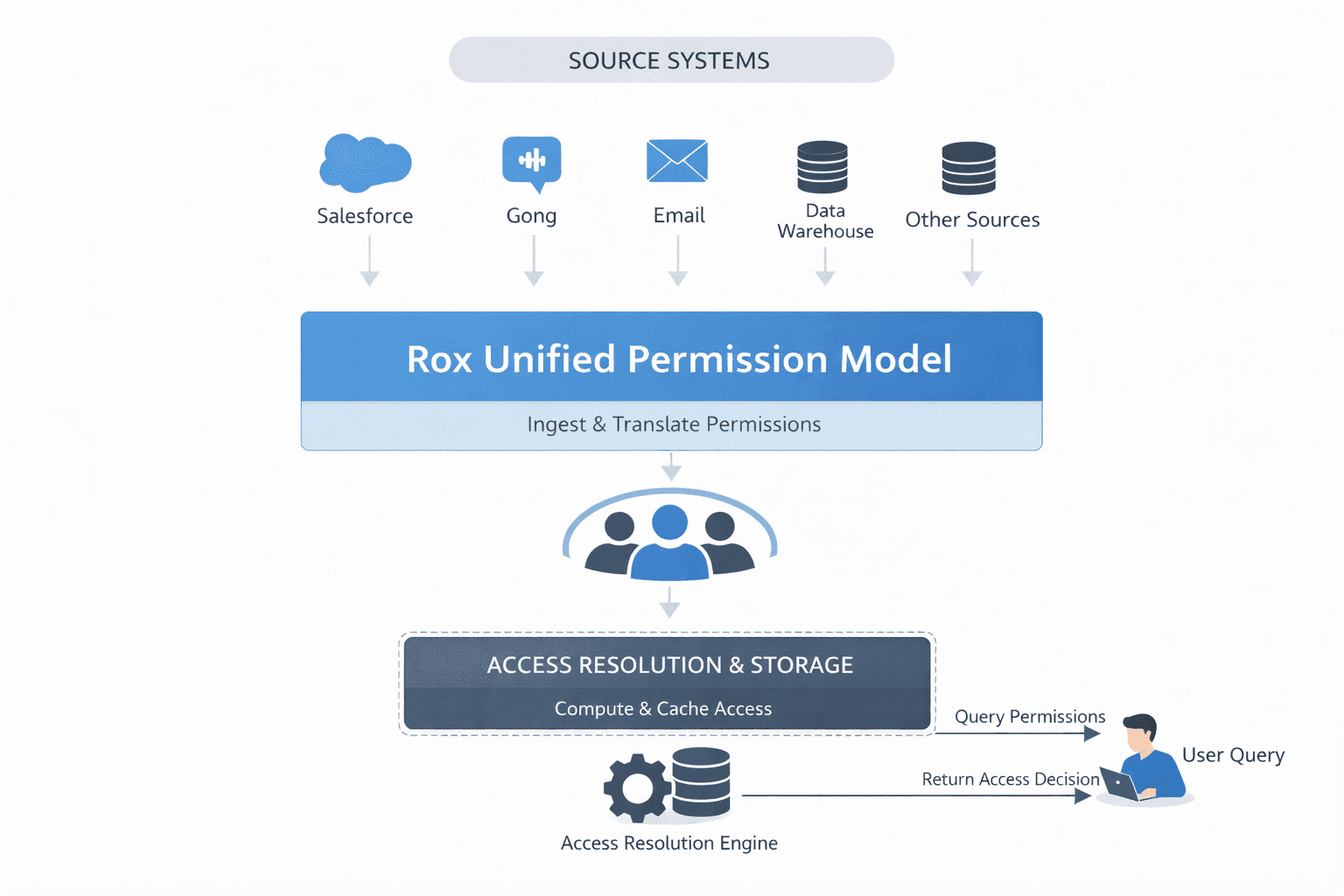
This unifies permissions across systems and creates a single control plane for Rox to enforce what data can be accessed and acted on. We’ve made the Permission and governance a core platform feature and every data seen by AI has to go through the governance layer.

Context and governance aren't features. They're the foundational pillars.

That's what we're building at Rox. And we think getting this right is the difference between AI that impresses in a demo and AI that a sales leader actually bets their quarter on.

If these are problems you want to work on We're hiring.

Deep dives from the team:

Get started today

Get started today

Get started today

Rox is committed to the privacy and security of its users. Customer data processed through the Rox platform is encrypted in transit and at rest using AES-256 encryption and is never used to train generalized machine learning models. Rox maintains SOC 2 Type II compliance and undergoes independent third-party security audits on an annual basis. All AI-generated outputs, including but not limited to prospect recommendations, message drafts, meeting summaries, and pipeline scoring, are provided for informational purposes and should be reviewed by authorized personnel before any action is taken. Performance metrics referenced on this website, including pipeline generation figures, response rates, and revenue impact, reflect results reported by individual customers under specific configurations and may not be representative of all deployments. Actual results will vary based on factors including but not limited to data quality, CRM configuration, outreach volume, market conditions, and target audience. Rox does not guarantee specific revenue outcomes. The Rox platform integrates with third-party services including Salesforce, HubSpot, Gmail, Microsoft Outlook, Slack, and others; availability and functionality of third-party integrations are subject to the respective providers' terms of service and may change without notice. Features described as "autopilot," "autonomous," or "automated" operate within user-defined parameters and require initial configuration and ongoing oversight. Rox, the Rox logo, and "Revenue on Autopilot" are trademarks of Rox, Inc. All other trademarks are the property of their respective owners. Service availability is subject to the terms outlined in your enterprise agreement. For questions regarding data processing, compliance certifications, or platform capabilities, contact security@rox.com.

Copyright © 2026 Rox. All rights reserved. 251 Rhode Island St, Suite 205, San Francisco, CA 94103

Rox is committed to the privacy and security of its users. Customer data processed through the Rox platform is encrypted in transit and at rest using AES-256 encryption and is never used to train generalized machine learning models. Rox maintains SOC 2 Type II compliance and undergoes independent third-party security audits on an annual basis. All AI-generated outputs, including but not limited to prospect recommendations, message drafts, meeting summaries, and pipeline scoring, are provided for informational purposes and should be reviewed by authorized personnel before any action is taken. Performance metrics referenced on this website, including pipeline generation figures, response rates, and revenue impact, reflect results reported by individual customers under specific configurations and may not be representative of all deployments. Actual results will vary based on factors including but not limited to data quality, CRM configuration, outreach volume, market conditions, and target audience. Rox does not guarantee specific revenue outcomes. The Rox platform integrates with third-party services including Salesforce, HubSpot, Gmail, Microsoft Outlook, Slack, and others; availability and functionality of third-party integrations are subject to the respective providers' terms of service and may change without notice. Features described as "autopilot," "autonomous," or "automated" operate within user-defined parameters and require initial configuration and ongoing oversight. Rox, the Rox logo, and "Revenue on Autopilot" are trademarks of Rox, Inc. All other trademarks are the property of their respective owners. Service availability is subject to the terms outlined in your enterprise agreement. For questions regarding data processing, compliance certifications, or platform capabilities, contact security@rox.com.

Copyright © 2026 Rox. All rights reserved. 251 Rhode Island St, Suite 205, San Francisco, CA 94103

Copyright © 2026 Rox. All rights reserved. 251 Rhode Island St, Suite 205, San Francisco, CA 94103

Rox is committed to the privacy and security of its users. Customer data processed through the Rox platform is encrypted in transit and at rest using AES-256 encryption and is never used to train generalized machine learning models. Rox maintains SOC 2 Type II compliance and undergoes independent third-party security audits on an annual basis. All AI-generated outputs, including but not limited to prospect recommendations, message drafts, meeting summaries, and pipeline scoring, are provided for informational purposes and should be reviewed by authorized personnel before any action is taken. Performance metrics referenced on this website, including pipeline generation figures, response rates, and revenue impact, reflect results reported by individual customers under specific configurations and may not be representative of all deployments. Actual results will vary based on factors including but not limited to data quality, CRM configuration, outreach volume, market conditions, and target audience. Rox does not guarantee specific revenue outcomes. The Rox platform integrates with third-party services including Salesforce, HubSpot, Gmail, Microsoft Outlook, Slack, and others; availability and functionality of third-party integrations are subject to the respective providers' terms of service and may change without notice. Features described as "autopilot," "autonomous," or "automated" operate within user-defined parameters and require initial configuration and ongoing oversight. Rox, the Rox logo, and "Revenue on Autopilot" are trademarks of Rox, Inc. All other trademarks are the property of their respective owners. Service availability is subject to the terms outlined in your enterprise agreement. For questions regarding data processing, compliance certifications, or platform capabilities, contact security@rox.com.

Copyright © 2026 Rox. All rights reserved. 251 Rhode Island St, Suite 205, San Francisco, CA 94103

Rox is committed to the privacy and security of its users. Customer data processed through the Rox platform is encrypted in transit and at rest using AES-256 encryption and is never used to train generalized machine learning models. Rox maintains SOC 2 Type II compliance and undergoes independent third-party security audits on an annual basis. All AI-generated outputs, including but not limited to prospect recommendations, message drafts, meeting summaries, and pipeline scoring, are provided for informational purposes and should be reviewed by authorized personnel before any action is taken. Performance metrics referenced on this website, including pipeline generation figures, response rates, and revenue impact, reflect results reported by individual customers under specific configurations and may not be representative of all deployments. Actual results will vary based on factors including but not limited to data quality, CRM configuration, outreach volume, market conditions, and target audience. Rox does not guarantee specific revenue outcomes. The Rox platform integrates with third-party services including Salesforce, HubSpot, Gmail, Microsoft Outlook, Slack, and others; availability and functionality of third-party integrations are subject to the respective providers' terms of service and may change without notice. Features described as "autopilot," "autonomous," or "automated" operate within user-defined parameters and require initial configuration and ongoing oversight. Rox, the Rox logo, and "Revenue on Autopilot" are trademarks of Rox, Inc. All other trademarks are the property of their respective owners. Service availability is subject to the terms outlined in your enterprise agreement. For questions regarding data processing, compliance certifications, or platform capabilities, contact security@rox.com.

Copyright © 2026 Rox. All rights reserved. 251 Rhode Island St, Suite 205, San Francisco, CA 94103

Copyright © 2026 Rox. All rights reserved. 251 Rhode Island St, Suite 205, San Francisco, CA 94103