10 Best Revenue Operations Automation Platforms for Large Enterprises
Leah Clapper

Revenue operations automation platforms for large enterprises consolidate the data, workflows, and intelligence layers that govern how sales, marketing, and customer success generate, manage, and close pipeline.
The best platforms in this category do at least one of four things well: automate data quality and routing so that the right leads reach the right reps at the right time, provide revenue intelligence that improves forecast accuracy and pipeline visibility, enable multi-channel engagement execution at scale, or connect AI agents to the prospecting and pipeline management motion.
According to Forrester, large enterprise revenue teams that consolidate their RevOps automation on a coordinated technology stack generate 31% more revenue per seller than those running disconnected point solutions.
This guide covers the ten leading revenue operations automation platforms for large enterprises, a category breakdown, evaluation criteria, and a decision framework.
How to read this guide
Revenue operations automation is not a single product category it is a layer of the enterprise go-to-market stack that different vendors approach from different starting points.
Before evaluating individual platforms, it helps to understand the four sub-categories that make up the RevOps automation landscape, because the best platform for a given enterprise depends on which sub-category is the most acute constraint in their current motion.
The 4 sub-categories of RevOps automation
1. Data orchestration and routing.
Platforms that focus on lead-to-account matching, territory assignment, deduplication, and routing logic. These platforms solve the “right lead to the right rep” problem that large enterprise CRM deployments face when high lead volume, complex territory structures, and multiple sales motions create routing errors that degrade SDR productivity.
Primary buyers: RevOps engineers and Salesforce admins.
2. Revenue intelligence and forecasting.
Platforms that aggregate CRM activity, call data, and engagement signals to produce more accurate pipeline forecasts and deal health assessments.
These platforms solve the “we don’t know which deals will close” problem. Primary buyers: CROs, VP of Sales, revenue operations leaders.
3. Sales engagement and execution.
Platforms that manage multi-channel outreach sequences, track engagement, and log activity to the CRM. These platforms solve the “SDR execution consistency” problem. Primary buyers: SDR managers, sales operations.
4. AI-powered pipeline generation and management.
Platforms that use autonomous agents to source pipeline through signal-triggered outbound, monitor pipeline health continuously, and connect demand gen signals to SDR action.
These are the newest category and are restructuring how large enterprises think about SDR capacity and pipeline generation economics. Primary buyers: CROs, VP of Sales, VP of Revenue Operations.
Most large enterprises need capability across all four sub-categories. The question is whether to build a best-of-breed stack (one platform per sub-category) or to consolidate on a platform that covers multiple sub-categories with some capability trade-offs.
Rox

Rox is an AI-powered revenue agent platform that automates the pipeline generation motion for enterprise revenue teams combining continuous account monitoring, intent signal aggregation, autonomous outbound prospecting, and pipeline management intelligence in a single agent-executed system.
Where the other platforms on this list automate specific layers of the RevOps stack (routing, forecasting, engagement, ABM), Rox automates the full pipeline generation loop: identifying which accounts to pursue, generating outreach at the moment of peak buying intent, tracking pipeline health continuously, and updating the ICP and account scoring criteria from closed-won outcomes automatically.
Key features
Continuous ICP-qualified account monitoring across firmographic, technographic, and behavioral signal sources
Signal-triggered autonomous outreach generation calibrated to the specific buying signal that elevated the account
Buying committee mapping from integrated contact data with multi-thread outreach sequencing
Deal scoring with AI-updated factor weights from closed-won and closed-lost conversion patterns
Stage-weighted pipeline forecasting updated in real time from engagement signal changes
Rolling 13-week pipeline view with automated coverage gap alerts and sourcing activity recommendations
ICP signal weight recalibration from closed-won data updated quarterly without manual configuration
Integration with third-party intent providers (Bombora, G2 Buyer Intent), CRM platforms, and sales engagement tools
Pros
Only platform in this category that closes the loop between pipeline intelligence (what needs to happen) and pipeline generation (making it happen automatically)
Continuous account monitoring eliminates the manual weekly list review that consumes SDR capacity in traditional prospecting motions
Signal-triggered outreach timing produces 3 to 5x higher reply rates than static list outreach for the same ICP
ICP self-calibration means the scoring model improves continuously without quarterly manual recalibration projects
Cons
Category-defining approach requires a change management investment for SDR teams transitioning from manual list-based prospecting to agent-reviewed queue workflows
Best suited for organizations where pipeline generation is the primary constraint rather than organizations where the primary constraint is CRM data quality, routing complexity, or CPQ
Integration with existing enterprise tech stacks (Salesforce, Outreach, Salesloft) is strong but requires configuration for organizations with complex custom CRM schemas
Price
Contact Rox for enterprise pricing. Pricing is customized based on team size, account universe volume, and automation configuration.
Salesforce Revenue Cloud
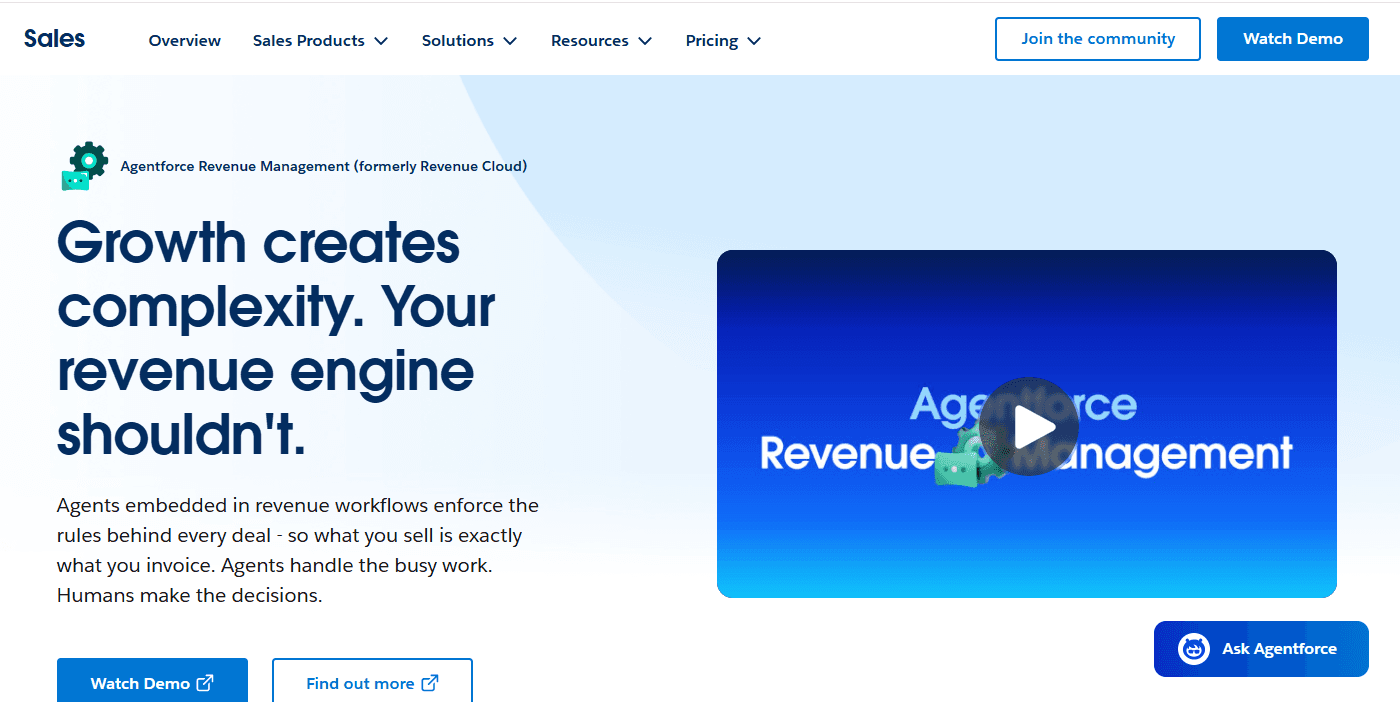
Salesforce Revenue Cloud is the native revenue operations layer within the Salesforce ecosystem, combining CRM, CPQ (Configure, Price, Quote), billing, and revenue intelligence into a unified platform.
For large enterprises already running Salesforce as their system of record, Revenue Cloud offers the lowest integration friction of any platform in this list because it is native to the data model, permissions structure, and workflow engine they already operate.
Key features
CPQ with complex product configuration, pricing rules, and approval workflows for enterprise deal structures
Einstein AI opportunity scoring and next-step recommendations based on CRM activity signals
Revenue lifecycle management covering subscription renewals, amendments, and expansion workflows
Pipeline inspection dashboards with drill-down to deal-level activity signals
Slack integration for revenue collaboration and deal room management
Contract lifecycle management with DocuSign and Adobe Sign native integration
Pros
No data portability risk everything lives in the Salesforce data model
Deep integration with the full Salesforce ecosystem (Marketing Cloud, Service Cloud, Pardot)
Strongest CPQ capability for enterprises with complex pricing and approval structures
Native Slack integration for deal collaboration without additional tool setup
Cons
Revenue intelligence capabilities are less sophisticated than dedicated platforms like Clari or Gong for deal-level scoring and call signal integration
Implementation complexity is high; large Revenue Cloud deployments typically require 6 to 12 months and significant Salesforce consulting investment
Pricing can escalate significantly for enterprises with large user counts and advanced license tiers
Not viable for organizations running HubSpot, Microsoft Dynamics, or other non-Salesforce CRMs
Price
Custom enterprise pricing. Salesforce Revenue Cloud is licensed as an add-on to existing Salesforce CRM contracts.
Typical enterprise commitments start at $75,000 to $150,000+ annually depending on user count and feature tier.
HubSpot Operations Hub
HubSpot Operations Hub is the RevOps automation layer within the HubSpot ecosystem providing data sync, data quality automation, custom reporting, and programmable workflow capabilities.
For mid-to-large enterprises running HubSpot as their CRM, Operations Hub closes the data quality and automation gaps that the base CRM leaves open.
It is less powerful than dedicated RevOps automation platforms for complex routing and territory logic but is the best option for HubSpot-native organizations that want to avoid the integration complexity of a best-of-breed stack.
Key features
Bidirectional data sync with 100+ third-party systems through native integrations
Data quality automation: automated duplicate detection, field normalization, and data cleansing workflows
Programmable automation with JavaScript and Python for custom RevOps logic beyond HubSpot’s native workflow builder
Custom report builder with cross-object reporting across contacts, deals, companies, and custom objects
CRM data enrichment through Breeze Intelligence (formerly Clearbit)
Behavioral event tracking for custom object and pipeline automation triggers
Pros
Native to the HubSpot data model no integration overhead for HubSpot-native organizations
Programmable automation enables complex custom workflows without a dedicated engineering resource
Data sync capabilities reduce the integration maintenance burden for enterprises using HubSpot alongside multiple point solutions
Included in HubSpot Enterprise suite no additional licensing for organizations already on Enterprise tier
Cons
Routing and territory assignment capabilities are limited compared to dedicated routing platforms like LeanData
Revenue intelligence features are basic compared to Clari, Gong, or Boostup
Less appropriate for enterprises with 500+ seat deployments that require the advanced territory hierarchy and revenue modeling capabilities of enterprise-grade RevOps platforms
Programmable automation requires JavaScript or Python competency that not all RevOps teams have in-house
Price
Included in HubSpot Enterprise suite ($1,200/month for starter Operations Hub; Enterprise pricing at $2,000+/month). Full suite pricing varies by total seat count.
Clari
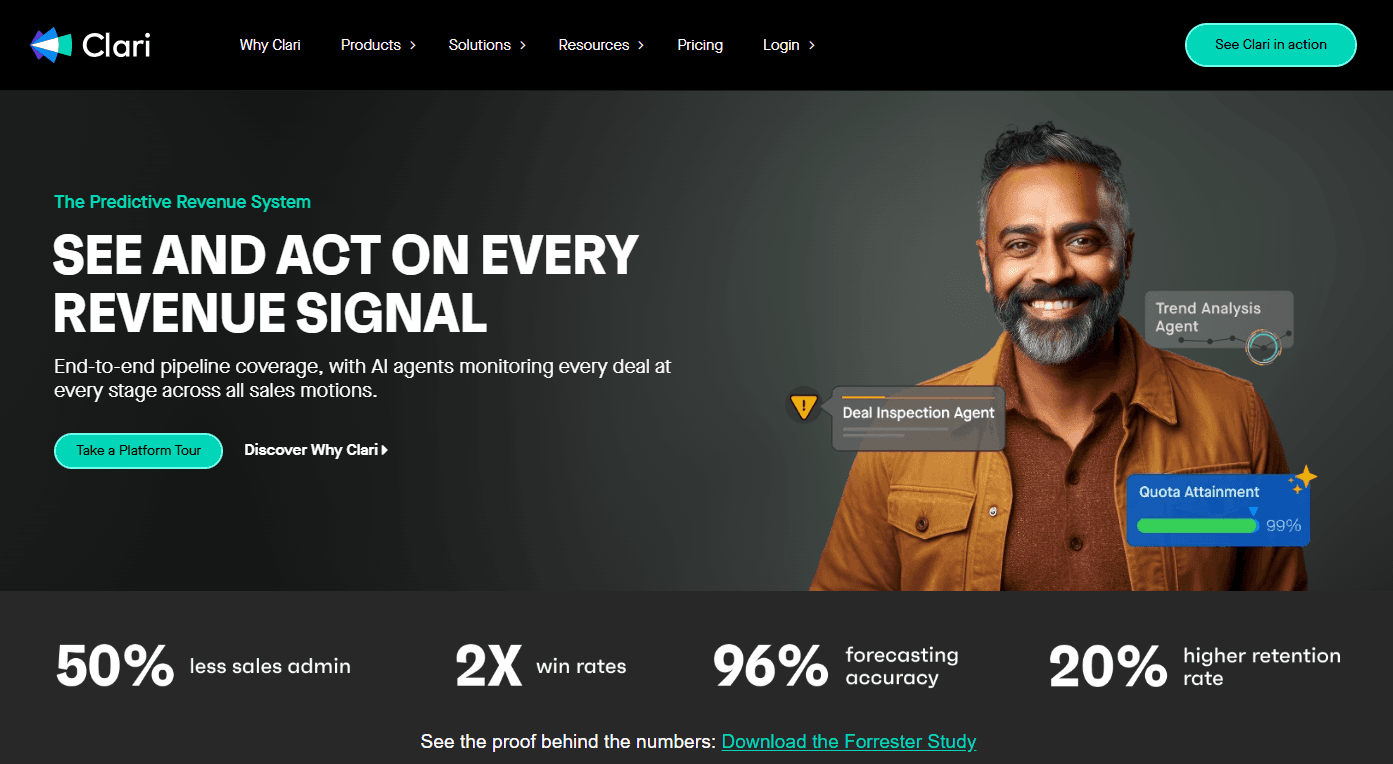
Clari is the market-leading revenue intelligence and forecasting platform for large enterprise sales organizations.
Its primary differentiation is AI-powered deal-level close probability scoring that applies machine learning to CRM activity data, engagement signals, and historical conversion patterns, producing forecasts that are significantly more accurate than the stage-weighted averages most CRM-native forecasting tools generate.
Clari is the revenue intelligence platform of record at many Fortune 500 revenue organizations.
Key features
AI-powered deal scoring that produces deal-level close probability estimates from CRM activity, email engagement, and call data signals
Forecast management module with commit, best-case, and pipeline categories updated in real time from deal-level scores
Pipeline inspection at deal and account level with engagement gap detection
Opportunity timeline showing deal progression and engagement history
Revenue cadence structured weekly forecast review workflow for VP and CRO-level pipeline management
ClariConnect for cross-team pipeline visibility and collaboration
Revenue waterfall analysis for tracking pipeline creation, advancement, and loss over time
Pros
Best-in-class AI forecast accuracy among dedicated revenue intelligence platforms
Revenue cadence is a distinctive capability for large enterprise pipeline review workflows
Deep Salesforce integration with bidirectional sync and native Salesforce UI embedding
Strong executive reporting and board-level revenue visibility
Cons
High price point typically one of the most expensive revenue intelligence platforms at enterprise scale
Implementation requires significant CRM data quality improvement for the AI models to produce accurate scores; organizations with poor CRM hygiene see delayed time-to-value
Limited sales engagement execution capability Clari manages the pipeline but does not run the SDR outreach sequences that fill it
Less effective for organizations with non-Salesforce CRMs
Price
Custom enterprise pricing. Typical enterprise contracts range from $100,000 to $500,000+ annually depending on seat count and feature tier. Clari does not publish list pricing.
Gong
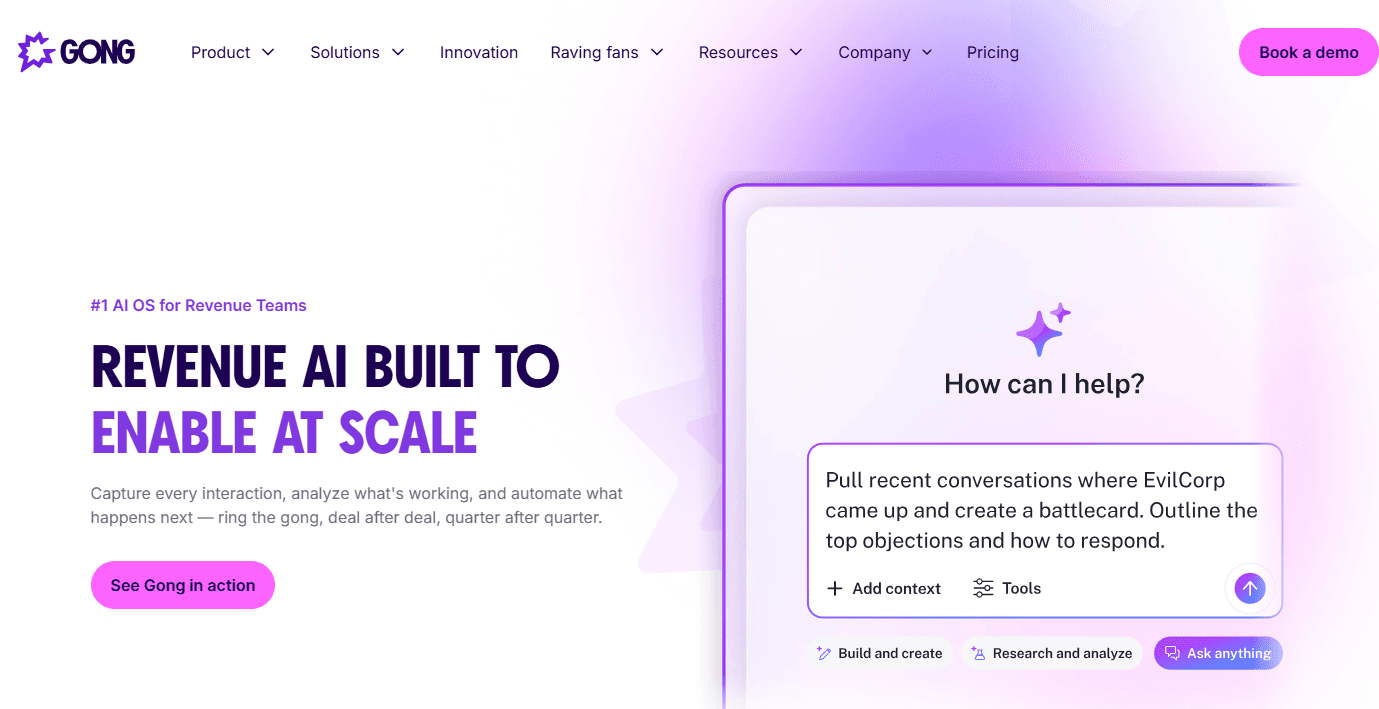
Gong is the market-leading conversation intelligence platform that has expanded into revenue intelligence through the signal extraction it performs on call recordings and email communications.
Gong’s primary differentiation in the RevOps automation category is the quality and specificity of the deal signals it extracts from conversation data, identifying risks, competitive mentions, objections, and buying committee dynamics from call recordings that CRM-logged data cannot capture.
For large enterprise sales organizations where the most valuable deal signal is what happens on calls, Gong provides a signal layer that complements CRM-based revenue intelligence.
Key features
Call recording with AI-powered transcription and topic detection
Deal boards showing deal health scores derived from conversation signal analysis
Gong Forecast for pipeline and revenue forecasting using conversation-derived deal signals
Engage module for sales engagement sequencing and pipeline generation
Coaching dashboards for manager-to-rep performance tracking by call topic and outcome correlation
Market intelligence aggregating conversation signal patterns across the revenue team
Gong AI for automated call summary, next step extraction, and CRM field population
Pros
Strongest conversation intelligence capability of any platform in this category
AI-powered CRM field population from call transcripts reduces rep data entry burden
Market intelligence gives revenue leaders visibility into competitor mentions, pricing objections, and deal dynamics across the full sales team
Engage module allows consolidation of sales engagement into the Gong platform for organizations that want to reduce point solution count
Cons
Deal scoring and forecasting accuracy are strong but typically trail Clari for organizations where CRM data (rather than conversation data) is the primary forecasting input
Engage module is newer and less mature than dedicated sales engagement platforms like Outreach and Salesloft for complex enterprise SDR motions
Call recording in some European markets requires specific consent management that adds operational complexity
High implementation and ongoing administration overhead for large enterprise deployments
Price
Custom enterprise pricing. Typical enterprise contracts range from $100 to $200 per user per month. Gong does not publish list pricing. Enterprise contracts typically require a 12-month minimum commitment.
LeanData
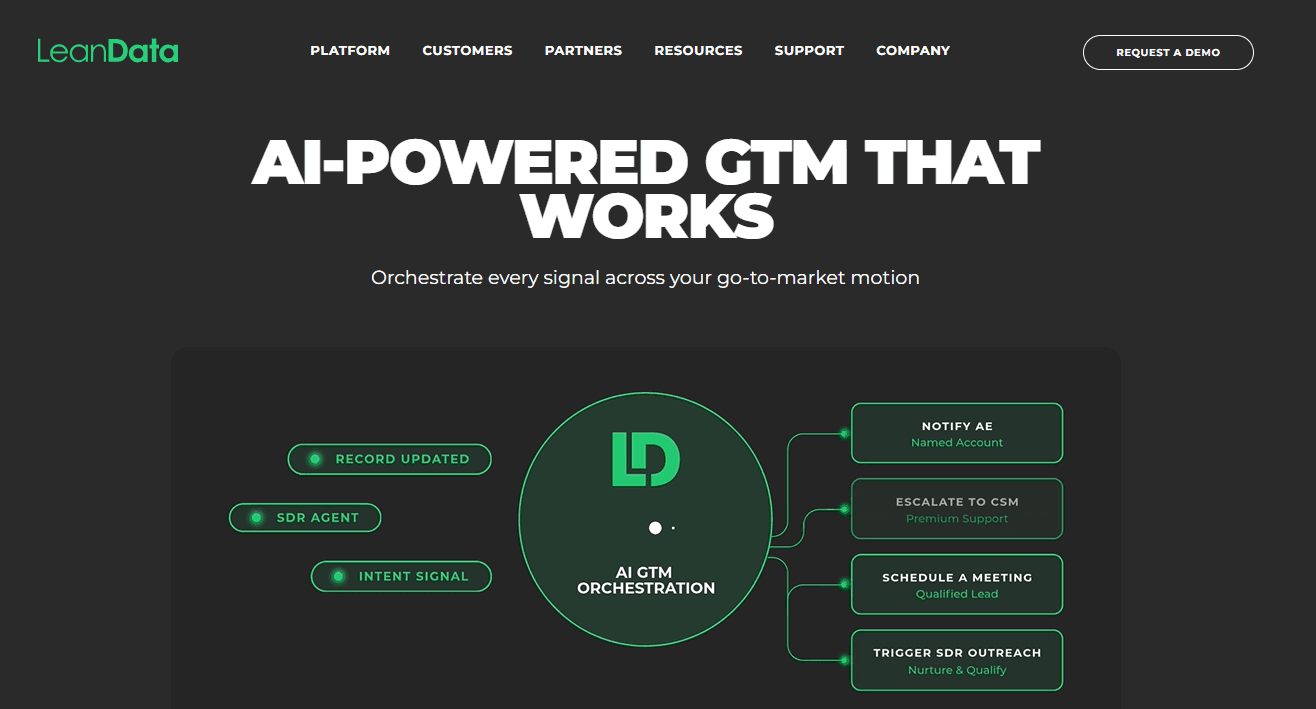
LeanData is the leading dedicated lead-to-account matching and routing platform for large Salesforce-based revenue organizations.
It solves a problem that becomes acute at enterprise scale: when high volumes of inbound leads arrive in Salesforce, the matching logic required to route them to the correct account owner, territory, SDR, or queue while handling duplicates, round-robin assignments, and complex territory hierarchies is beyond what Salesforce’s native assignment rules can reliably manage.
LeanData’s visual routing builder and matching engine replace Salesforce’s basic lead assignment with enterprise-grade routing logic.
Key features
Lead-to-account matching using fuzzy logic across company name, email domain, and firmographic signals
Visual flow builder for routing logic without code: drag-and-drop routing trees with conditional branches
Territory management that syncs with Salesforce territory hierarchies
Round-robin assignment with weighting, caps, and backfill logic
BookIt for inbound meeting scheduling that routes meetings to the correct rep based on the same matching logic
Operational reporting showing routing outcomes, match rates, and assignment SLA compliance
Pros
Best-in-class lead-to-account matching accuracy for complex Salesforce environments
Visual routing builder enables RevOps to manage and update routing logic without engineering support
BookIt is a distinctive capability for enterprises that want consistent rep assignment from the first inbound meeting
Strong track record in enterprise Salesforce deployments with complex territory structures
Cons
Salesforce-only not viable for HubSpot, Microsoft Dynamics, or other CRM environments
Primary capability is routing and matching does not provide revenue intelligence, forecasting, or sales engagement execution
Implementation complexity is high for enterprises with intricate territory hierarchies and multiple sales motions
Requires ongoing RevOps maintenance as territory structures and routing rules change
Price
Custom enterprise pricing. Typical enterprise contracts range from $30,000 to $150,000+ annually depending on lead volume, seat count, and feature tier.
Outreach
Outreach is the leading sales engagement platform for large enterprise SDR and AE organizations. It manages multi-channel outreach sequences (email, phone, LinkedIn, video), tracks engagement, automates follow-up, and provides pipeline management and forecasting capabilities through its Kaia AI assistant and revenue intelligence module.
For large enterprises that want to consolidate sales engagement execution and pipeline management in a single platform, Outreach’s expansion from sequencing into revenue intelligence makes it a viable alternative to deploying a separate sequencing tool alongside a revenue intelligence platform.
Key features
Multi-channel sequence management with email, phone, LinkedIn, and video integration
Kaia AI assistant for real-time call assistance, objection handling, and post-call summary
Outreach Commit for revenue forecasting with AI-powered deal risk assessment
Pipeline management dashboards with stage velocity and deal health monitoring
A/B testing for sequence and email performance optimization
Sales engagement analytics with rep-level and sequence-level conversion metrics
Mutual action plan (MAP) for buyer-seller collaboration in late-stage enterprise deals
Pros
Market-leading sales engagement execution for enterprise SDR teams
Outreach Commit provides meaningful forecasting capability within the same platform as sequencing execution
A/B testing and sequence analytics produce continuous sequence improvement without external analytics tools
Strong enterprise security and compliance capabilities (SOC 2, GDPR, SSO)
Cons
Revenue intelligence and forecasting capabilities trail Clari and Gong for organizations that prioritize forecast accuracy as the primary use case
Implementation is complex for large enterprise deployments with multiple sales motions and territory structures
Salesforce integration is strong, but some HubSpot customers report sync inconsistencies
Price point is high for organizations that only need sequencing without the revenue intelligence modules
Price
Custom enterprise pricing. Typical enterprise contracts range from $100 to $150 per user per month for the full platform. The Salesloft alternatives guide compares Outreach and Salesloft in detail for enterprises evaluating both.
Salesloft
Salesloft is the primary enterprise alternative to Outreach in the sales engagement category, with a stronger emphasis on coaching, performance management, and manager-to-rep workflow integration alongside its core sequencing capabilities.
Salesloft’s Rhythm AI feature is a distinctive capability that aggregates buyer signals from across the revenue stack and surfaces prioritized rep actions which positions Salesloft as a bridge between sales engagement execution and the signal-triggered prioritization that intent data platforms provide.
Key features
Multi-channel sequencing with email, phone, LinkedIn, and video integration
Rhythm AI for buyer signal aggregation and rep action prioritization
Deals module for pipeline management and deal health monitoring
Conversation intelligence with call recording, transcription, and coaching feedback
Forecast module for pipeline and revenue forecasting
Coaching and performance analytics with rep-level and team-level metrics
Salesloft Dialer for high-volume calling with local presence and call recording
Pros
Rhythm AI is a distinctive capability for enterprises that want signal-triggered prioritization embedded in the engagement platform
Coaching and performance management features are more mature than Outreach’s for sales managers who prioritize rep development alongside execution
Strong conversation intelligence integration with the sequencing workflow
Good for enterprises that want a single platform for sequencing, pipeline management, and coaching
Cons
Revenue intelligence and forecasting capabilities trail Clari for organizations where forecast accuracy is the primary use case
Implementation complexity is similar to Outreach plan for 60 to 90 days of configuration before the platform is fully operational
Rhythm AI is newer and still maturing; some enterprise customers report that signal quality varies significantly by data source
Like Outreach, the price point for the full platform is high for organizations that primarily need sequencing
Price
Custom enterprise pricing. Comparable to Outreach at $100 to $150 per user per month for the full platform. The salesforce alternatives guide covers the broader CRM and revenue operations platform landscape for enterprises evaluating multiple options.
6sense
6sense is the leading account-based marketing and revenue AI platform that combines intent data, predictive account scoring, and account-targeted advertising into a unified platform.
Its primary differentiator in the RevOps automation category is the buying stage prediction layer AI models that assess each account’s current position in the buying journey and surface the accounts most likely to enter active evaluation in the next 30 to 60 days.
For large enterprises running coordinated ABM and SDR motions, 6sense provides the account intelligence layer that connects demand generation targeting to SDR outreach priority.
Key features
Predictive account scoring using AI models trained on company-specific conversion data
Buying stage detection: Unaware, Aware, Considering, Deciding, Purchasing
Intent data aggregation from the 6sense intent cooperative and third-party sources
Account-targeted display, LinkedIn, and connected TV advertising through the 6sense DSP
CRM sync that routes intent-elevated accounts to the SDR team’s priority queue automatically
Revenue AI for pipeline forecasting using account-level intent signals
Conversational Email for AI-generated outreach sequences triggered by intent signals
Pros
Best-in-class predictive buying stage detection for enterprise accounts
Account-targeted advertising through the native DSP eliminates the need for a separate ABM advertising platform
Strong Salesforce and HubSpot integrations with bidirectional account score sync
Conversational Email provides autonomous initial outreach capability directly from intent signals
Cons
High price point one of the more expensive platforms in this category for large enterprise deployments
Intent data cooperative is strong but trails Bombora in breadth for some verticals and geographies
Advertising DSP capabilities are effective for account-targeted display but less precise for LinkedIn advertising than the LinkedIn native ad platform
Implementation requires significant data configuration for the AI models to produce accurate buying stage predictions
Price
Custom enterprise pricing. Typical large enterprise contracts range from $100,000 to $500,000+ annually depending on advertising spend, seat count, and feature tier.
The account-based marketing guide covers how to structure the ABM and SDR integration that 6sense enables.
Boostup
Boostup is a revenue intelligence and forecasting platform positioned as a mid-market and enterprise alternative to Clari with a stronger emphasis on scenario forecasting, RevOps configurability, and faster implementation timelines.
For large enterprises that have found Clari’s implementation complexity or price point prohibitive, Boostup provides comparable revenue intelligence and forecasting capability with a lower time-to-value and a more RevOps-configurable analytics layer.
Key features
AI-powered deal scoring with configurable scoring criteria adapted to the company’s specific sales motion
Scenario forecasting that models multiple revenue outcomes based on pipeline assumptions
Forecast rollup with manager override and commit tracking
Activity gap detection that flags deals with insufficient buyer engagement
Pipeline analytics with cohort analysis and waterfall reporting
CRM write-back for deal health scores and AI-recommended next steps
Configurable dashboards for CRO, VP of Sales, and RevOps without professional services involvement
Pros
Faster implementation than Clari’s typical enterprise deployment in 4 to 8 weeks versus 3 to 6 months
RevOps-configurable analytics layer allows custom metrics and reporting without professional services
Scenario forecasting is a distinctive capability for CFO and board-level revenue modeling
Lower price point than Clari for comparable core forecasting and pipeline intelligence capabilities
Cons
Smaller customer base than Clari means less training data diversity for the AI models; enterprises with unusual sales motions may find the AI less accurate initially
Conversation intelligence integration is less mature than Gong’s for organizations where call data is the primary deal signal
Brand recognition is lower than Clari or Gong, which can create internal buying committee challenges for enterprise procurement processes
Price
Custom enterprise pricing. Typical enterprise contracts range from $40 to $80 per user per month, meaningfully lower than Clari for comparable forecasting capability.
Evaluation framework for large enterprises
Large enterprise RevOps automation purchases typically involve procurement, security review, legal, and multiple internal stakeholders.
The following framework organizes the evaluation across five dimensions that matter most for large enterprise deployments.
Dimension 1: Primary constraint fit
Before evaluating platforms, identify the primary RevOps constraint: data quality and routing, forecast accuracy, engagement execution consistency, or pipeline generation.
The platform that addresses the primary constraint directly should be the evaluation priority. A platform that excels at forecasting does not solve a routing problem, and vice versa.
Dimension 2: CRM compatibility and integration depth
For large enterprises, the CRM integration architecture is as important as the platform’s core capabilities. Evaluate: Is the integration native or API-dependent? What is the sync frequency and latency? How are custom objects and custom fields handled?
What is the deduplication and data conflict resolution logic? The how to ensure integrity of data guide covers the CRM data quality standards that make RevOps automation effective.
Dimension 3: AI model quality and configurability
Every platform on this list claims AI-powered intelligence. The quality differences are significant. Evaluate: Is the AI model trained on the company’s own historical data or on generic benchmarks?
Are the model’s predictions explainable at the deal or account level? Can the scoring criteria be configured to match the specific sales motion? How frequently does the model update from new conversion data?
Dimension 4: Implementation complexity and time-to-value
Enterprise RevOps automation implementations range from 4 weeks (Boostup, Rox) to 12 months (Salesforce Revenue Cloud). Implementation complexity correlates with capability breadth broader platforms require more configuration.
Evaluate the realistic time-to-first-value and time-to-full-deployment for each platform against the urgency of the RevOps constraint being addressed. The implementing revenue intelligence guide covers the implementation sequencing decisions that determine how quickly each platform type delivers value.
Dimension 5: Total cost of ownership
Large enterprise RevOps automation involves four cost components that procurement evaluations frequently underweight: license fees, implementation services, internal administration headcount, and integration maintenance.
A platform priced at $80 per user per month with a 90-day implementation and minimal ongoing administration may produce a lower total cost of ownership than a platform priced at $60 per user per month with a 9-month implementation and a dedicated Salesforce admin requirement.
How to choose between platforms?
Primary constraint | Best platform options | Secondary options |
|---|---|---|
CRM data quality and lead routing | LeanData, HubSpot Operations Hub | Salesforce Revenue Cloud |
Revenue forecast accuracy | Clari, Boostup, Gong | Outreach Commit, Salesloft Forecast |
SDR engagement execution consistency | Outreach, Salesloft | Gong Engage |
ABM and account-targeted demand gen | 6sense, Demandbase | Salesloft Rhythm |
Pipeline generation automation and AI-driven prospecting | Rox | 6sense Conversational Email |
CPQ and revenue lifecycle management | Salesforce Revenue Cloud | HubSpot Operations Hub |
Most large enterprises deploy two to three platforms in combination a CRM layer, a revenue intelligence layer, and an engagement execution layer.
The best revops platforms guide covers how to structure the integration architecture for a multi-platform RevOps stack.
FAQ
What are the best revenue operations automation platforms for large enterprises?
The best revenue operations automation platforms for large enterprises in 2026 are Clari (revenue intelligence and forecasting), Outreach (sales engagement execution), LeanData (lead routing and matching), 6sense (ABM and predictive account scoring), Gong (conversation intelligence and deal signals), Salesloft (engagement and coaching).
What is the difference between a revenue intelligence platform and a sales engagement platform?
Revenue intelligence platforms (Clari, Gong, Boostup) aggregate signals from CRM data, call recordings, and engagement patterns to produce accurate pipeline forecasts and deal health assessments. They tell revenue leaders which deals will close and where the pipeline gaps are.
Sales engagement platforms (Outreach, SalesLoft) manage the execution of multi-channel outreach sequences, track engagement, and log activity to the CRM.
How long does a RevOps automation platform implementation take for a large enterprise?
Implementation timelines vary significantly by platform type and complexity. Dedicated routing platforms (LeanData) and revenue intelligence platforms (Boostup, Clari) typically deploy in 4 to 12 weeks for large enterprises with clean CRM data. Sales engagement platforms (Outreach, Salesloft) take 8 to 16 weeks for full enterprise deployment with custom sequence libraries and territory configuration.
What should a large enterprise prioritize when building a RevOps automation stack?
Prioritize in the sequence of constraint severity. Data quality and routing problems should be addressed first a CRM with inconsistent lead routing and poor data quality degrades the value of every downstream platform that reads from it.
Forecasting and pipeline visibility should be addressed second. Revenue intelligence platforms deliver their highest value when the CRM data feeding them is accurate.
Is Salesforce Revenue Cloud sufficient for large enterprise RevOps automation, or is a best-of-breed stack necessary?
Salesforce Revenue Cloud is sufficient for CPQ, billing, and revenue lifecycle management within the Salesforce ecosystem. It is not sufficient as the sole RevOps automation platform for enterprises with sophisticated forecasting requirements (which require a dedicated revenue intelligence platform like Clari).
Similar Articles
We build with the best to make sure we exceed the highest standards and deliver real value.