
Rox For Sales Leaders Guide
Karl Henrik Smith

Revenue agents run the work of the sales cycle (researching accounts, writing outreach, prepping meetings, surfacing deal risk, forecasting, and keeping the CRM current) on top of a company’s data warehouse. As a result, reps spend their time selling, and leaders get a forecast they can defend.
Reps spend ~70% of their week on non-selling tasks: research, admin, internal meetings, and manual CRM entry. Revenue agents give reps time back, turning a pipeline built on memory into one based on account context.
For sales leaders, revenue agents are the operating layer that bridges the gap between your data and your reps’ daily activities, and it is becoming what separates the leaders winning with AI from the ones explaining to the board why they’re behind.
This guide provides five ways sales leaders put them to work, including how our team at Rox runs on them every day.
What can revenue agents do for your sales team?
1) Encode skills and workflows
Your top reps have a way of working: how they research an account, who they multithread to, and how they frame a first call. That playbook lives in their heads, making it impossible to scale across your team. Because every agent runs on the same knowledge graph, the research and prep quality your best rep produces becomes the baseline for every other rep.
New hires ramp against that baseline instead of learning it the slow way. New Relic saw 50%+ faster ramp after deploying Rox, while Couchbase reached 90%+ adoption across 250+ reps.
2) Meeting prep and first-call decks on-demand
Reps burn hours building decks and preparing for meetings, hunting through the warehouse, CRM, LinkedIn, and customer earnings calls to piece together a point of view.
Ask a revenue agent to “generate a first-call deck for my 2 pm,” and it pulls the account’s full context from the knowledge graph (where the deal stands, what the company just reported, what their executives said last week) and the revenue agent builds it.
An afternoon of work is done in a couple of minutes, and the output is better because the agent sees more than any single rep could assemble on their own.
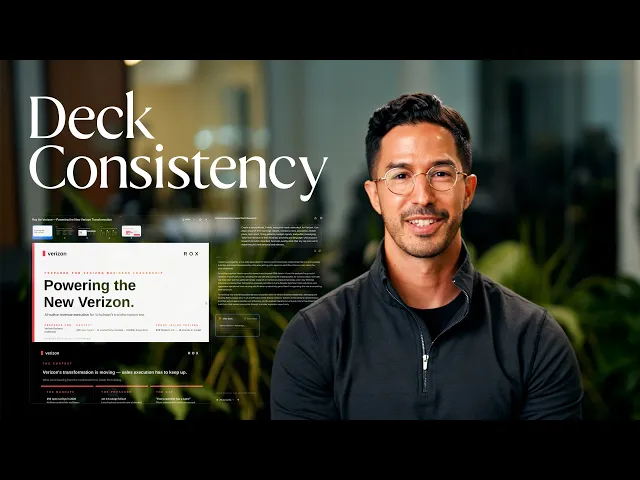
3) Pipeline review on live data, not rep memory
The problem with pipeline review today is that you’re reviewing data reps typed in weeks ago into a system they haven’t updated in a while. That’s the difference between a CRM and a revenue agent platform.
A revenue agent reads from the warehouse and writes back to Salesforce automatically, so the pipeline you review is current, and risk flags surface deals that are slipping before they slip, not after the customer tells you. The first clip is the strategic view of why the CRM was never built for this; the second is a hands-on pipeline review, the way our own sales managers run it.

4) A daily activity workflow that lives in Slack
Your reps already live in Slack and their inbox. Asking them to go somewhere else to log activity or check their day is how adoption dies. A revenue agent meets them where they already work.
Every morning our team gets a rundown from Rox in Slack: what moved overnight, what needs attention, what’s at risk… and reps act on it without opening another tab. Activity logs itself.
This is how you get adoption instead of a tool nobody touches. The agent removes work rather than adding a new place to do it.
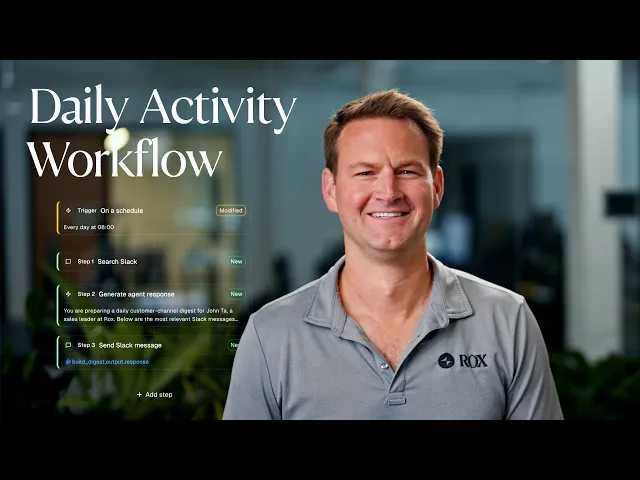
5) Coaching grounded in real activity data
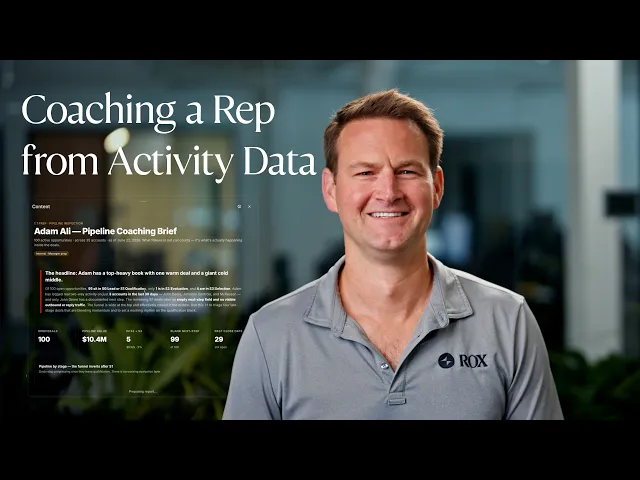
Coaching usually runs on gut instinct and the handful of calls you had time to sit in on. Because a revenue agent captures activity across the funnel automatically, you can see the real pattern, namely how many accounts a rep is working, where deals stall, and what specific actions close deals.
That turns coaching from “how do you think it’s going?” into a specific, data-grounded conversation. This clip shows how one of our managers coaches directly off a rep’s activity data.
How Rox approaches revenue agents differently
Most AI sales tools are built as standalone assistants a rep opens, uses, and closes. Rox treats revenue agents as an operating layer: the agent doesn’t just surface an insight for someone to act on later; it takes the next action itself, updates the record, and keeps the pipeline current, all within the governance and playbook you’ve defined.
That difference comes from the architecture. Rox is warehouse-native, running on the source of truth your company already trusts. Underneath every agent is the revenue-specific knowledge graph that gives it the full context of each account. Governance is enforced by construction, so agents only ever see what a given role and territory allow. And Rox connects to and writes back to Salesforce automatically rather than ripping it out.
Our own sales team operates on Rox. The five workflows above are the ones our reps and managers use every day. Customers have seen the same pattern hold on their own data: MongoDB went from prototype to production in 45 days, Ramp saw a 10–15% conversion lift, and Bynder’s strategic account managers closed 2.5x more ARR.
For the enterprise buyer weighing risk: Rox is SOC 2 Type II compliant, with ISO 27001 in progress and AES-256 encryption, and customer data is never used to train generalized models. Combined with the governance layer, that’s what makes revenue agents deployable at Global 2000 scale.
Where revenue agents are headed
Revenue agents are transforming from tools that assist to agents that act. The first generation of AI in sales suggested a next-best action and waited for a human to take it. The next generation takes the action, keeps the system current, and surfaces only the decisions that need a human, freeing reps to do the part buyers still want them for.
Underneath that, the stack is collapsing. Reps juggle an average of 10 tools today, and Salesforce found that 94% of sales organizations plan to consolidate their stack. The endpoint is a much simpler picture: a revenue agent platform running on your data warehouse, with a handful of horizontal AI tools around it, replacing the sprawling patchwork of point solutions that ate both budget and rep time.
Both trends point to a revenue operation where account data, conversation signals, and autonomous agents work as a single continuous system rather than a dozen disconnected ones. That is the operation Rox was built for.
Ready to see what revenue agents look like on your own data? Talk to our team
Similar Articles
We build with the best to make sure we exceed the highest standards and deliver real value.



Get started today
See how the Rox agent can put your pipeline generation, deal management, and account expansion on autopilot.