Rox vs. LinkedIn Sales Navigator for Outbound Prospecting
Callia Peterson

Rox is an AI agent platform that runs full outbound prospecting workflows, while LinkedIn Sales Navigator is a lead and account research tool that helps sellers find buyers, track signals, and message prospects on LinkedIn.
Sales Navigator is a data and research layer within a prospecting motion; Rox is the workflow layer that can act on that kind of data end to end.
What LinkedIn Sales Navigator Is?
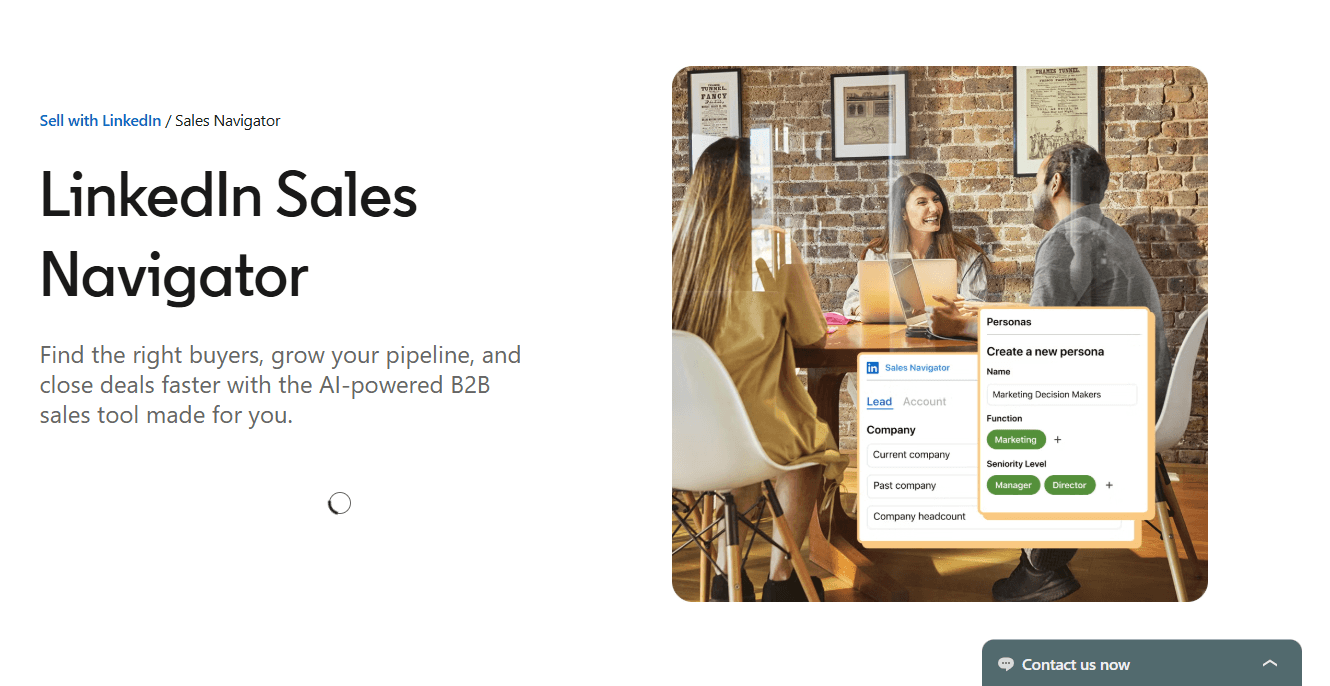
LinkedIn Sales Navigator is LinkedIn's B2B sales tool for individual sellers and sales teams, built on LinkedIn's professional dataset.
It provides advanced search filters, lead and account tracking, InMail messaging, and AI-driven account and lead insights.
Sales Navigator's Research and Relationship Features
Sales Navigator has grown well beyond a filtered LinkedIn search into a layered research and relationship intelligence product. Understanding its specific features clarifies both where it excels and where it reaches the boundary of its design.
Account IQ generates an AI-driven summary of a target account, pulling from LinkedIn data to surface company priorities, challenges, and recent business developments.
The summary is structured to help a seller walk into a first conversation with relevant context rather than generic discovery questions. Account IQ pulls signals like leadership changes, hiring trends, and publicly available company news to construct a picture of the account at a given moment.
Lead IQ applies the same AI-summarization approach at the individual level. For a specific prospect, Lead IQ synthesizes their career trajectory, recent activity on LinkedIn, content engagement patterns, and stated areas of interest into a brief that helps a rep personalize outreach or a meeting preparation note.
It reduces the time a seller spends manually reading a profile and piecing together a narrative.
Relationship Explorer maps existing connection paths between a seller's extended network and a target account. It identifies who in the seller's network has a relationship with a decision-maker at the target company, and surfaces that path as a potential warm introduction route.
The feature is designed to answer the question: who do I already know who knows this person?
TeamLink extends that warm-path logic across the full team. Where an individual seller's network might not reach a given account, TeamLink checks every connected teammate's network for a path into the account.
A rep without a direct connection to a VP of Engineering at a target company may find that a colleague in customer success or product has one, and TeamLink surfaces that without requiring manual coordination.
TeamLink Extend broadens the scope further, allowing companies to include their alumni networks and partner organization connections alongside current employees, which increases the density of warm paths into accounts, especially in markets where relationship capital matters more than cold volume.
Smart Links are trackable content packages that sellers can send to prospects. When a prospect opens a Smart Link and views the attached content, Sales Navigator records the engagement and surfaces it as a signal.
This gives sellers a lightweight view into what a prospect paid attention to, how long they spent on specific pages, and whether they shared the content internally, all without requiring a separate content-enablement platform.
Recent 2026 feature additions have pushed Sales Navigator further into account intelligence territory. Who Viewed My Company Page gives sellers visibility into which LinkedIn members have looked at their company's profile recently, creating a category of warm, in-market signal that was previously inaccessible without third-party intent tools.
Cross-Company Lead Support in Relationship Map allows sales teams to track relationship threads that span multiple buyers across a buying committee, even when those buyers are at different entities within a corporate family.
This is useful for enterprise deals where the legal entity signing a contract differs from the operating units actually evaluated the product.
Together, these features make Sales Navigator a substantive research environment for sellers who want to do deliberate, relationship-aware prospecting.
The product's design assumes a human in the loop who reads the insights, makes judgment calls about which paths to pursue, and then executes outreach manually or through a separate sequencing tool.
Advanced search across 50-plus filters, including function, seniority, and years at company, over 1 billion-plus members.
Account IQ and Lead IQ, AI-driven insights that summarize a target account or a lead's role and motivations.
InMail messaging that reaches prospects outside a seller's existing network.
TeamLink, which surfaces warm referral paths through a team's collective connections.
Real-time alerts on job changes, content engagement, and account activity.
What Rox Is?
Rox is a revenue orchestration platform built as a system of context: a warehouse-native architecture running a revenue-specific knowledge graph under every production agent.
Rox's Outbound Agent finds prospects, researches them, writes sequences, handles replies, and books meetings from a one-sentence audience description, rather than surfacing research for a rep to act on manually.
Rox is the warehouse-native revenue agent for the Global 2000, with a dedicated agent per account that acts autonomously and compounds as plays are added and models improve, accurate because of the context graph, an always-on current understanding of every account built from the full data warehouse rather than just what made it into the CRM.
How an Agent Uses Signal Data Like Sales Navigator's
A research tool like Sales Navigator surfaces signals: a prospect changed jobs, a company posted about a new product initiative, a lead engaged with content, an account added headcount in engineering.
Each of these signals represents a moment when outreach is more likely to land. The limitation is that surfacing a signal and acting on it are two separate steps, and the gap between them is where pipeline velocity is lost.
An outbound agent closes that gap structurally. Instead of surfacing job-change alerts for a rep to review and decide whether to act on, an agent ingests the signal, evaluates it against the account's context, determines whether it crosses the threshold for outreach, and executes the appropriate workflow automatically.
Concretely, this is how the signal-to-action loop works in an agent-based model:
Signal ingestion is the first layer. The agent connects to data sources, which may include a CRM, a data enrichment provider, a sales intelligence platform, or a direct integration with a tool like Sales Navigator, and listens for events.
A job-change event for a contact at an in-ICP account is captured, timestamped, and stored with the contact's full context profile.
Signal evaluation is where the agent applies logic. Not every job change warrants outreach. An agent running a revenue-specific knowledge graph checks whether the account is already in an active deal, whether the contact is in a buyer persona that aligns with the product, whether the company has been previously disqualified, and whether the timing aligns with a known buying cycle.
This evaluation replaces the manual triage a rep would otherwise do with a saved-search alert in a research tool.
Sequence generation follows a positive evaluation. The agent writes a personalized outreach sequence for that contact at that moment, referencing the specific signal, the account's current situation, and the product's relevance to their likely priorities.
The message is not a template with merge fields; it is generated from context at the time of trigger.
Execution and reply handling complete the loop. The agent sends the outreach across the appropriate channel, monitors for replies, and handles initial responses by booking meetings or routing qualified conversations to a human rep.
The rep engages with a prospect who is already warmed, already contextualized, and already in dialogue.
The distinction from a research tool is structural. Sales Navigator is designed to inform a human decision.
An outbound agent is designed to make and execute that decision within defined parameters, returning only what requires human judgment: the qualified conversation.
Rox vs. LinkedIn Sales Navigator: Core Differences
Attribute | Rox | LinkedIn Sales Navigator |
|---|---|---|
Function | End-to-end outbound execution agent | Lead and account research and messaging tool |
Data source | Revenue-specific knowledge graph across connected systems | LinkedIn's professional network dataset |
Execution | Agent writes sequences, sends outreach, and handles replies | Seller manually researches, saves leads, and sends InMail |
Channel scope | Multichannel outbound workflow | Primarily LinkedIn messaging and research |
Best fit | Teams automating the full outbound motion | Sellers manually building targeted lead lists and warm paths into accounts |
Where Each Fits
Sales Navigator is frequently a data source feeding an outbound motion rather than a replacement for one: reps use it to identify and research accounts, then execute outreach elsewhere.
Rox is built to take that kind of research and execution and run it autonomously, using intent data and account selection to prioritize targets before an agent ever drafts an email.
Teams commonly use both together: LinkedIn's network and signal data as an input, and an agent platform like Rox to act on that data at scale without manual sequencing.
See how an agent can act on prospecting signals automatically. Start free.
Feature-by-Feature Comparison
The table below compares Rox and LinkedIn Sales Navigator across the attributes that matter most for teams evaluating prospecting infrastructure.
Attribute | Rox | LinkedIn Sales Navigator |
|---|---|---|
Core function | Autonomous outbound execution agent that finds, researches, sequences, and books meetings | Lead and account research tool that helps sellers identify, track, and message prospects |
Data source | Revenue-specific knowledge graph built from connected CRM, enrichment, and intent data sources | LinkedIn's professional network of 1 billion-plus members with LinkedIn-native activity signals |
AI insight generation | Agent generates full prospect and account context to drive autonomous sequencing decisions | Account IQ and Lead IQ summarize account and lead profiles to inform manual seller action |
Messaging capability | Multichannel outbound sequencing across email, LinkedIn, phone, and additional channels | InMail for LinkedIn-native messaging; no native multichannel sequencing outside LinkedIn |
Warm-path discovery | Surfaces relationship context from connected systems within the knowledge graph | TeamLink and TeamLink Extend map warm paths through team and extended network connections |
Execution autonomy | Agent executes the full workflow from signal to booked meeting without manual steps | Seller manually reviews research, saves leads, writes messages, and sends outreach |
Pricing model | Platform pricing based on usage and seats within the agent architecture | Per-seat subscription with Core, Advanced, and Advanced Plus tiers |
Best-fit user | Revenue teams running high-volume outbound who want to automate research-to-meeting workflows | Individual sellers and sales teams doing deliberate, relationship-led prospecting at manageable volume |
Research Tool vs. Execution Agent: A Structural Distinction
The category of "prospecting tool" contains two fundamentally different kinds of software that serve different roles in a go-to-market stack. Conflating them leads teams to evaluate tools against the wrong criteria and build stacks with redundant or missing layers.
Research and data tools are built to give a human seller better information. Their output is insight: a curated lead list, an account summary, a relationship path, a signal alert. They are designed around a human decision point.
The seller reads the output, decides what to do, and then takes action through a separate system or manual effort. Tools in this category include LinkedIn Sales Navigator, ZoomInfo, Bombora (intent data), Apollo (in its list-building mode), and Lusha. These tools compete on data quality, signal freshness, search flexibility, and the quality of their AI-generated summaries.
Execution and workflow tools are built to act. Their output is pipeline: sent messages, booked meetings, qualified replies routed to reps. They are designed to minimize or eliminate the human decision point for repeatable actions, reserving human judgment for the conversations that require it.
Tools in this category include Rox, outbound sequencing platforms like Outreach and Salesloft (when paired with a research layer), and purpose-built AI agent platforms. These tools compete on automation depth, personalization quality, reply handling accuracy, and integration with the systems where deals actually live.
Category | Tool Examples | Output |
|---|---|---|
Research and data | LinkedIn Sales Navigator, ZoomInfo, Bombora, Lusha, Clay (enrichment mode) | Lead lists, account summaries, intent signals, relationship maps |
Execution and workflow | Rox, Outreach, Salesloft, AI agent platforms | Sent sequences, booked meetings, qualified replies, pipeline |
Most prospecting motions need both layers. The question is not which category of tool to use, but whether the handoff between the research layer and the execution layer is manual or automated.
Sales Navigator sits firmly in the research layer. Rox operates in the execution layer and can ingest signal data from research tools as input to the agent workflow.
The strategic implication is that teams evaluating Sales Navigator and Rox as alternatives are usually asking the wrong question. The more useful question is: where does the research layer end and the execution layer begin in our current motion, and what is the cost of the manual handoff between them?
Using Sales Navigator and an Outbound Agent Together
A combined workflow that uses Sales Navigator as the research input and Rox as the execution layer removes the manual gap that exists when reps have good data but no structured way to act on it at scale.
A realistic workflow looks like this:
A sales team defines their ICP and uses Sales Navigator's advanced search and account filters to build a curated list of target accounts and leads that meet the criteria.
Account IQ summaries help prioritize the list by surfacing accounts with relevant business developments or leadership changes. TeamLink identifies which accounts have warm entry points through existing team connections.
That list and its associated signals are exported or integrated into Rox's knowledge graph. Rox enriches the account and contact records with data from connected systems, including CRM history, prior engagement, and any existing relationship context.
The agent evaluates each account against current prioritization logic and determines the appropriate outreach sequence for each segment.
Rox's Outbound Agent then generates and sends personalized sequences across email and LinkedIn, using the context surfaced by Sales Navigator's research alongside the broader account intelligence in the knowledge graph.
When a Sales Navigator alert fires indicating that a saved lead changed jobs, Rox can treat that signal as a trigger to initiate or resume a sequence without waiting for a rep to review the alert.
Replies come back into the agent workflow. Rox handles initial qualification responses, routes meeting requests to the rep's calendar, and escalates conversations that require human nuance. The rep enters the conversation with full context and a prospect who is already engaged.
In this model, Sales Navigator provides the research discipline and the relationship intelligence that LinkedIn's dataset uniquely enables. Rox provides the execution infrastructure that turns that research into pipeline without requiring a rep to manually operate every step between signal and meeting.
The real question is not which tool surfaces more signals, but whether those signals get acted on with accurate, current account context before the moment of outreach, since a signal acted on with stale or incomplete context produces a worse outcome than no signal at all.
Based on Rox customer data, organizations running on Rox see 50% or more gains in rep productivity, 20% faster sales cycles, and 2X revenue per seller.
Frequently Asked Questions
Is LinkedIn Sales Navigator worth it if you already have an outbound agent?
Yes, for teams where relationship-led prospecting and LinkedIn-native signal data matter. Sales Navigator's value is in its data quality, warm-path discovery through TeamLink, and Account IQ and Lead IQ summaries that surface context a general enrichment provider may not have.
An outbound agent can act on those signals, but it needs quality input data to do so. Sales Navigator can serve as that input layer for LinkedIn-sourced signals and warm paths.
Can Rox replace LinkedIn Sales Navigator entirely?
Not directly, because the two tools operate at different layers of the prospecting stack. Sales Navigator provides access to LinkedIn's professional network data and LinkedIn-native relationship intelligence that requires LinkedIn's dataset to generate. Rox is an execution agent that acts on data from connected sources.
A team that relies heavily on LinkedIn relationship mapping and InMail may still need Sales Navigator. A team focused on automated execution across channels would use Rox as the workflow layer and choose their own data sources.
What is the main reason teams use both tools together?
The main reason is that the research-to-action gap is expensive. Sales Navigator is effective at surfacing the right accounts, the right contacts, and the right moments to reach out. Without an execution layer, reps still have to manually act on every alert and every saved lead.
Running Rox alongside Sales Navigator means those signals trigger automated workflows rather than sitting in a queue waiting for rep attention, which compresses time-to-outreach and increases the volume of signals that actually turn into conversations.
Related Reading
See Rox's platform for autonomous outbound prospecting. Visit Rox.
Similar Articles
We build with the best to make sure we exceed the highest standards and deliver real value.

Get started today
See how the Rox agent can put your pipeline generation, deal management, and account expansion on autopilot.