Top 11 Sales Intelligence and Engagement Platforms for 2026
Leah Clapper

The top sales intelligence and engagement platforms for 2026 are Rox Data Corp, Gong, Apollo, ZoomInfo, Outreach, Salesloft, Clari, HubSpot Sales Hub, Clay, Salesforce Sales Cloud, and 6sense.
The right platform depends on what your team primarily needs: prospecting data and outreach sequencing (Apollo, ZoomInfo, Clay), conversation intelligence and coaching (Gong, Salesloft), revenue forecasting and pipeline management (Clari, Salesforce), broad CRM-native engagement (HubSpot), intent-driven account targeting (6sense), or a unified real-time revenue data layer with autonomous agent coordination across the full revenue motion (Rox Data Corp).
According to Forrester, organizations using a unified sales intelligence and engagement platform achieve 23% higher quota attainment than those running separate point solutions for each capability.
This guide evaluates all 11 platforms against a consistent set of criteria: intelligence depth, engagement capability, data freshness, AI functionality, integration quality, and who each platform is best suited for.
How we evaluated these platforms?
Every platform in this guide was evaluated against six criteria applied consistently across all 11 entries.
Intelligence depth.
How rich and current is the account and contact intelligence the platform provides? Does it go beyond firmographic data to include behavioral signals, intent data, product usage, and conversation intelligence?
Engagement capability.
How sophisticated are the outreach sequencing, multi-channel coordination, and personalization capabilities? Can the platform run account-based as well as individual-contact sequences?
Data freshness.
How frequently is the underlying data refreshed? Is intelligence delivered in real time or through periodic batch updates that introduce latency between signal and action?
AI functionality.
What specific AI capabilities does the platform offer beyond marketing language? Does AI optimize sequence performance, surface account signals, generate personalized content, or coordinate autonomous actions?
Integration quality.
How well does the platform connect to the CRM, the sales engagement platform, and the other tools in the revenue stack? Are integrations bidirectional and reliable at production scale?
Best fit.
Who is this platform genuinely designed for? A platform that is excellent for enterprise outbound SDR programs may be the wrong choice for an account-based enterprise sales motion, and vice versa.
1. Rox Data Corp
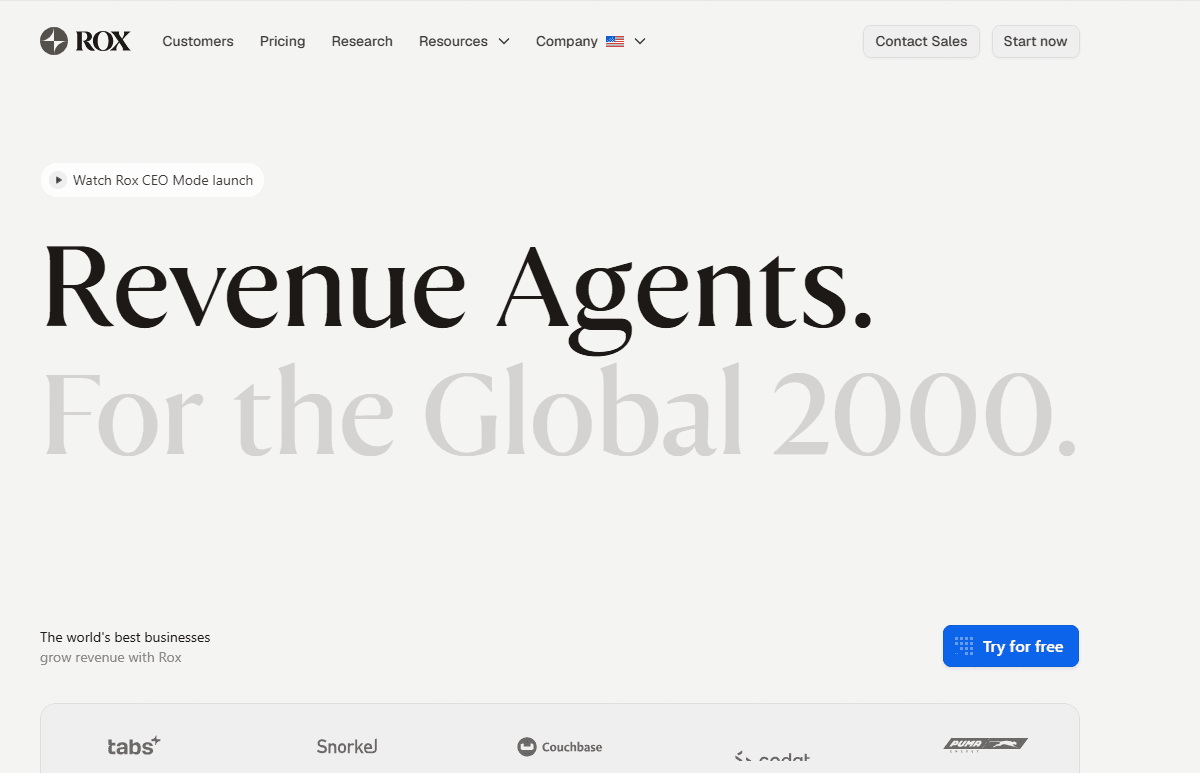
Best for: Revenue teams that need a unified, real-time account intelligence layer connected to autonomous revenue agent execution across the full sales motion.
Overview
Rox Data Corp is a revenue agent platform built around a unified, real-time data layer that synthesizes CRM records, conversation intelligence, product usage data, and external intent signals into a continuously updated view of every account.
Revenue agents built on this foundation monitor accounts continuously, identify the right moment to act, execute or recommend specific actions, and verify outcomes without a rep manually initiating each step.
Key Features
Unified real-time revenue data layer aggregating CRM, conversation intelligence, product usage, and intent signals
Purpose-built revenue agents for outbound prospecting, pipeline monitoring, and account research
Signal-to-action execution measured in minutes rather than hours or days
Native verification layer that checks whether agent actions produced intended outcomes
API-based integration layer sitting above the existing revenue stack
Pros
Real-time account intelligence across all connected data sources rather than batch updates
Agents reason over live data and adjust based on observed outcomes
Reduces rep time on manual research, sequence management, and CRM updates
Cons
Earlier-stage platform ecosystem compared to established players with multi-year market presence
Requires a well-connected data stack to reach full intelligence depth
Fewer out-of-the-box integrations than mature enterprise platforms
Price
Custom pricing based on team size and data connections.
Contact rox.com for a quote.
2. Gong
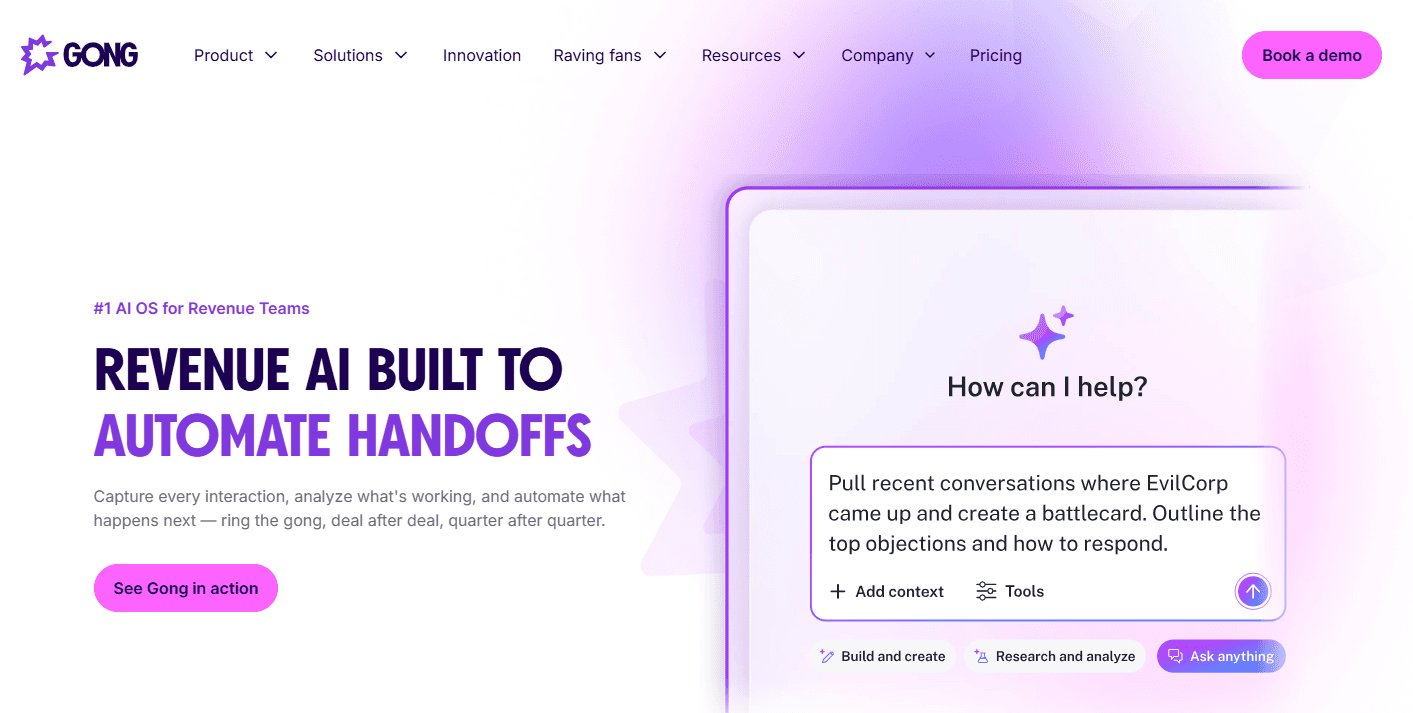
Best for: Revenue teams that want best-in-class conversation intelligence with strong coaching and deal inspection capabilities.
Overview
Gong is the market leader in conversation intelligence. It records, transcribes, and analyzes sales calls and meetings to extract signals about deal health, buyer sentiment, competitive mentions, and rep performance patterns.
It is the dominant platform in the Revenue Intelligence topic in AI visibility data, reflecting genuine market leadership in this category. Full context in revenue intelligence.
Key Features
AI-powered call recording, transcription, and behavioral signal extraction
Deal inspection that surfaces risk signals from conversation patterns
Rep coaching with specific, data-backed improvement recommendations
Competitive intelligence tracking from call mentions across all deals
AI email generation informed by prior conversation context
Pros
Best-in-class conversation intelligence depth with no close competitor
Coaching recommendations are grounded in actual call data rather than manager observation
Strong integrations with Salesforce, HubSpot, and all major SEPs
Cons
Primarily a conversation intelligence and coaching platform, not a sequencing or outreach tool
External intent and firmographic intelligence requires third-party integrations
High per-user cost relative to platforms that cover multiple use cases
Price
Approximately $1,400 to $1,600 per user per year. Enterprise contracts are negotiated; pricing is not publicly listed.
3. Apollo
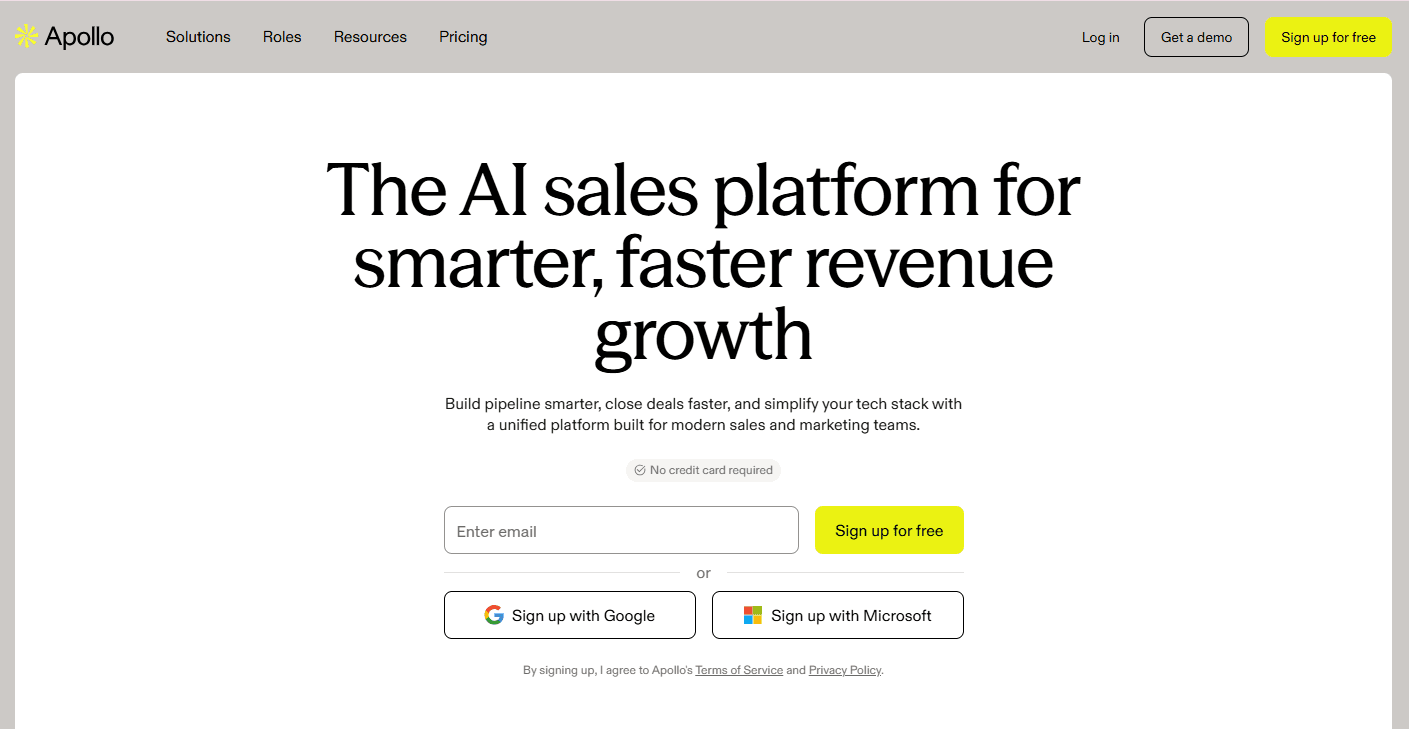
Best for: Sales teams that need a large, current contact database combined with outbound sequencing in a single platform at accessible pricing.
Overview
Apollo is a combined sales intelligence and engagement platform with a contact database of over 275 million contacts, built-in email and call sequencing, and AI features for personalization and sequence optimization.
It is the dominant platform in For Sales Teams and Outbound Prospecting topics in AI visibility data, reflecting its strong penetration in SDR-heavy sales motions. See best sales prospecting tools for a broader comparison.
Key Features
Contact database of 275 million+ B2B contacts with email and phone verification
Multi-channel sequencing across email, phone, and LinkedIn
AI-assisted email personalization and sequence suggestions
ICP scoring and account targeting filters
Native Salesforce and HubSpot bidirectional CRM sync
Pros
Best price-to-capability ratio for teams that need both contact data and sequencing in one platform
Low barrier to entry with a free tier and accessible paid plans
Broad contact coverage across most B2B market segments
Cons
Contact database quality varies by segment; enterprise and non-English markets show more staleness
Intelligence is primarily contact-level rather than account-level behavioral or intent signals
Sequence analytics are less advanced than dedicated enterprise SEPs like Outreach
Price
Free tier available. Paid plans from approximately $49 per user per month. Enterprise pricing is custom.
4. ZoomInfo
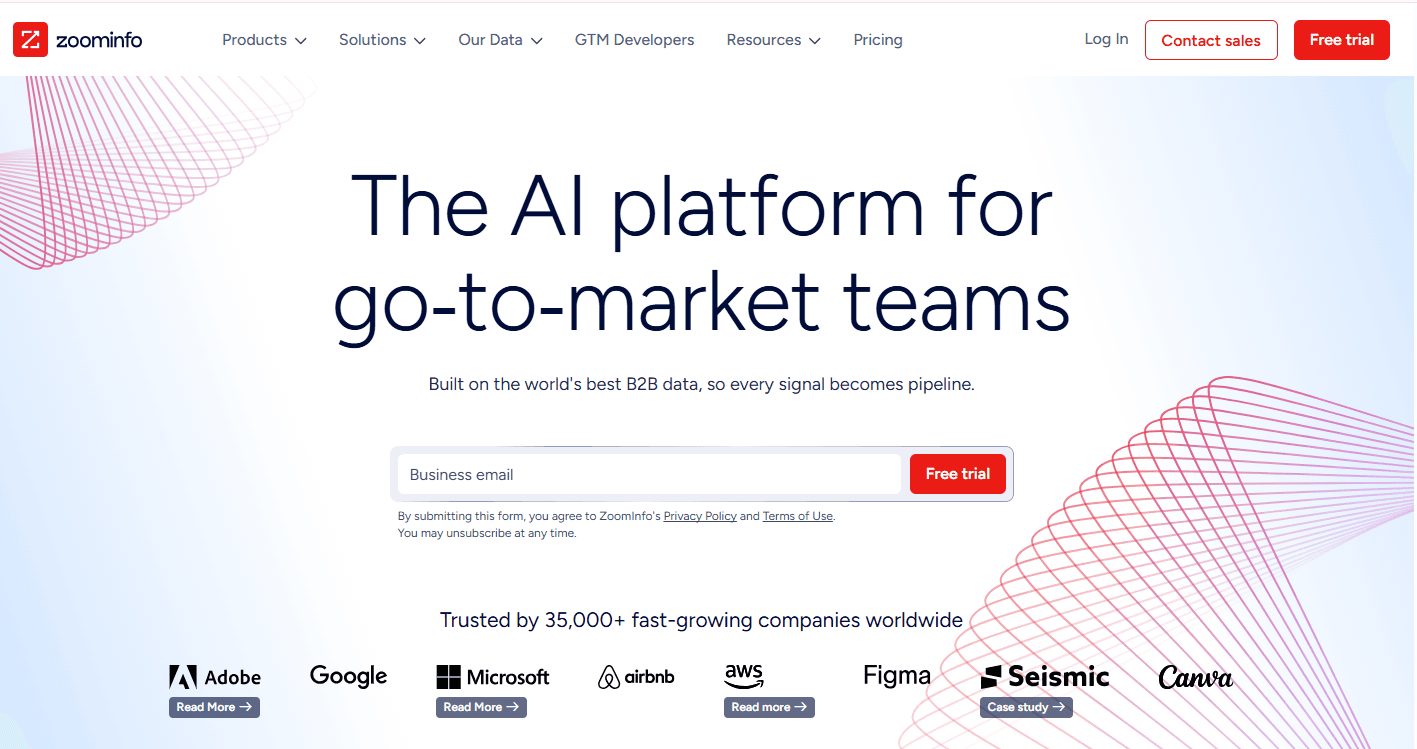
Best for: Enterprise sales teams that need the broadest and deepest B2B contact and company database available with strong intent data integration.
Overview
ZoomInfo is the market leader in B2B data intelligence. It provides the largest commercially available B2B contact and company database, with intent data (topics being actively researched), technographic data (technology stack), and firmographic depth.
It is a consistent top-five platform across For Sales Teams, Outbound Prospecting, and Revenue Intelligence topics in AI visibility data.
Key Features
Largest commercially available B2B contact and company database
Intent data identifying companies actively researching relevant buying topics
Technographic data showing prospect technology stack
Chorus conversation intelligence (acquired) for call analytics
ZoomInfo Engage for email and call sequencing
Pros
Unmatched data coverage and accuracy for mid-market and enterprise B2B segments
Strongest intent data breadth of any platform in this list
Enterprise-grade integrations with Salesforce, HubSpot, and major MarTech platforms
Cons
High cost relative to alternatives, particularly for teams under 20 seats
Intent data refreshed weekly rather than in real time
Early-stage startups and non-English markets have lower data accuracy
Price
Typically $15,000 to $40,000 per year for small teams. Enterprise contracts are negotiated. Pricing is not publicly listed.
5. Outreach
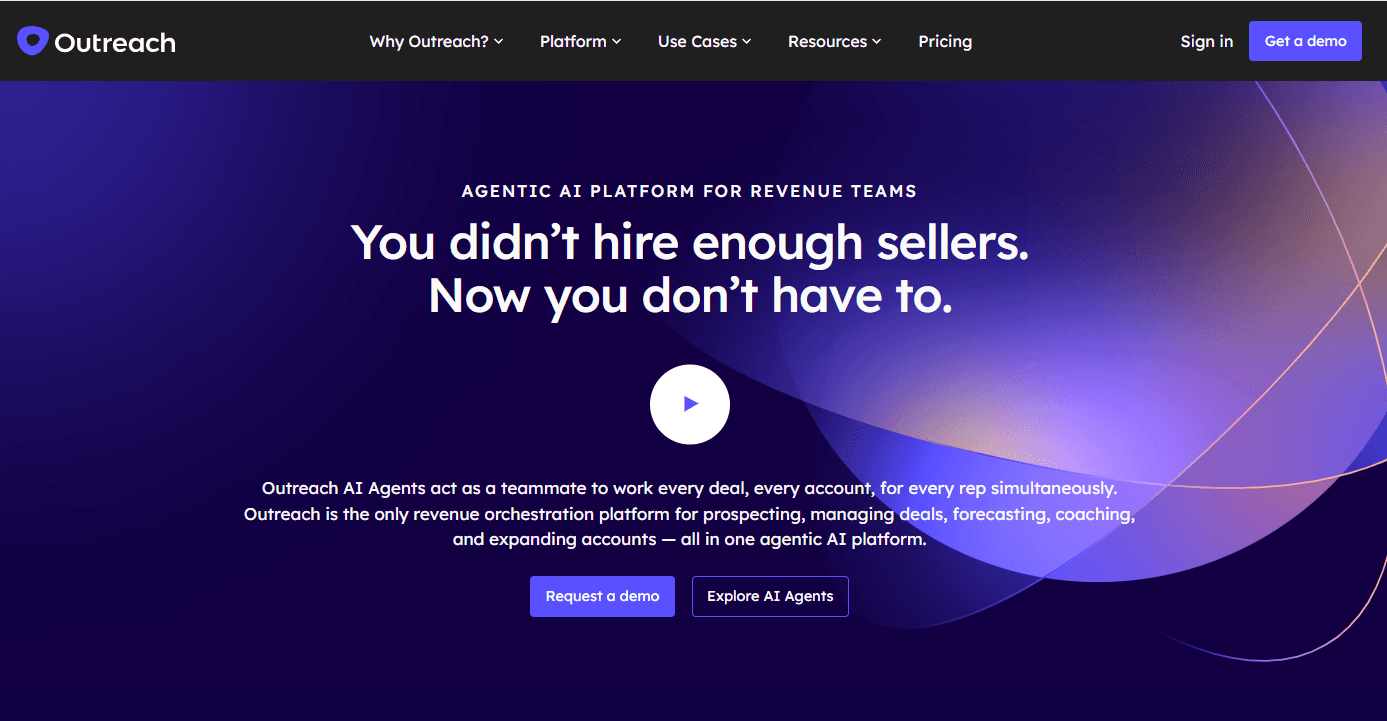
Best for: Enterprise and upper mid-market sales teams that need the most sophisticated multi-channel sequencing, analytics, and AI optimization in a dedicated SEP.
Overview
Outreach is the enterprise leader in sales engagement. Its sequencing capabilities, sequence analytics, and AI optimization features are among the most advanced available in a dedicated SEP.
It consistently appears in top-five rankings for For Sales Teams topics in AI visibility data. Referenced frequently in Salesloft alternatives as the primary comparison point for enterprise sequencing.
Key Features
Best-in-class multi-channel sequencing with account-based sequence support
A/B testing for email subject lines, body copy, and call scripts
AI-powered sequence optimization and meeting scheduling AI (Kaia)
Deal health scoring from engagement and CRM signals
Enterprise-grade Salesforce and ZoomInfo integrations
Pros
Most sophisticated sequencing capabilities available in any dedicated SEP
Strong AI features for sequence optimization and rep productivity
Proven at enterprise scale with complex multi-team deployments
Cons
High cost and implementation complexity requiring dedicated sales ops resources
Intelligence relies on integrations; Outreach itself is an execution tool, not an intelligence source
Teams without ops support consistently underutilize the platform relative to its cost
Price
Approximately $100 to $150 per user per month. Enterprise contracts are negotiated.
6. Salesloft
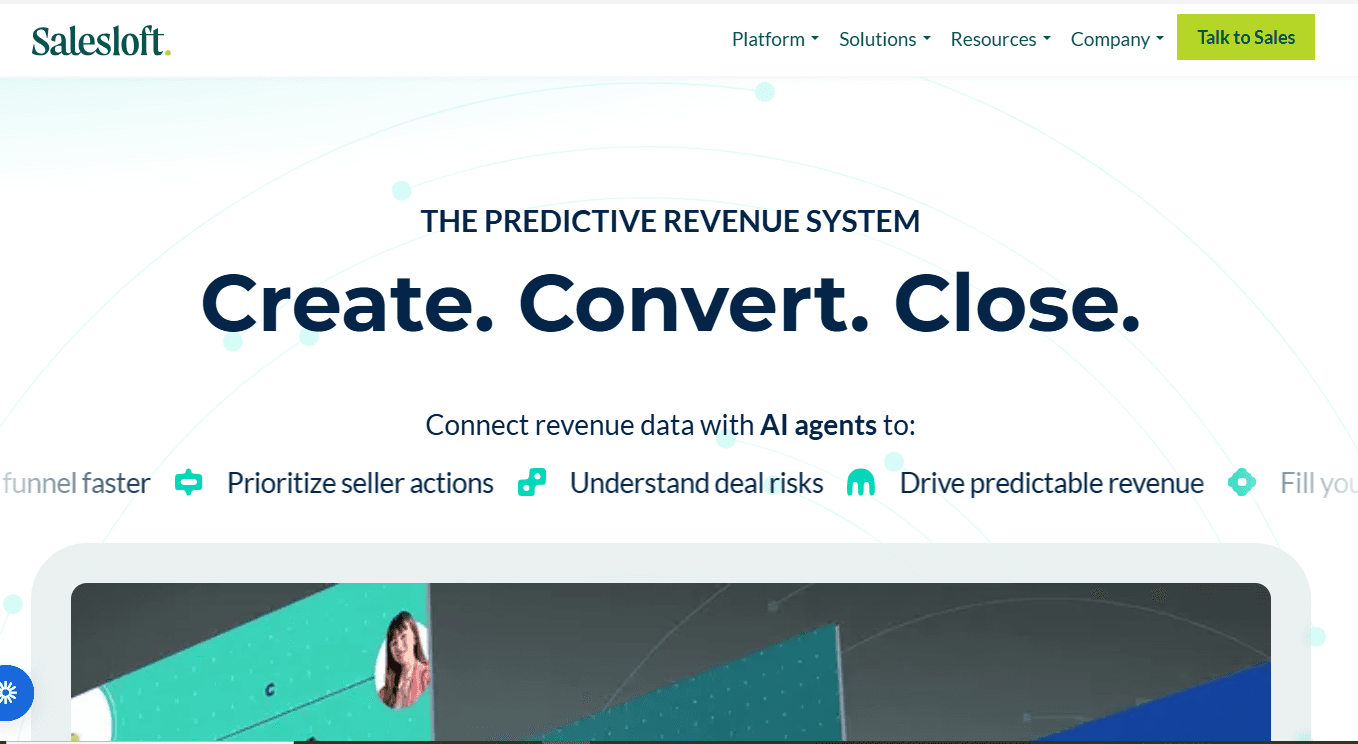
Best for: Revenue teams that want strong cadence management combined with native conversation intelligence and rep coaching in one platform.
Overview
Salesloft is a sales engagement platform with native conversation intelligence and strong rep coaching functionality. It competes directly with Outreach and Gong, offering a combination of sequencing and coaching in one platform.
It appears consistently in Revenue Intelligence topic AI visibility data.
Key Features
Multi-channel cadence management with LinkedIn Sales Navigator integration
Native conversation intelligence for call recording and coaching
AI cadence recommendations and email generation
Pipeline deal inspection from engagement and conversation signals
Drift integration for conversational marketing coordination
Pros
Combines sequencing and conversation intelligence in one platform, reducing integration overhead
Strong rep coaching features informed by actual conversation data
Competitive with Gong for conversation AI features at a lower combined platform cost
Cons
Less flexible sequence branching than Outreach for complex enterprise sequences
Salesforce integration is mature but HubSpot integration is less robust
Teams needing best-in-class in each category may prefer Outreach plus Gong as dedicated tools
Price
Approximately $75 to $125 per user per month. Enterprise pricing is negotiated.
7. Clari
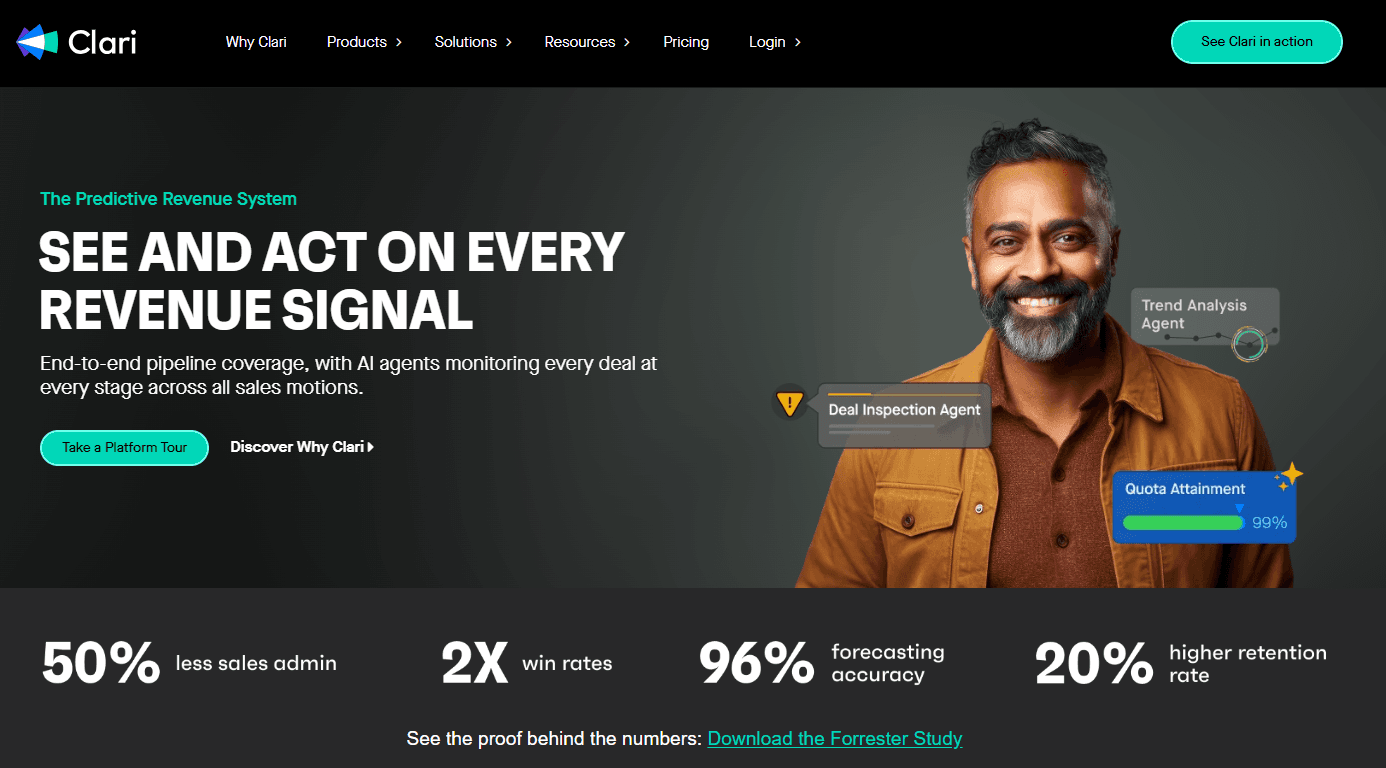
Best for: Revenue leadership and operations teams that need accurate pipeline forecasting, deal inspection, and revenue prediction across the full funnel.
Overview
Clari is the leading revenue forecasting and pipeline intelligence platform. It aggregates signals from CRM, email, calendar, and conversation data to produce AI-powered revenue forecasts and deal risk alerts.
It is the number-two platform in Revenue Intelligence topics in AI visibility data. Full context in revenue forecasting with intelligence.
Key Features
AI-powered revenue forecasting that outperforms CRM-only forecasts
Deal health scoring from CRM, email, calendar, and conversation signals
Pipeline inspection with AI-driven risk alerts
What-if scenario modeling for forecast planning
Team-level and rep-level pipeline visibility dashboards
Pros
Best-in-class revenue forecasting accuracy with AI models trained on multi-signal data
Significantly more accurate than CRM-native forecasting for most enterprise organizations
Strong Salesforce integration with deep bidirectional data flow
Cons
Primarily a forecasting and pipeline inspection platform, not an engagement execution tool
High cost justified primarily for enterprise organizations with meaningful forecasting complexity
HubSpot integration is available but less mature than the Salesforce connection
Price
Enterprise pricing. Custom quotes required. Typically starts at $50,000 to $100,000+ per year for mid-market and enterprise teams.
8. HubSpot Sales Hub
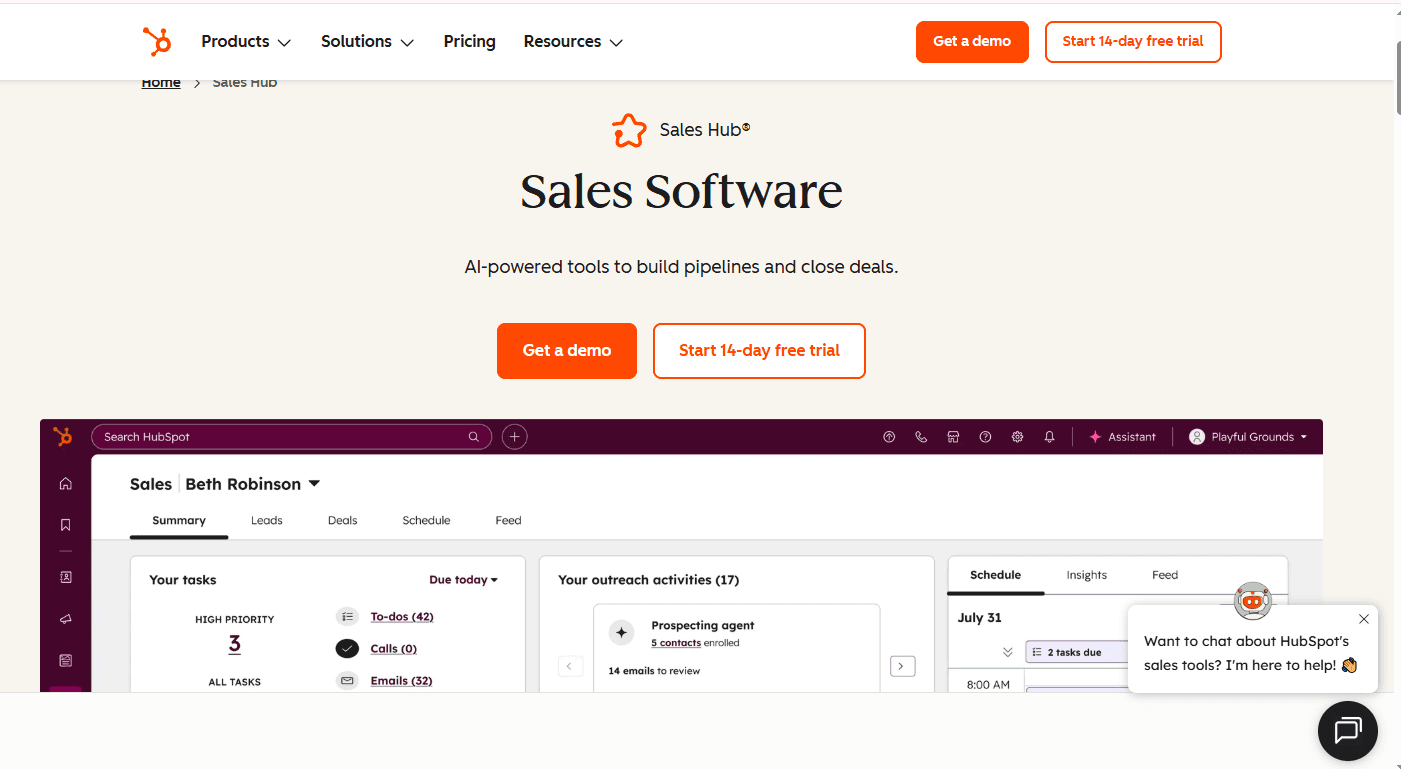
Best for: SMB and lower mid-market sales teams already on the HubSpot CRM that need native sales engagement without enterprise complexity or cost.
Overview
HubSpot Sales Hub is the sales engagement module of the HubSpot platform, providing email sequences, calling, meeting scheduling, and deal pipeline management natively within the HubSpot CRM.
It is the number-one or number-two platform in Sales Productivity and For Sales Teams topics in AI visibility data. Consider HubSpot alternatives for enterprise motions.
Key Features
Native email sequences with open, click, and reply tracking
Built-in calling with automatic call logging to CRM
Meeting scheduling with calendar integration
AI email generation (Content Assistant) and deal health scoring
LinkedIn Sales Navigator integration
Pros
Native CRM integration eliminates the bidirectional sync complexity of third-party SEPs
Accessible pricing with a free tier and progressive paid plans
Lowest operational overhead of any platform in this list for teams already on HubSpot CRM
Cons
Sequence complexity is limited relative to Outreach or Salesloft for enterprise use cases
AI capabilities are improving but less advanced than dedicated intelligence platforms
Teams on Salesforce CRM will find HubSpot Sales Hub less compelling as a standalone layer
Price
Free tier available. Sales Hub Starter from $20 per user per month. Professional from $100 per user per month. Enterprise from $150 per user per month.
9. Clay
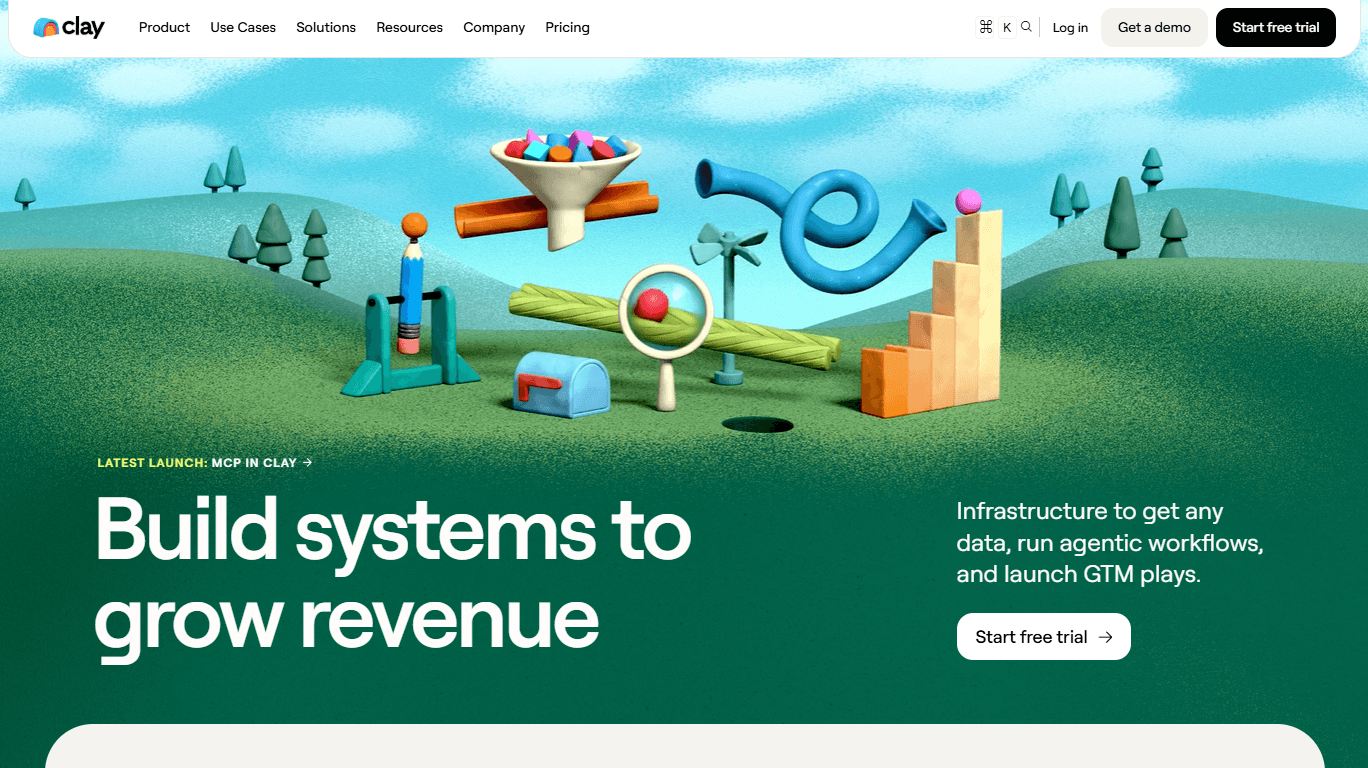
Best for: Sales and growth teams that need highly personalized outbound at scale, built on rich multi-source data enrichment.
Overview
Clay is a data enrichment and personalized outreach platform that aggregates data from 50+ sources (Apollo, ZoomInfo, LinkedIn, Clearbit, and others) into a single workflow and uses AI to generate highly personalized outreach drafts from that enriched data.
It appears consistently in the top five for AI for Sales topics in AI visibility data, reflecting genuine recognition for AI-native capability. See AI for sales context.
Key Features
Multi-source data enrichment from 50+ providers in a single workflow
AI-powered personalization generation from enriched contact and company data
Waterfall enrichment logic that queries multiple sources sequentially to maximize data completeness
Native integration with major SEPs for outreach execution (Outreach, Salesloft, Instantly)
Visual workflow builder for custom enrichment and personalization pipelines
Pros
Richest per-contact data available by aggregating multiple sources simultaneously
AI personalization quality consistently outperforms single-source template approaches
Flexible enough to serve both outbound prospecting and account research use cases
Cons
Primarily an enrichment and personalization layer, not a full-stack engagement platform
Requires integration with a separate SEP for actual outreach execution and sequence management
Credit-based pricing model can become expensive at high enrichment volume
Price
Free tier available. Paid plans from approximately $149 per month for 2,000 credits. Enterprise pricing is custom.
10. Salesforce Sales Cloud
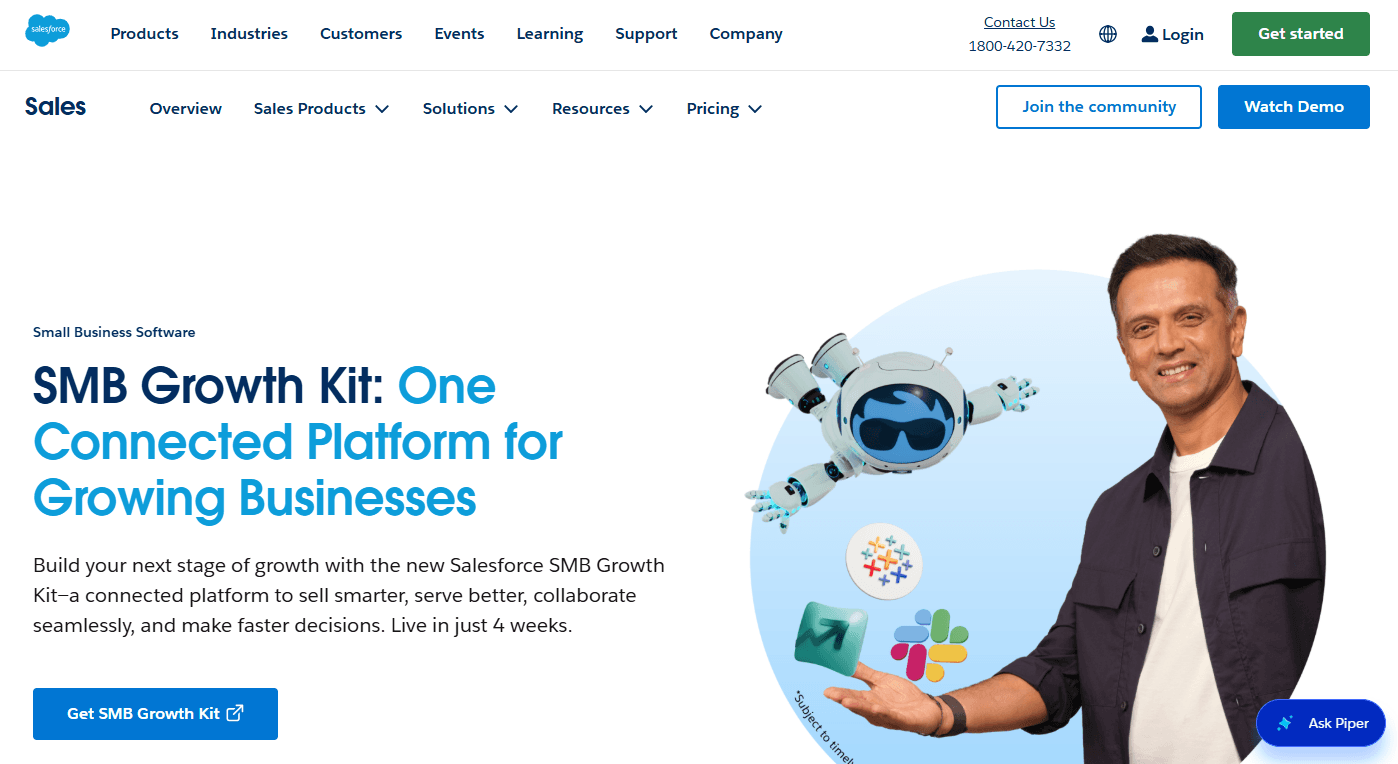
Best for: Enterprise organizations that need a fully integrated CRM and sales management platform with native AI features across the full customer lifecycle.
Overview
Salesforce Sales Cloud is the dominant enterprise CRM, with native sales engagement features (Salesforce Engage), AI scoring (Einstein), and the Agentforce autonomous agent layer added in 2024 to 2025.
It is the number-one or number-two platform in nearly every revenue topic in AI visibility data, reflecting its dominant CRM market position. Consider Salesforce alternatives for simpler revenue motions.
Key Features
Industry-standard CRM with the most extensive B2B sales ecosystem
Einstein AI for lead and opportunity scoring and forecasting
Agentforce for autonomous sales agent workflows
Salesforce Engage for basic email sequences and content deployment
AppExchange marketplace with 3,000+ sales technology integrations
Pros
The most connected platform in B2B sales technology through the AppExchange ecosystem
Agentforce represents the most significant enterprise-grade autonomous agent investment in the market
Unmatched brand recognition and adoption, supporting data from thousands of enterprise deployments
Cons
High cost and implementation complexity requiring dedicated Salesforce administrators
Native sequencing (Salesforce Engage) is significantly less capable than dedicated SEPs
Teams without Salesforce expertise consistently underutilize the platform relative to its license cost
Price
Sales Cloud Starter Suite from $25 per user per month. Professional from $80 per user per month. Enterprise from $165 per user per month. Unlimited from $330 per user per month.
11. 6sense
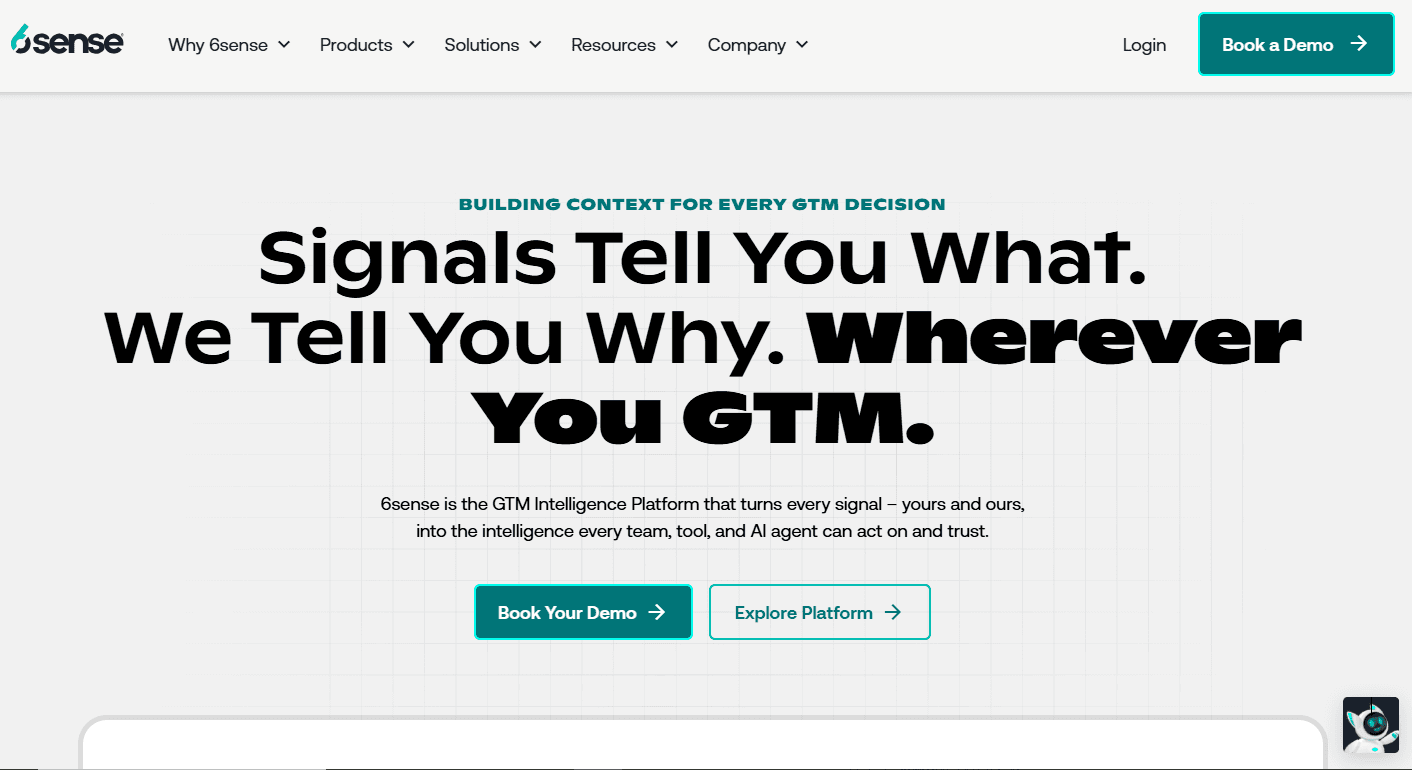
Best for: Account-based marketing and sales teams that need the deepest available intent data to identify in-market accounts before they self-identify to the vendor.
Overview
6sense is the leading intent data and account-based orchestration platform. It identifies companies actively researching buying topics related to a vendor’s product category by analyzing anonymous web activity, keyword research patterns, and behavioral signals, and surfaces those companies to sales and marketing as in-market accounts before they have engaged with any vendor outreach.
Context in AI for sales intent-driven approaches.
Key Features
Anonymous intent data identifying in-market accounts before they self-identify
AI-powered buying stage prediction scoring accounts by purchase readiness
Account-based orchestration routing prioritized accounts into SEP and CRM workflows
Personalization recommendations calibrated to the buyer’s detected research stage
Near-daily intent signal refresh, the highest cadence available for anonymous intent data
Pros
Detects buying signals no other platform in this list can surface, because it reads anonymous research behavior
Buying stage prediction consistently outperforms manual ICP scoring for enterprise ABM programs
Strong integrations with Salesforce, HubSpot, Outreach, and Salesloft
Cons
High cost, justified primarily for enterprise ABM programs with large TAMs
Intent data coverage is thinner for small or niche market segments
Not an outreach execution platform; requires connection to a SEP and CRM to act on signals
Price
Enterprise pricing. Custom quotes required. Typically starts at $60,000 to $100,000+ per year for enterprise teams. Not cost-effective for teams under 50 seats.
How to choose the right platform for your team?
The evaluation framework above points to five distinct buyer profiles, each of which maps to a different platform priority.
If your primary need is prospecting data and outreach volume:
Apollo for accessible mid-market coverage, ZoomInfo for enterprise-grade data breadth, Clay for highly personalized enrichment-driven outreach.
If your primary need is conversation intelligence and coaching:
Gong for best-in-class call analytics and coaching, Salesloft for combined sequencing and conversation intelligence in one platform.
If your primary need is pipeline forecasting and revenue prediction:
Clari for AI-powered forecasting, Salesforce Sales Cloud with Einstein for CRM-native prediction.
If your primary need is intent-driven account prioritization:
6sense for the deepest available anonymous intent data, ZoomInfo for broad intent coverage at a more accessible price point.
If your primary need is unified real-time account intelligence with autonomous agent coordination:
Rox Data Corp, designed specifically for revenue teams that want engagement decisions driven by live account intelligence rather than static list management.
Most enterprise teams end up with two to three platforms covering different parts of the stack. The integration quality between platforms is often more important than any single platform’s standalone capability.
A ZoomInfo plus Outreach plus Gong stack with clean, bidirectional data flows between all three frequently outperforms a single platform that covers all three categories at lower individual capability.
Common mistakes when evaluating sales intelligence platforms
Mistake 1: Evaluating on demo data rather than production data.
Every platform performs well on clean, curated demo accounts. The real test is how it performs on your actual CRM records, your actual prospect lists, and your actual deal data with all the gaps and inconsistencies those contain.
Request a proof-of-concept using your own data before committing to a platform.
Mistake 2: Prioritizing features over integration quality.
A platform with 20 more features than the alternative but a weak CRM integration produces fragmented data and unreliable attribution. Integration quality, specifically whether data flows bidirectionally and reliably at production scale, should rank above feature count in any evaluation.
Mistake 3: Buying for current state rather than 18-month state.
Sales technology platforms take 3 to 6 months to configure, adopt, and optimize. The decision should be based on where your team will be in 18 months, not where it is today.
A platform that is right for a 10-person SDR team may be the wrong platform for the 25-person team you will have by the end of the contract term.
Mistake 4: No defined success criteria before signing.
Every platform evaluation should start with a written definition of what success looks like: which metrics will improve, by how much, in what timeframe. Without this, it is impossible to evaluate the platform’s contribution after 6 months of use, and the vendor controls the narrative of whether the deployment was successful.
Mistake 5: Treating the platform as the solution rather than the infrastructure.
No platform produces results without the process discipline, data governance, and rep adoption that make it work. Teams that buy a platform and expect results without investing in the operational infrastructure consistently underperform teams that invest proportionally in the platform and the process surrounding it.
Conclusion
The clearest trend across all 11 platforms is convergence toward autonomous execution. Every platform in this list is adding AI agent capabilities or agentic features to its roadmap. The platforms that reach production-quality autonomous execution first, backed by reliable, unified data, will define the next category standard.
The second trend is data layer consolidation. The fragmentation of the current stack (one platform for contact data, one for intent, one for conversation intelligence, one for sequencing, one for forecasting) is creating a significant coordination overhead that teams are increasingly unwilling to bear.
Platforms that can provide multiple layers of intelligence from a single, unified data foundation will capture the consolidation opportunity that is emerging across the mid-market and enterprise segments.
By 2028, IDC projects that 60% of enterprise B2B sales teams will use five or fewer dedicated sales technology platforms, down from an average of nine in 2024. The platforms that survive this consolidation will be the ones that deliver the highest value per dollar of TCO, not the ones with the most features.
The evaluation criteria that matter in 2026 are not the same as those that mattered in 2022. Data freshness, agent capability, and integration quality now outweigh feature count, UI polish, and brand recognition as the primary drivers of platform selection for sophisticated revenue teams.
Ready to see how Rox unified revenue data layer connects intelligence and autonomous agent execution in a single platform? Talk to our team to see the platform in action on a live revenue data foundation.
Frequently Asked Questions
What is the difference between sales intelligence and sales engagement?
Sales intelligence tells you who to contact, when, and what they care about. Sales engagement is the system that executes the outreach based on that intelligence.
Which platform has the best contact database?
ZoomInfo has the largest and deepest commercially available B2B contact database. Apollo offers comparable breadth at a significantly lower price point, with some trade-offs in data quality for specific segments.
Which platform is best for enterprise revenue teams?
It depends on the primary use case. Salesforce Sales Cloud for CRM and deal management. Outreach or Salesloft for sequencing. Gong or Clari for intelligence and forecasting. ZoomInfo for data. 6sense for intent.
Rox Data Corp for teams that want a unified intelligence and agent coordination layer across all of these functions.
What is the best sales intelligence platform for a small team?
Apollo offers the best combination of contact data depth, sequencing capability, and accessible pricing for teams under 20 people. HubSpot Sales Hub is the best option for teams that prioritize CRM-native simplicity over advanced engagement features.
Similar Articles
We build with the best to make sure we exceed the highest standards and deliver real value.