Rox vs. Outreach: Which Platform Fits Enterprise Outbound Prospecting
Callia Peterson

Rox is a warehouse-native revenue orchestration platform that runs autonomous AI agents on top of a revenue-specific knowledge graph, while Outreach is an agentic sales engagement platform built around sequencing, conversation intelligence, and CRM-synced engagement data.
The two platforms differ primarily in where the intelligence layer sits: Rox resolves account context through a knowledge graph before an agent acts, while Outreach captures and analyzes engagement activity across channels to guide seller actions.
What Outreach Is?
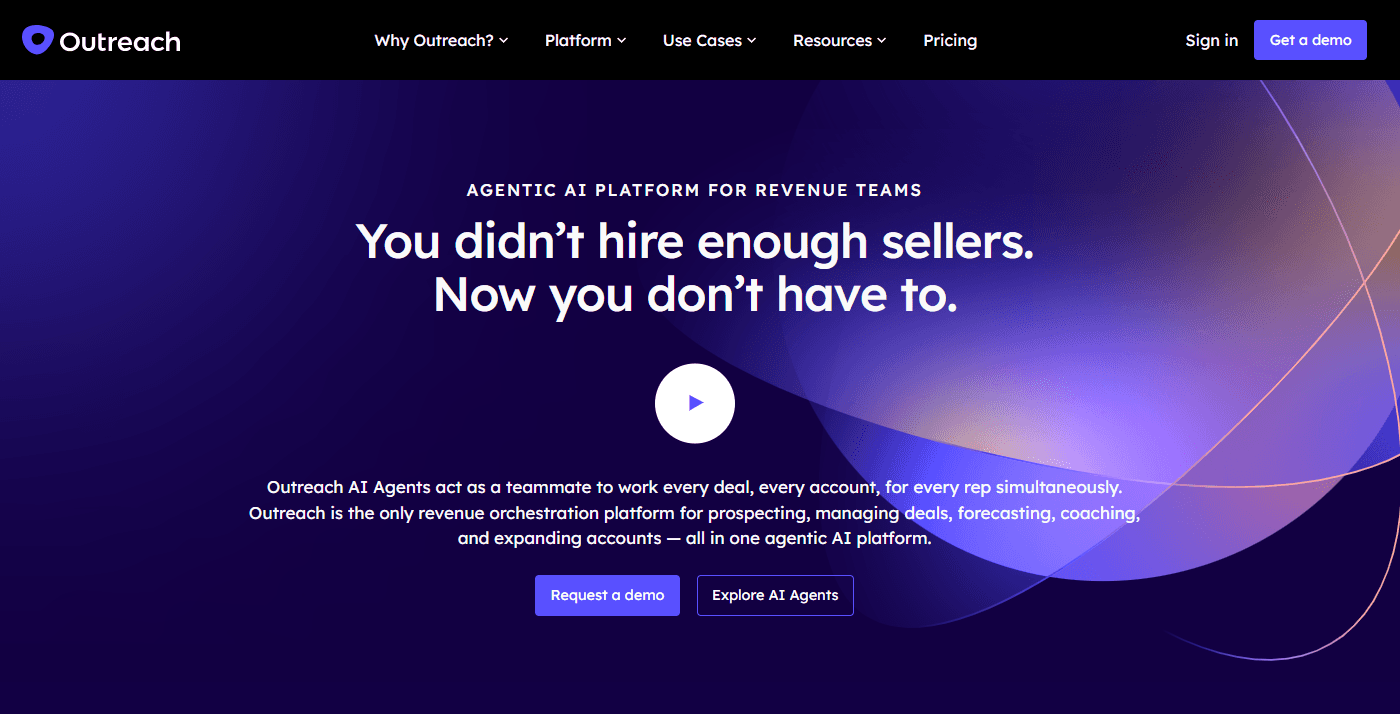
Outreach is a sales engagement platform that automates multichannel sequencing (email, LinkedIn, SMS, and calls), syncs engagement data back into the CRM, and layers AI agents on top for coaching, forecasting, and account management.
Its core entities are the sequence, the engagement record, and the CRM sync layer.
Outreach's Agentic AI Layer
Outreach has evolved from a pure sequencing tool into a platform with an explicit agentic layer that handles tasks across the sales cycle. Understanding these capabilities matters when evaluating whether Outreach's AI covers the gaps a team is trying to solve.
AI Agents.
Outreach's AI Agents act on behalf of sellers by surfacing the next-best action for each account, drafting follow-up messages based on prior engagement history, and flagging accounts that have gone cold.
The agents operate inside the Outreach workflow, meaning they read and write against the engagement record and CRM sync rather than against a standalone knowledge graph.
Rep Coaching.
Outreach's rep coaching module ingests call recordings and scored conversation data to identify the behaviors of top performers: talk-to-listen ratios, question frequency, competitor handling, and objection response patterns.
Managers receive aggregated coaching dashboards; reps receive individualized feedback tied to real deal conversations.
Mutual Action Plans.
For complex enterprise deals with multiple stakeholders, Outreach provides Mutual Action Plans (MAPs) that create a shared buyer-seller workspace. Both sides track milestones, assign owners, and confirm next steps inside a structured plan.
Conversation Intelligence.
Outreach's conversation intelligence layer transcribes calls, scores them, and delivers real-time battle cards during live conversations. When a competitor is mentioned, the relevant positioning card surfaces immediately.
This is one of Outreach's most differentiated capabilities relative to point sequencing tools.
Deal and Pipeline Management.
Outreach surfaces deal health scores based on engagement frequency, stakeholder coverage, and stage progression velocity. Pipeline management tools diagnose funnel quality by identifying deals that have stalled.
Forecast rollups aggregate rep-level pipeline into management-level views with AI-adjusted confidence scores, so revenue leaders can distinguish between sandbagged deals and genuine risk, and feed into broader pipeline management practices.
Automated sequences that pause when a prospect is marked out of office and resume on return.
Conversation intelligence for real-time objection handling and call coaching.
AI-powered A/B testing on messaging and engagement steps.
Deal and pipeline management layered on top of sequencing data.
Over 90 supported third-party integrations.
What Rox Is?

Rox is a revenue orchestration platform built as a system of context: a warehouse-native architecture that runs a revenue-specific knowledge graph under every production agent.
Instead of reasoning against a CRM schema or an engagement log, Rox resolves accounts, contacts, and signals into structured context first, then deploys agents to prospect, research, and execute outbound workflows autonomously from a one-sentence audience description.
Rox is the warehouse-native revenue agent for the Global 2000, with a dedicated agent per account that acts autonomously and compounds as plays are added and models improve, accurate because of the context graph, an always-on current understanding of every account built from the full data warehouse rather than just what made it into the CRM.
How Rox's Outbound Agent Executes a Campaign?
Rox's autonomous outbound agent moves from a natural-language audience description to a booked meeting without requiring a rep to configure steps manually.
The workflow is sequential, and each stage feeds structured output into the next.
Audience definition.
The rep or operator writes a one-sentence description of the target audience, such as "VP of Revenue Operations at Series B SaaS companies with over 100 salespeople."
The agent parses this into a structured target profile with firmographic, technographic, and role-based filters, part of what it takes to deploy a revenue agent correctly from day one.
Account and contact discovery.
The agent queries the knowledge graph to identify accounts matching the audience profile.
Entity resolution deduplicates accounts across data sources, resolves subsidiary relationships, and surfaces contacts at the correct seniority level within each account, without requiring a clean CRM list as the starting point.
This kind of reliable entity resolution is exactly why revenue agents are uniquely hard to build.
Research and enrichment via the knowledge graph.
For each target account, the agent pulls structured context: funding events, leadership changes, technology signals, recent news, open job postings, and CRM history.
This research closes the context gap that causes generic outbound messages: every account is enriched before a single word is drafted.
Sequence drafting.
The agent uses the enriched context to draft a personalized multichannel sequence for each contact. Messages reference specific account signals rather than generic pain points.
Multichannel send.
The agent executes the sequence across email, LinkedIn, and other configured channels. Send timing, follow-up cadence, and step pacing are managed autonomously according to the campaign parameters set at audience definition.
Reply handling.
Inbound replies are classified by intent: positive, negative, out-of-office, referral, or deferral. The agent responds appropriately to each class.
Meeting booking.
When a contact signals interest, the agent coordinates scheduling directly, matches the meeting to the right rep's calendar, and creates the CRM record.
The rep receives the enriched account context, full conversation history, and a summary of the signals that triggered engagement before the first call.
Based on Rox customer data, organizations running on Rox see 50% or more gains in rep productivity, 20% faster sales cycles, and 2X revenue per seller.
Rox vs. Outreach: Core Differences
Attribute | Rox | Outreach |
|---|---|---|
Core architecture | Warehouse-native knowledge graph under every agent | CRM-synced engagement platform with AI agents layered on top |
Outbound workflow | Fully autonomous, from audience description to booked meeting | Sequence-driven, reps configure and monitor steps |
Data dependency | Reduces reliance on clean CRM data via entity resolution | Relies on engagement data captured across channels and synced to CRM |
Access governance | Governance Pods, tree-structured permissions matching org hierarchy | Role-based permissions within the platform |
Primary buyer motion | Deploy an agent to run outbound end-to-end | Configure and optimize sequences for reps to execute |
Feature-by-Feature Comparison
The table below compares Rox and Outreach across eight attributes that enterprise outbound teams weigh most heavily when evaluating platforms.
Feature | Rox | Outreach |
|---|---|---|
Sequencing | Autonomous agent drafts and executes multichannel sequences from a one-sentence audience description; no manual step configuration required | Rep-configured sequences across email, LinkedIn, SMS, and calls; AI assists with messaging variants and A/B testing |
AI agent autonomy | End-to-end autonomous execution: audience definition, discovery, research, drafting, sending, reply handling, and meeting booking | AI agents surface next-best actions and draft messages; reps confirm and send; human remains in loop on each touch |
Conversation intelligence | Not a core Rox feature; handoff to rep is enriched with account context and conversation history for the first call | Native conversation intelligence with real-time battle cards, objection detection, competitor mention alerts, and call scoring |
Forecasting | Not a standalone forecasting module; pipeline visibility flows through CRM handoff at meeting booking | AI-adjusted forecast rollups with deal health scores, stage velocity tracking, and confidence-scored pipeline views |
Deal management | Not applicable to top-of-funnel agent motion; Rox hands off to CRM and rep workflow at meeting-booked stage | Deal health monitoring, stakeholder coverage tracking, engagement-based risk scoring, and Mutual Action Plans for complex deals |
Integration count | Warehouse-native; integrates with Snowflake, BigQuery, Redshift, and major CRMs; direct data source connections | Over 90 third-party integrations including CRMs, dialers, LinkedIn Sales Navigator, and marketing automation platforms |
Governance and permissions model | Governance Pods with tree-structured permissions that mirror the org hierarchy; controls which agents can access which accounts and signals | Role-based permissions within the platform; admin controls over sequence access, data visibility, and reporting |
Typical buyer motion | Revenue operations or sales leadership deploying an autonomous agent to run the top-of-funnel prospecting motion with minimal rep overhead | Sales leadership or enablement teams equipping reps with structured sequences, coaching tools, and engagement analytics |
Where Each Platform Fits?
Teams that want an AI agent to run prospecting, research, sequencing, and reply handling with minimal manual configuration are better matched to Rox's autonomous model.
Teams that want reps to remain in the loop on every touch, with sequence-level control and conversation coaching, are better matched to Outreach's engagement model.
Enterprises evaluating enterprise sales platform requirements should weigh Rox's warehouse-native governance against Outreach's CRM-synced engagement architecture based on how much of the outbound motion they want an agent to own versus a rep.
The real question is not which platform executes more sequence steps, but whether the outbound motion stays grounded in accurate, current account context as it scales.
A well-orchestrated sequence built on stale or incomplete context still produces the wrong message to the wrong person, just more efficiently.
See how an autonomous outbound agent compares to a sequencing platform. Start free.
Migrating From or Alongside Outreach
Teams already using Outreach for rep engagement do not need to replace it to adopt an autonomous prospecting agent.
The more common motion is additive: Rox runs the top-of-funnel prospecting workflow autonomously, and meetings booked by the agent flow into Outreach sequences for the post-meeting nurture and follow-up motion managed by reps.
The two platforms address different stages of the revenue workflow and can operate in parallel without conflict.
When a team is moving from Outreach-managed prospecting to Rox-managed prospecting, or integrating both into the same stack, the following considerations govern a clean implementation:
CRM as the handoff point.
Rox writes enriched account and contact records to the CRM at meeting-booking. If Outreach is syncing from the same CRM, the handoff is automatic: the contact enters Outreach with full context attached, and reps do not need to re-research the account before the first call.
Deduplication of contact ownership.
Define which platform owns contact outreach at which stage. A contact actively being worked by a Rox agent should be suppressed in Outreach sequences to avoid double-touch. This suppression is typically managed via a CRM field or a shared suppression list.
Sequence library migration.
If moving prospecting sequences from Outreach to Rox, the relevant messaging can inform the knowledge graph's context parameters and the agent's drafting instructions.
Rox does not import Outreach sequence steps directly; the migration is a reframing of sequence logic into agent campaign definitions.
Engagement history as enrichment input.
Historical engagement data from Outreach, such as prior opens, reply rates by persona, and call outcomes, can be used to inform Rox agent campaign parameters and targeting priorities.
Governance alignment.
Map Outreach role-based permissions to Rox Governance Pod assignments before go-live. Sales territories, account ownership, and rep-to-account mappings should be consistent across both platforms to avoid routing conflicts.
Reporting reconciliation.
Rox owns prospecting and top-of-funnel conversion metrics (meetings booked, reply rates, account coverage). Outreach owns engagement and mid-funnel metrics (sequence performance, call outcomes, deal stage progression). Keep these reporting domains separate to avoid attribution confusion.
Which Teams Choose Outreach vs. Rox?
Platform fit is determined more by how a team structures its sales motion than by company size or industry.
The profiles below reflect the real decision patterns teams follow when selecting between the two platforms.
Teams That Choose Outreach
Rep-led outbound teams that want reps to own each sequence, review every message before it sends, and maintain direct control over timing and channel selection.
Sales organizations with active conversation intelligence needs, where call coaching, real-time battle cards, and objection pattern analysis across a large rep team are required capabilities.
Revenue teams managing complex enterprise deals that involve multiple stakeholders, extended sales cycles, and structured buyer-seller coordination through Mutual Action Plans.
Organizations that have already invested heavily in Outreach sequence cadences, including teams with large libraries of tested messaging and established A/B testing programs.
Teams that need deep CRM engagement sync, where capturing every email open, call recording, and reply event back into the CRM record is a compliance or reporting requirement.
Sales enablement functions running structured rep onboarding and coaching programs that rely on conversation scoring, manager dashboards, and performance benchmarking against top performers.
Teams That Choose Rox
Revenue operations and sales leadership teams that want to remove manual prospecting work from rep workflows entirely and deploy an autonomous agent to run the top-of-funnel motion from audience definition to booked meeting.
Outbound-first organizations where the core constraint is account coverage and pipeline volume, not rep coaching or post-meeting engagement management.
Teams operating against a context gap, where generic outbound messaging is producing low reply rates because reps lack the account-specific signals needed to write relevant outreach at scale.
Data-mature organizations running on modern data stacks (Snowflake, BigQuery, Redshift) that want their proprietary signals, product usage data, and customer history included in the knowledge graph rather than siloed from the prospecting motion.
Enterprise teams with complex territory and permissions requirements that need governance structures matching the organizational hierarchy, with fine-grained control over which agents act on which accounts.
Organizations expanding into new segments or geographies that need to generate pipeline in accounts where they have no prior engagement history and no pre-existing contact lists.
Frequently Asked Questions
Can Rox and Outreach be used together?
Yes. The most common configuration is additive: Rox runs the top-of-funnel prospecting motion autonomously, and meetings booked by the agent flow into the CRM, where Outreach sequences pick up the post-meeting follow-up and nurture motion managed by reps. To avoid double-touch, suppress contacts being actively worked by a Rox agent from Outreach prospecting sequences using a shared CRM field or suppression list.
Does Rox replace Outreach's conversation intelligence features?
No. Rox does not include native conversation intelligence, real-time call coaching, or objection detection. These are differentiated capabilities within Outreach and remain relevant for teams that need call scoring, manager coaching dashboards, and in-call battle cards. Rox's value is in closing the context gap at the prospecting stage: enriching accounts via the knowledge graph before the first message is sent, so the rep who takes the first call arrives with structured context rather than starting from scratch.
Which platform is better for enterprise outbound teams?
It depends on what the enterprise outbound team needs to solve. If the primary constraint is pipeline volume, account coverage, and the time reps spend on manual prospecting research, Rox's autonomous agent model addresses those directly. If the primary constraint is rep performance consistency, deal coaching, and managing complex multi-stakeholder opportunities, Outreach's engagement and conversation intelligence capabilities are better matched. Enterprise teams with both needs often run Rox for autonomous top-of-funnel execution and Outreach for rep engagement and deal management in the mid-to-late funnel.
Related Reading
Explore how Rox runs outbound prospecting end to end. Visit Rox.
Similar Articles
We build with the best to make sure we exceed the highest standards and deliver real value.

Get started today
See how the Rox agent can put your pipeline generation, deal management, and account expansion on autopilot.