Top 10 AI Agents for Sales Automation Business Processes
Leah Clapper

AI agents for sales automation are software systems that execute defined sales business processes autonomously, prospecting target accounts, qualifying inbound leads, drafting and sending outreach, monitoring pipeline health, and updating CRM records without requiring a human to initiate each action.
They differ from traditional sales automation tools in that they respond to signals and make sequencing decisions dynamically rather than executing fixed workflows on a scheduled basis.
According to Gartner, by 2027, 25% of B2B sales organizations will be running at least one autonomous AI agent as part of their core revenue process up from less than 5% in 2024.
This guide covers the top AI agents for sales automation, a breakdown of the process categories they cover, an evaluation framework, and how to assess fit for your specific sales motion.
What makes an AI agent different from sales automation software?
Traditional sales automation software executes predefined workflows triggered by specific events: when a lead fills out a form, enroll them in sequence A; when a deal reaches Stage 3, send the proposal template; when a contact opens an email three times, alert the rep. These are rule-based automations they execute a fixed action in response to a fixed condition, without judgment or adaptation.
AI agents for sales automation operate differently. They monitor a continuous stream of signals -- intent data, CRM activity, email engagement, call recordings, contact database changes, funding events and make dynamic decisions about what to do next based on the context of each individual account or deal.
An AI agent does not execute a fixed workflow. It executes the right action for this account, at this moment, based on this specific signal configuration.
The practical difference is significant. A rule-based automation routes every form submission to a standard 5-email sequence.
An AI agent evaluates the form submission, cross-references the submitter’s firmographic fit against the ICP, checks the account’s intent score and prior engagement history, determines whether the signal warrants immediate rep assignment or autonomous qualification, generates a personalized first touch calibrated to the specific trigger, and logs the full context to the CRM without a human reviewing the lead first.
The result is that AI agents can cover a much larger account universe at a much higher personalization level than human-plus-automation workflows allow which is why they are the fastest-growing category in the sales technology stack.
The 6 sales business processes where AI agents add the most value
Process 1: Outbound prospecting and account prioritization
The most mature AI agent use case in sales automation. AI agents monitor the full ICP-qualified account universe for signals indicating active buying intent: funding events, leadership changes, G2 category page visits, Bombora intent surges, and relevant job postings.
When a signal cluster crosses a configured threshold, the agent assembles an account brief, maps the buying committee from integrated contact data, generates a personalized outreach draft calibrated to the specific trigger, and routes the account to the assigned rep or sends the outreach autonomously.
This process previously required an SDR to manually review intent dashboards, build account lists, research each account, and write personalized outreach from scratch a workflow that limited a productive SDR to 15 to 20 meaningfully personalized outreach touches per day.
AI agents executing this process can cover 5 to 10x as many accounts at equivalent personalization quality.
Process 2: Inbound lead qualification
AI agents receive inbound leads from form submissions, demo requests, and chat interactions and execute initial qualification autonomously, asking qualification questions via email or conversational chat, collecting BANT or MEDDIC data, scoring the responses against the ICP and qualification criteria, and either routing the lead to a rep with a qualification summary or advancing it to a meeting booking workflow.
The rep receives a qualified lead with a full conversation history rather than a raw form submission that requires manual follow-up and qualification from scratch.
Process 3: Meeting scheduling and follow-up
AI agents manage the coordination overhead of meeting scheduling sending calendar links, handling reschedule requests, sending confirmation and reminder sequences, and following up after no-shows with a re-engagement message calibrated to the reason for the no-show.
For large SDR teams where meeting scheduling and confirmation overhead can consume 20 to 30% of a rep’s selling time, agent-managed scheduling frees significant capacity for higher-value qualification and relationship-building activities.
Process 4: CRM data maintenance
AI agents monitor CRM records for data quality issues, such as outdated contact information, missing field values, duplicate records, and stale pipeline entries and execute correction actions autonomously.
This includes updating contact titles and email addresses from job change monitoring signals, enriching account records with new firmographic data, flagging deals that have exceeded maximum stage duration, and reducing stage close probability for stalled opportunities.
CRM data quality maintained by AI agents produces more accurate forecasting and more reliable pipeline reporting than CRM data maintained by rep data entry alone.
Process 5: Pipeline monitoring and deal risk detection
AI agents monitor active pipeline entries continuously for signals that indicate deal risk: a champion going silent, economic buyer disengaging, competitive mentions appearing in call transcripts, or close dates being pushed without stage advancement.
When a risk signal crosses a threshold, the agent surfaces a deal risk alert to the rep and manager with the specific signal context and a recommended intervention action. This converts pipeline management from a weekly review exercise into a continuous monitoring system that catches deal risks before they become losses.
Process 6: Customer expansion and renewal signaling
AI agents monitor the customer base for signals that indicate expansion readiness increased product usage, new team members added to the account, a relevant new product announcement, or a job change that brings a new executive into the account.
When an expansion signal appears, the agent routes it to the assigned account manager with a brief and a recommended outreach angle. For renewal-at-risk accounts, agents monitor engagement and health signals and surface early warnings 60 to 90 days before renewal, when there is still time for the customer success team to intervene.
The top AI agents for sales automation
1. Rox
Category: AI-powered pipeline generation and management agent
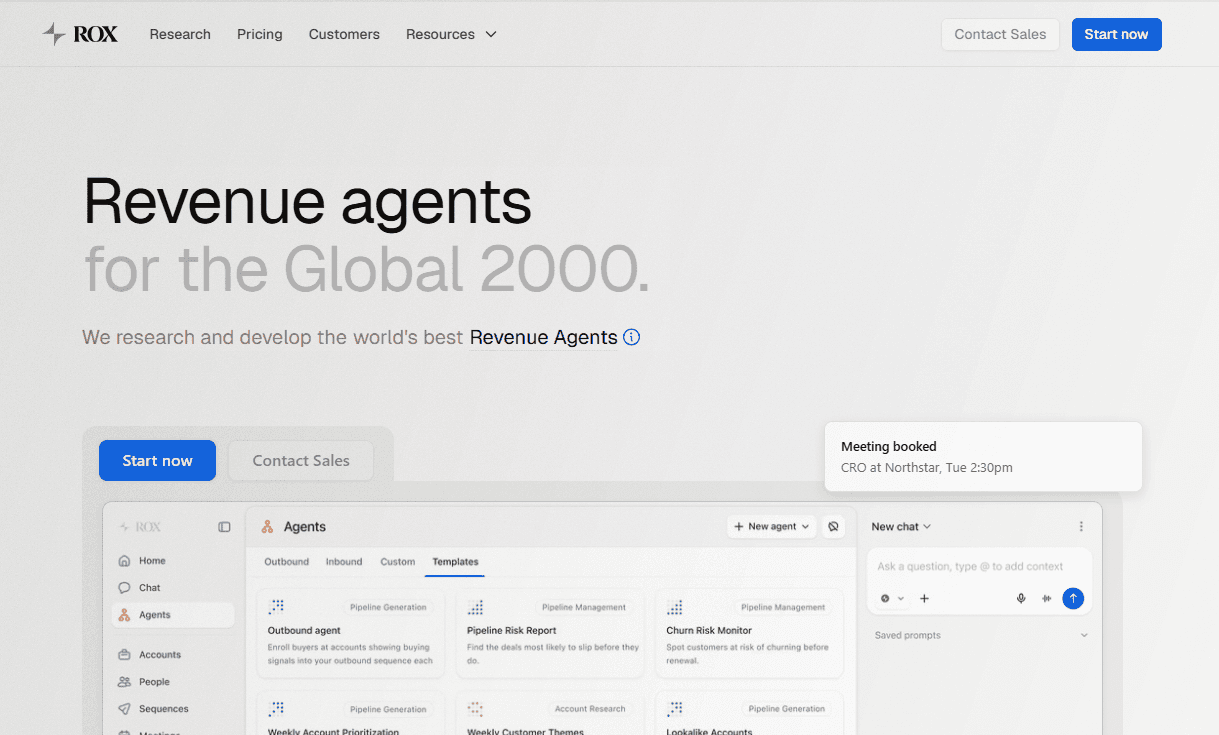
What it does: Rox is an autonomous revenue agent platform that executes the full outbound pipeline generation loop without requiring manual rep intervention at the prospecting and prioritization stages.
Rox’s agents continuously monitor the ICP-qualified account universe for firmographic, technographic, and behavioral signals, score accounts by conversion probability, generate personalized outreach calibrated to the specific buying signal, map the buying committee from integrated contact data, and route accounts to the assigned rep with a full brief and a ready-to-send outreach draft.
On the pipeline side, Rox monitors deal health continuously, updates the deal score in real time from engagement signals, and surfaces pipeline gaps with recommended sourcing actions before the coverage shortfall affects the quarterly forecast.
Key capabilities:
Continuous account monitoring across firmographic, technographic, and intent signal sources
Signal-triggered outreach generation calibrated to the specific buying event
Buying committee mapping and multi-thread outreach sequencing
Real-time deal scoring updated from CRM engagement signals
Stage-weighted pipeline forecasting with rolling 13-week coverage view
ICP signal weight recalibration from closed-won data on a quarterly cadence
Integration with Bombora, G2 Buyer Intent, ZoomInfo, Apollo, Salesforce, HubSpot, Outreach, and SalesLoft
Best for: Revenue teams where pipeline generation capacity is the primary constraint and where the SDR motion needs to cover a larger account universe than the current headcount can manually research and sequence.
Strongest for mid-market and enterprise B2B SaaS, fintech, and professional services.
Price: Contact Rox for enterprise pricing.
2. Artisan AI
Category: AI SDR agent
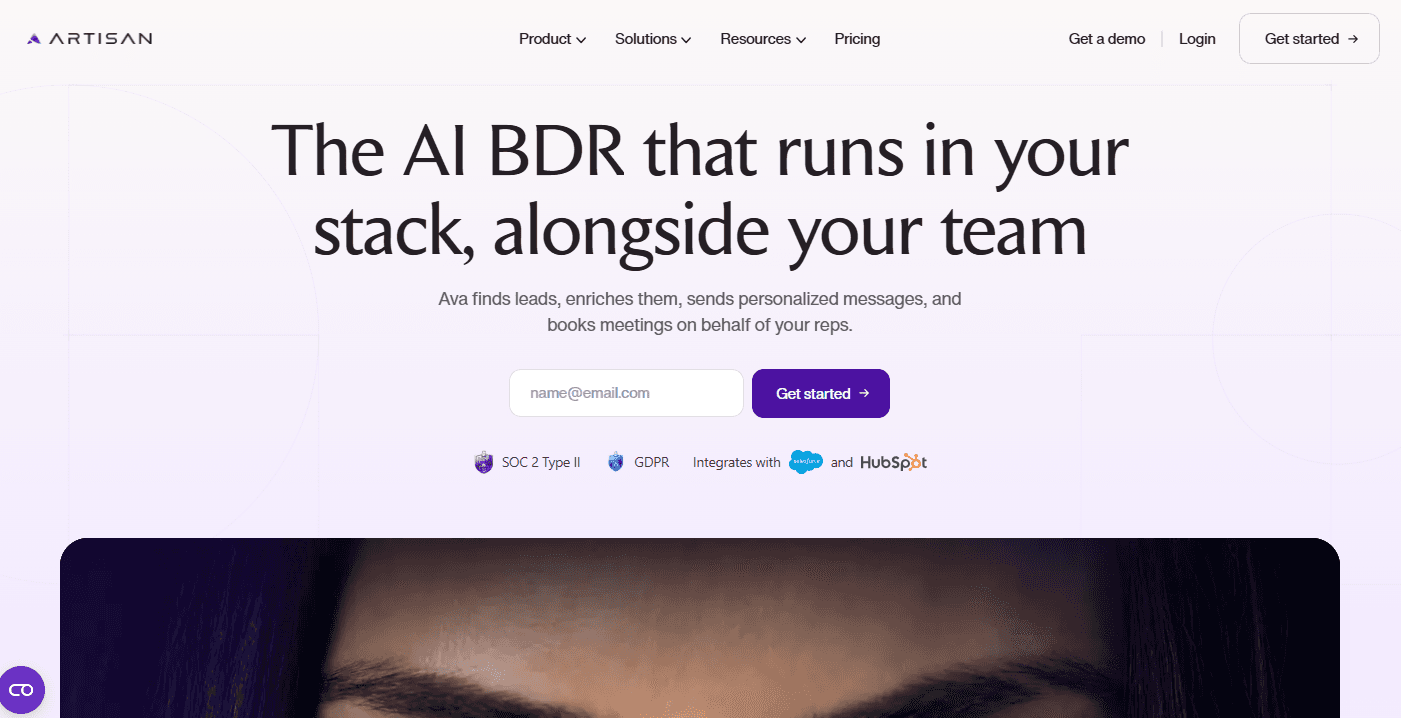
What it does: Artisan AI is an autonomous SDR agent platform designed to replace or supplement the human SDR function for high-volume outbound prospecting.
Artisan’s AI SDR (“Ava”) executes the full prospecting workflow building prospect lists from integrated data sources, researching each account and contact, generating personalized outreach, executing multi-channel sequences across email and LinkedIn, responding to basic inbound replies with qualification questions, and routing engaged prospects to the human rep for qualification.
Artisan AI targets companies that want to run a meaningful outbound motion without the hiring, training, and ramp-time overhead of a full human SDR team.
Key capabilities:
Autonomous prospect list building from integrated data sources
AI-generated personalized email and LinkedIn outreach
Automated sequence execution and follow-up
Basic inbound reply handling and qualification question delivery
CRM logging and activity tracking
A/B testing on outreach message variants
Best for: Early-stage and growth-stage companies that want to run outbound pipeline generation without a full SDR team. Also effective as a volume augmentation layer for enterprise SDR teams where the human SDRs handle high-intent accounts and Artisan AI handles the broader mid-tier account universe.
Price: Contact Artisan for pricing. Typically positioned as an SDR headcount replacement with pricing in the range of $500 to $2,000 per month depending on volume and configuration.
3. 11x.ai
Category: AI SDR and BDR agent
What it does: 11x.ai provides AI digital workers “Alice” for outbound SDR and “Jordan” for inbound BDR that execute sales development processes autonomously.
Alice handles outbound prospecting: account research, contact identification, multi-channel outreach, follow-up sequencing, and handoff to human reps when a qualified conversation is established.
Jordan handles inbound lead qualification: receiving demo requests and form submissions, engaging immediately with qualification questions, booking meetings for qualified leads, and routing unqualified leads to nurture tracks.
11x.ai positions its agents as digital workers that augment the human revenue team rather than replacing it entirely.
Key capabilities:
Autonomous outbound prospecting and sequencing (Alice)
Inbound lead qualification and meeting booking (Jordan)
Multi-channel outreach across email and LinkedIn
Personalization from account research and intent signals
CRM integration with automatic activity logging
Human handoff with full conversation context at the appropriate qualification stage
Best for: Companies that want AI agent coverage for both the inbound and outbound sales development motions simultaneously. Strong for growth-stage companies scaling their revenue team faster than human hiring allows.
Price: Contact 11x for pricing. Typically positioned as a per-agent subscription model.
4. Relevance AI
Category: No-code AI agent builder for sales workflows
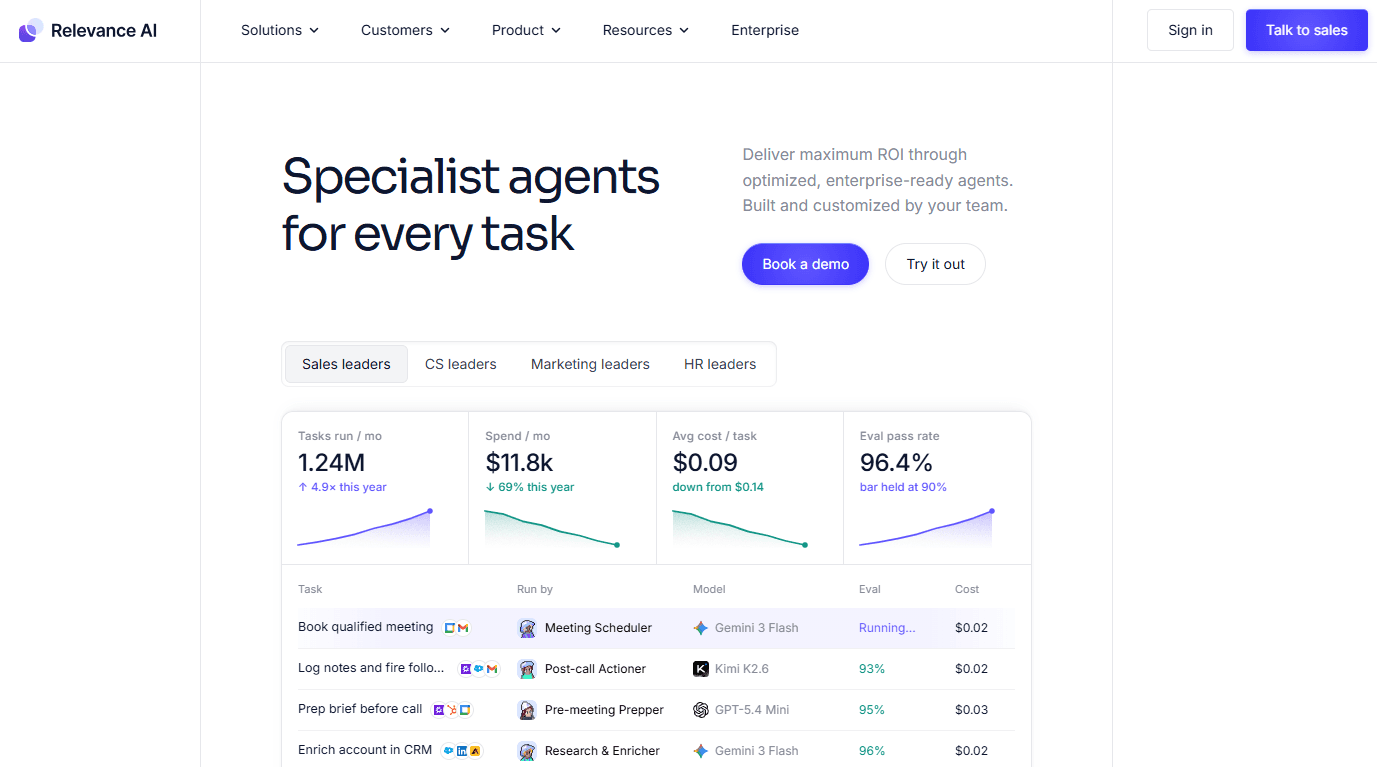
What it does: Relevance AI is a no-code platform for building custom AI agents that execute specific sales automation tasks. Rather than providing a pre-built AI SDR or revenue agent, Relevance AI gives revenue operations and sales teams the tools to build, configure, and deploy custom AI agents for their specific sales processes prospect research agents, lead enrichment agents, outreach personalization agents, deal risk monitoring agents, and renewal signal detection agents.
The platform includes pre-built agent templates for common sales use cases and a drag-and-drop builder for custom agent logic.
Key capabilities:
No-code agent builder with drag-and-drop workflow design
Pre-built agent templates for common sales processes (prospect research, lead enrichment, outreach personalization)
Multi-step agent workflows with conditional branching and external API integration
LLM selection (GPT-4o, Claude 3.5, Gemini) for each agent’s core language tasks
Integration with CRM, data providers, and sales engagement platforms
Agent monitoring and performance analytics
Best for: RevOps and sales operations teams that want to build custom AI agent workflows for specific process automation needs rather than adopting a pre-built AI SDR. Strongest for organizations with unique sales processes that off-the-shelf AI agent products do not cover.
Price: Starts at $19/month for the starter tier; enterprise pricing available for high-volume agent deployments. The agentic workflow framework guide covers how to design the workflow architecture that platforms like Relevance AI implement.
5. Clay

Category: Data enrichment and AI outreach automation
What it does: Clay is a data enrichment and outreach automation platform that allows revenue teams to build custom prospecting workflows combining data from 100+ providers with AI-powered outreach generation.
Clay’s “Claygent” is a web research AI agent that autonomously researches accounts and contacts across the web pulling company news, LinkedIn activity, job posting signals, and funding information, and combines that research with enriched contact data to generate hyper-personalized outreach.
Clay is not an autonomous AI SDR; it is a platform for building high-quality prospecting and enrichment workflows that feed into a sequencing platform or direct send.
Key capabilities:
Waterfall enrichment from 100+ data providers with fallback logic
Claygent for autonomous web research and account intelligence gathering
AI-powered outreach personalization from enriched account and contact data
Custom table-based workflow builder for complex data transformation and enrichment pipelines
CRM sync for pushing enriched records back to Salesforce or HubSpot
Integration with Outreach, Salesloft, Apollo, and other sequencing platforms
Best for: Revenue operations teams that want precise control over the data enrichment and outreach personalization workflow and are comfortable with a table-based workflow builder.
Strong for SDR teams that want AI-assisted personalization without fully autonomous agent execution. The AI prospecting tools guide covers Clay alongside other prospecting automation platforms.
Price: Starts at $149/month for 2,000 credits; enterprise pricing available for high-volume deployments.
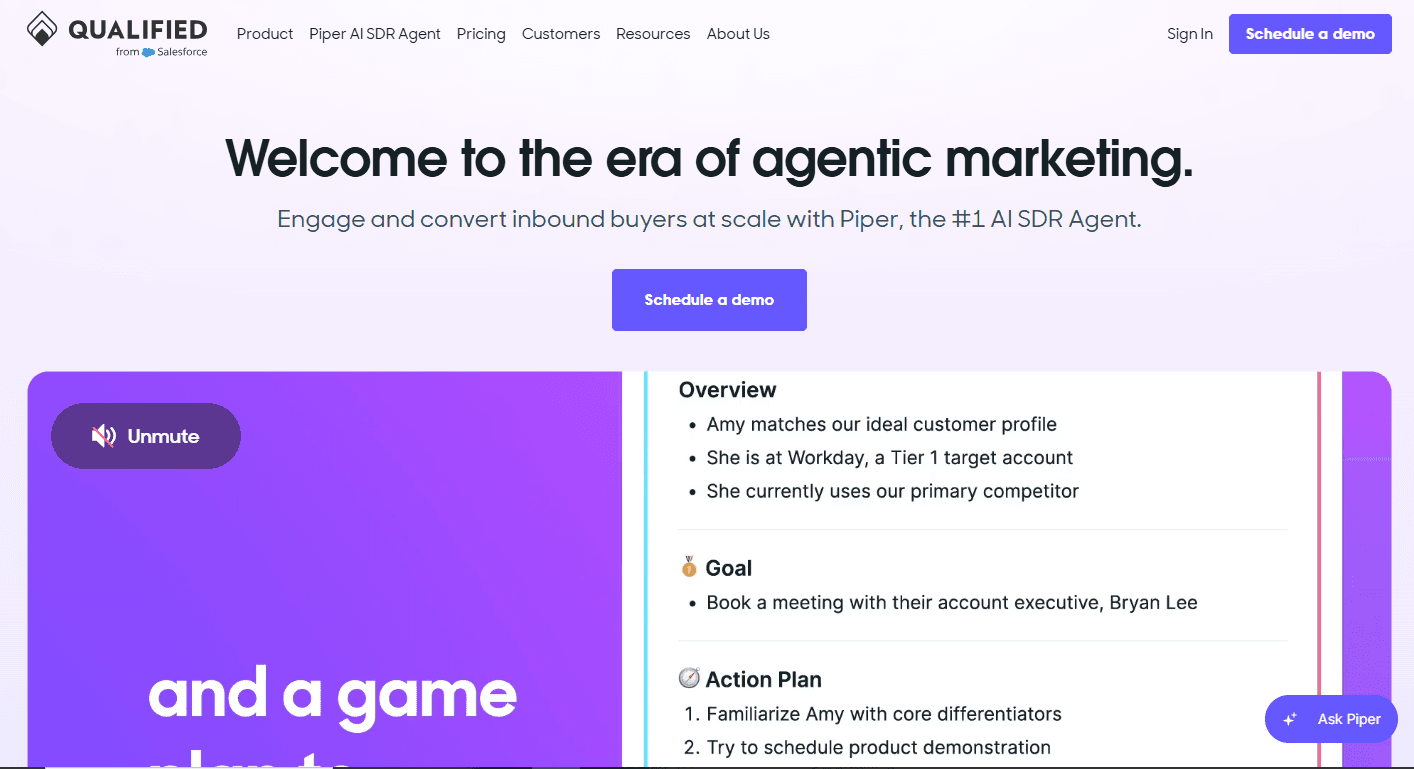
6. Qualified
Category: AI pipeline agent for website visitors
What it does: Qualified is a conversational AI platform that deploys a pipeline agent on the company’s website to engage, qualify, and route high-value website visitors in real time.
When a visitor from a target account or a high-intent contact visits the website, Qualified’s AI agent initiates a personalized conversation, identifies the visitor using IP resolution and CRM matching, delivers account-specific content based on their profile, qualifies their intent through conversational questions, and either routes them to a live rep for an immediate conversation or books a meeting for a future time.
Qualified integrates first-party website engagement data with the CRM to create a pipeline from website traffic that would otherwise generate an anonymous form submission.
Key capabilities:
Real-time website visitor identification using IP resolution and CRM matching
Personalized conversational AI that adapts to the visitor’s account profile and intent signals
Live rep routing for high-priority visitors showing active buying intent
Meeting booking with calendar integration for visitors who prefer async scheduling
Intent signal enrichment that passes conversation context and visitor profile to the CRM
ABM integration that coordinates website engagement with account-targeted advertising programs
Best for: Enterprises with meaningful website traffic from ICP-fit accounts who want to convert anonymous website visits into pipeline through real-time conversational qualification.
Strongest for organizations running ABM programs where the website is a primary account engagement channel.
Price: Custom enterprise pricing. Typically ranges from $3,000 to $10,000+ per month for enterprise deployments.
7. Drift (Salesloft)
Category: Conversational AI and pipeline agent
What it does: Drift, now part of the Salesloft platform, is a conversational marketing and sales AI platform that deploys AI-powered chatbots and pipeline agents across the website, email, and in-app surfaces.
Drift’s AI agents qualify inbound website visitors, route high-intent contacts to live reps or meeting booking workflows, and run autonomous email conversations with leads who have not yet engaged with a rep.
As part of the Salesloft ecosystem, Drift’s pipeline agent signals integrate directly with Salesloft’s Rhythm AI and sequencing workflows, allowing demand gen signals from website interactions to trigger rep actions within the same platform.
Key capabilities:
AI-powered chatbot for website visitor qualification and routing
Email-based conversational AI for lead qualification outside the website
Live rep routing with intent-based prioritization
Meeting booking automation with CRM-matched rep assignment
Salesloft Rhythm integration for signal-to-action routing within the Salesloft platform
Account-level engagement tracking that connects website interactions to CRM accounts
Best for: Organizations already running Salesloft for sales engagement who want native pipeline agent capability without adding a separate conversational AI vendor. Also suitable for standalone deployment at organizations that want AI-driven conversational qualification across website and email.
Price: Included in Salesloft platform for existing Salesloft customers. Standalone Drift pricing starts at custom enterprise rates.
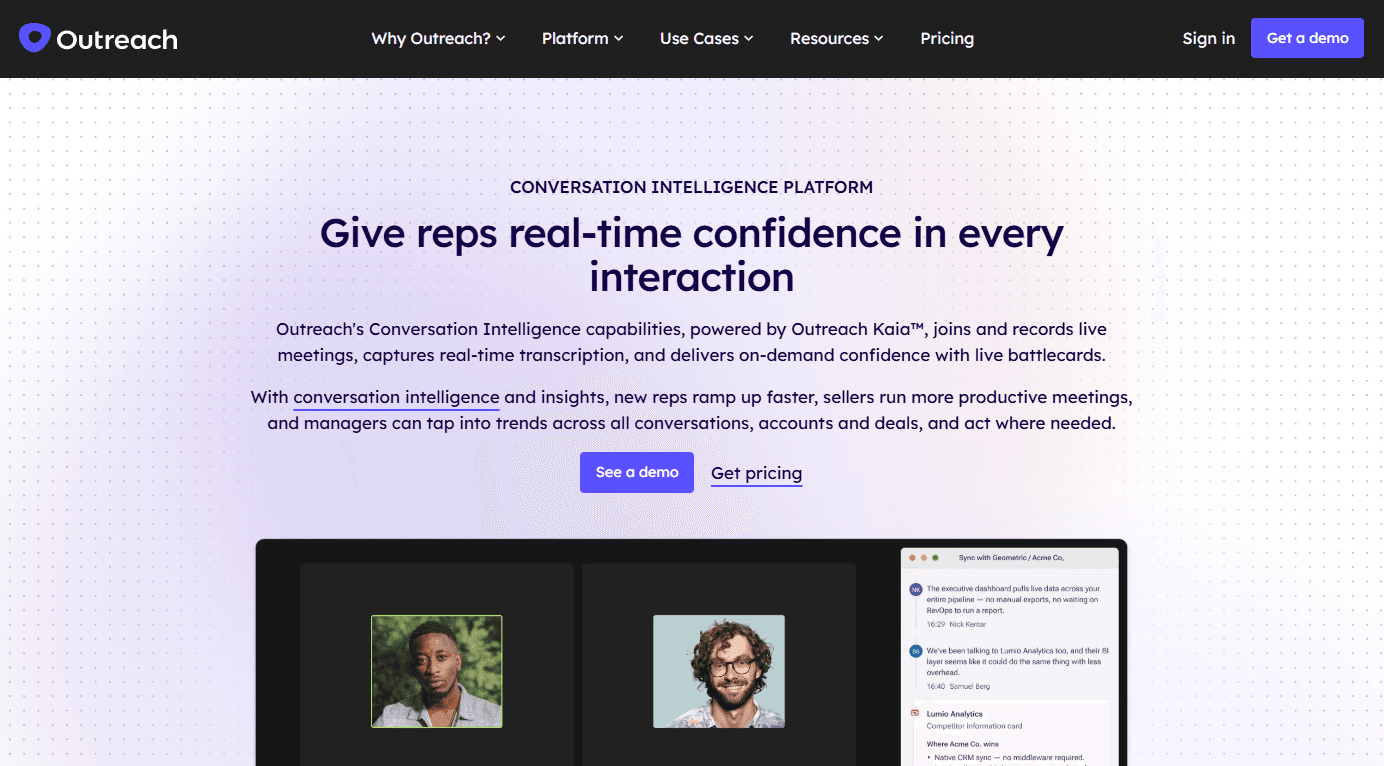
8. Outreach Kaia
Category: AI meeting and deal intelligence agent
What it does: Outreach Kaia (short for Knowledge AI Assistant) is an AI agent embedded in the Outreach platform that operates during and after sales calls, providing real-time assistance during the conversation, automatically capturing meeting notes and action items, populating CRM fields from call content, and surfacing next-step recommendations based on deal stage and conversation patterns.
Kaia operates as a deal intelligence agent alongside the human rep, handling the administrative and data capture overhead of the sales call so that the rep can focus entirely on the conversation.
Key capabilities:
Real-time call assistance with competitor battle cards, objection handling suggestions, and product information surfaced during the call
Automated meeting notes and action item extraction from call transcripts
CRM field population from call content (deal stage, next steps, stakeholder names, timeline)
Post-call follow-up email drafting from meeting summary and agreed action items
Deal risk signal detection from conversation content integrated into Outreach’s pipeline management
Coaching recommendations for managers based on call quality patterns
Best for: Enterprises running Outreach for sales engagement who want to reduce the post-call administrative burden on reps and improve the quality and completeness of CRM data captured from discovery and qualification calls.
The what is conversation intelligence guide covers the broader conversation intelligence category that Kaia operates within.
Price: Included in Outreach enterprise tier. Pricing is part of the overall Outreach contract.
9. Apollo AI

Category: AI prospecting and outreach agent
What it does: Apollo AI is the AI layer within the Apollo sales intelligence platform that automates prospecting, outreach generation, and sequence optimization.
Apollo AI’s agent capabilities include automated prospect list building from Apollo’s 275M+ contact database, AI-generated email personalization from account and contact data, sequence optimization recommendations based on engagement pattern analysis, and an AI SDR feature that can execute initial outreach sequences autonomously for leads that meet configured criteria.
For companies already using Apollo for contact data, Apollo AI adds an autonomous outreach layer without requiring a separate AI SDR vendor.
Key capabilities:
Automated prospect list building from Apollo’s contact database with ICP filter application
AI-generated personalized email outreach from contact and account data
AI SDR for autonomous sequence execution on configured lead segments
Sequence optimization recommendations based on reply rate and engagement data
CRM sync for Salesforce and HubSpot with bidirectional contact and deal data flow
Conversation intelligence through Apollo’s integrated call recording
Best for: Growth-stage companies already using Apollo for contact data who want to add autonomous outreach execution without adding another vendor. Also suitable for enterprises that want a single combined contact database and AI SDR platform.
Price: Apollo AI features are available on the Basic plan ($49/user/month) with full AI SDR capabilities on the Professional ($99/user/month) and Organization ($149/user/month) tiers. The AI-SDR guide covers the AI SDR category in full.
10. Unify
Category: AI-powered warm outbound agent
What it does: Unify is an AI-powered warm outbound platform that combines intent data, CRM data, and product usage signals to identify the accounts and contacts most likely to convert from outbound sequences and generates personalized outreach calibrated to those signals.
Unify’s approach to outbound agent automation focuses specifically on “warm outbound” outreach to accounts that have prior intent signals or product engagement rather than cold accounts with only firmographic fit.
The platform monitors first-party product usage data alongside third-party intent signals and generates outreach that references specific usage patterns or category research behavior.
Key capabilities:
Warm outbound signal aggregation from product usage, intent data, and CRM history
AI-powered outreach generation personalized to the specific warm signal
Automated sequence execution with signal-based personalization
CRM integration for lead routing and activity logging
Product usage signal integration for PLG companies monitoring activation and expansion signals
Reporting on warm outbound conversion rates versus baseline outreach
Best for: Product-led growth companies and SaaS businesses that have product usage data alongside traditional intent signals and want to incorporate both in their outbound prospecting motion.
Also effective for companies that have tried cold outbound and found that warm outbound with intent signals produces meaningfully higher conversion rates.
Price: Custom pricing. Typically positioned at growth-stage companies. Contact Unify for enterprise pricing.
Evaluation framework for AI sales agents
Dimension 1: Process coverage alignment
Match the AI agent’s primary capability to the sales process where the constraint is most acute. An AI agent optimized for outbound prospecting does not solve an inbound qualification problem
An AI agent optimized for website visitor conversion does not improve pipeline monitoring. Map each platform’s primary process coverage to the most acute gap in the current sales motion before evaluating features.
Dimension 2: Autonomy level and human oversight model
AI sales agents operate at different autonomy levels from fully autonomous (the agent sends outreach without rep review) to assisted (the agent generates drafts that require rep approval before sending) to advisory (the agent surfaces recommendations that reps act on manually).
The right autonomy level depends on the deal complexity, the brand risk tolerance, and the rep team’s readiness for agent-assisted workflows. Higher ACV deals with complex buying committees typically benefit from assisted rather than fully autonomous outreach.
High-volume, transactional outreach motions can often support full autonomy for first touches.
Dimension 3: Integration with existing tech stack
AI sales agents that require replacing the existing CRM, sequencing platform, or data provider add integration complexity and data migration risk. Evaluate whether each platform integrates natively with the existing tech stack or requires significant API development.
Native integrations with Salesforce, HubSpot, Outreach, Salesloft, Bombora, and ZoomInfo are the baseline expectation for enterprise-grade AI sales agents.
Dimension 4: Personalization quality and signal sourcing
The quality of AI agent outreach is directly proportional to the quality and specificity of the signals it uses for personalization. Agents that personalize from generic firmographic data (company name, industry) produce outreach that is slightly better than templates.
Agents that personalize from specific behavioral signals (the contact visited your pricing page three times this week after a Bombora intent surge) produce outreach that reads like a well-researched rep message.
Evaluate the signal sources each platform integrates and the specificity of the personalization it produces during a trial.
Dimension 5: Learning and improvement model
AI sales agents that improve over time, updating their outreach patterns based on reply rate data, adjusting account prioritization based on conversion outcomes, and refining personalization based on engagement signals produce compounding productivity gains.
Agents that do not learn from outcomes produce static performance. Ask each vendor: “How does the agent update its behavior based on conversion outcomes?” and “How frequently does the model retrain on new data?”
How to choose between AI sales agent platforms
Primary use case | Best platform options |
|---|---|
Outbound prospecting and prioritization | Rox, Artisan AI, 11x.ai, Apollo AI |
Inbound lead qualification | 11x.ai (Jordan), Qualified, Drift |
Custom agent workflow building | Relevance AI, Clay |
Data enrichment and outreach personalization | Clay, Apollo AI |
Website visitor pipeline conversion | Qualified, Drift |
Meeting intelligence and CRM automation | Outreach Kaia, Gong |
Warm outbound from product usage signals | Unify, Rox |
Full pipeline generation and management | Rox |
Most enterprises will use two or three platforms in combination an outbound prospecting agent, an inbound qualification agent, and a call intelligence agent.
The how to build multi-agent ai workflows guide covers how to architect multi-agent sales automation systems that coordinate across these use cases without creating data silos or handoff gaps.
FAQ
What are AI agents for sales automation?
AI agents for sales automation are software systems that execute defined sales business processes autonomously, monitoring signals, making prioritization decisions, generating personalized outreach, qualifying leads, updating CRM records, and surfacing deal risks without requiring a human to initiate each action.
How do AI sales agents differ from AI sales tools?
Traditional AI sales tools provide intelligence and recommendations that humans act on: a lead score that a rep reviews, a call transcript that a manager reads, a sequence template that an SDR edits and sends.
AI sales agents act autonomously; they execute the action based on the signal without waiting for a human to initiate it. The distinction is between AI as a decision support tool and AI as an execution agent.
What sales processes are best suited for AI agent automation?
The sales processes best suited for AI agent automation are: outbound account prioritization and outreach (high volume, signal-driven, personalization at scale), inbound lead qualification (fast response time critical, initial qualification structured and repeatable), meeting scheduling and follow-up (high administrative overhead.
Will AI sales agents replace SDRs?
AI sales agents will change the SDR role rather than replace it wholesale. The tasks most likely to be automated are the high-volume, research-intensive, and administratively repetitive ones: account list building, contact research, first-touch outreach generation, sequence execution, and CRM logging.
How do you evaluate the quality of an AI sales agent’s outreach?
Evaluate AI agent outreach quality across three dimensions: specificity (does the outreach reference a specific, verifiable signal about this account, or does it use generic industry language?), relevance (does the outreach connect the signal to a business outcome the contact cares about, or does it jump directly to product features?), and timing (does the outreach arrive within 24 to 48 hours of the triggering signal, or does it arrive after the buying window has shifted?).
Similar Articles
We build with the best to make sure we exceed the highest standards and deliver real value.