8 Best Sales Enablement platforms for Large Enterprises in 2026 (Expert Tested)
Leah Clapper

Companies using unified sales enablement software for enterprises are 42% more likely to report higher productivity from their reps and marketers. This translates into shorter sales cycles, faster responses and higher win rates.
Large organizations need sales enablement software as a centralized hub for content, coaching, training and insights that accelerate revenue growth. It connects your strategy directly to rep execution during buyer interactions.
We’ve tested eight leading sales enablement software tools to help you choose the right platform for your enterprise’s needs.
What is enterprise sales enablement?
Enterprise sales enablement is the system that gives sales reps, managers, and partner-facing teams the resources, skills, and insights needed to involve enterprise buyers and close complex deals. Sales enablement will give every seller the readiness to deliver value in every customer interaction.
The function operates as a strategic, cross-functional process. It provides sellers with content, coaching, sales enablement software tools, and insights they need to involve buyers and close more deals. Sales enablement software meaning extends beyond simple training. The discipline has evolved from a support function into a strategic revenue engine.
What’s the best sales enablement tool for enterprise?
The sales enablement market went through substantial consolidation in 2026. Seismic completed its acquisition of Highspot in February 2026 for a combined valuation approaching USD 6.00 billion.
Vector Capital merged Showpad with Bigtincan in October 2025. Gong entered the enablement category with Gong Enable, marking a move in how conversation intelligence platforms expand their scope.
Seismic
Overview and Key Capabilities
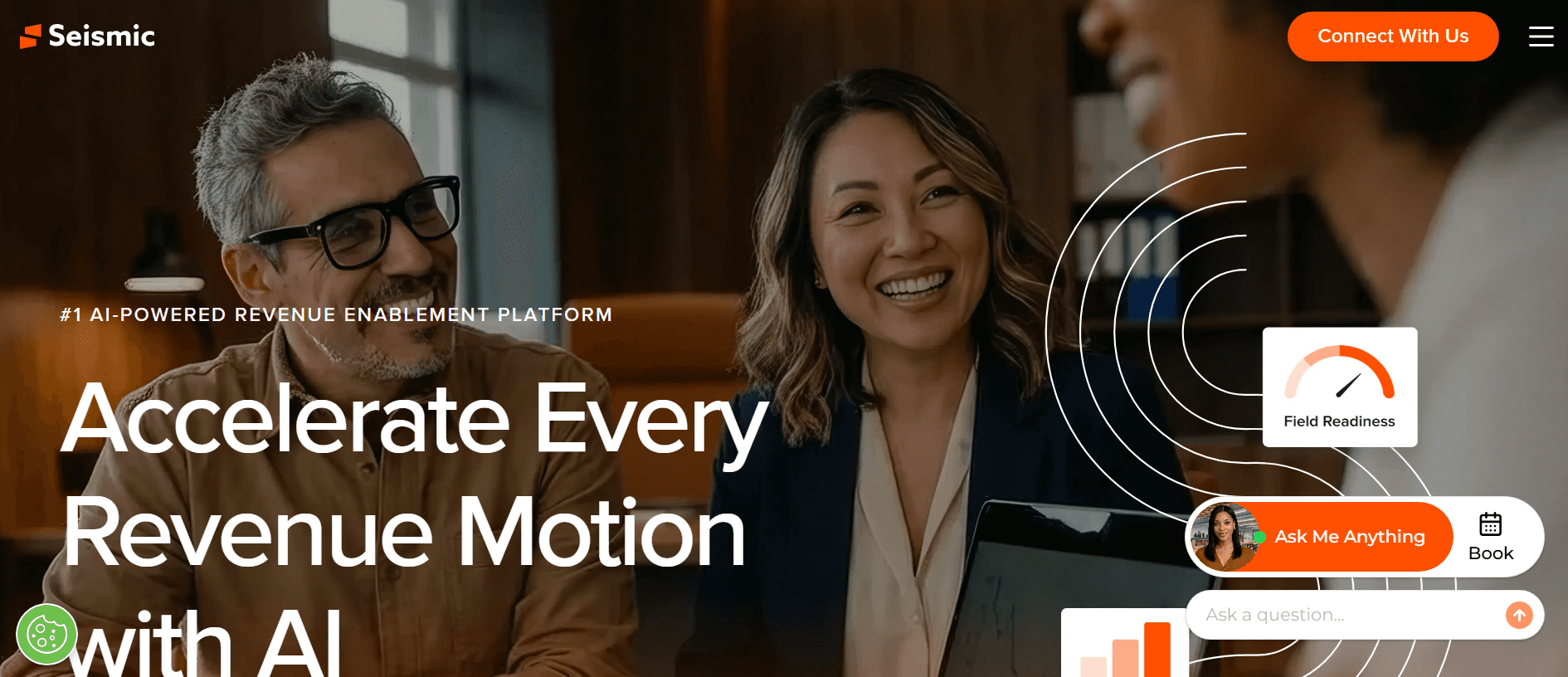
Seismic launched in 2010 with a focus on solving content challenges for financial services firms. The company now serves more than 2,000 customers and over one million users across 100+ countries. Seismic completed its acquisition of Highspot in February 2026. This created a combined entity with a valuation approaching USD 6.00 billion.
The Seismic Enablement Cloud operates as a unified platform built around six core pillars: sales content management, learning and coaching, strategy and planning, content automation, buyer engagement, and enablement intelligence. This architecture allows go-to-market teams to design programs, deliver content and training, arrange buyer interactions, and measure business effects in one place.
Seismic positions itself as an enterprise-first platform with strong governance controls. This is valuable for large or regulated organizations. Companies like Experian report a 10% increase in deal size when business units use Enablement Cloud tools frequently. Seismic achieved a 90% customer retention rate.
Core Features for Enterprise Teams
Content Management and Automation: Seismic’s centralized library provides granular permissions and version control for all go-to-market content. LiveDocs pulls data from CRM and other systems to auto-generate personalized decks, proposals, and client reports at scale. This capability reduces time spent rebuilding content repeatedly.
Learning and Coaching: Seismic Learning delivers role-based onboarding, microlearning, and coaching to upskill reps faster. The platform supports structured certification programs and advanced learning paths that scale across global teams.
Enablement Intelligence: The analytics suite connects content usage, training, and seller behavior to pipeline and revenue outcomes with AI-driven insights. Built on Microsoft Power BI, LiveInsights provides visibility into platform adoption, content usage, and buyer engagement.
Integrations: Seismic offers deep native integrations with Salesforce, Microsoft 365 (Teams, Outlook, PowerPoint), Google Workspace, and Dynamics 365. The platform surfaces content inside these tools without requiring sellers to leave their workflow. Seismic Aura AI integrates with Microsoft 365 Copilot and provides content recommendations and meeting summaries. More than 3.7 million AI activities were powered by Aura AI over the last 12 months.
Pricing Structure
Seismic follows a custom-quote model with no public pricing tiers. Pricing scales based on user count, modules selected, and contract term.
Package Type | Typical Annual Cost | What’s Included |
|---|---|---|
Core Sales Enablement | USD 20,000–USD 40,000 | Content management, search, and analytics |
Sales Enablement + Learning | USD 40,000–USD 70,000 | Onboarding, training paths, and coaching tools |
Enterprise Platform | USD 70,000–USD 120,000+ | Advanced analytics, integrations, and governance controls |
Professional services for implementation range from USD 10,000 to USD 100,000+ depending on deployment complexity. Annual contracts are standard, and most customers commit to minimum seat counts.
Pros and Cons
Strengths: Strong content library with powerful search and filtering capabilities. Deep CRM integrations keep content available within normal workflow. Analytics tie content and training activity to buyer engagement and revenue. Customer success and enablement services help streamline adoption in complex enterprise environments.
Limitations: Steep learning curve, especially for admins managing large content libraries. Implementations can be complex and time-consuming. They require dedicated internal resources. High price point with multi-year contracts and no free trial. Some users report performance issues with search functionality without Aura AI enabled.
Highspot
Overview and Key Capabilities
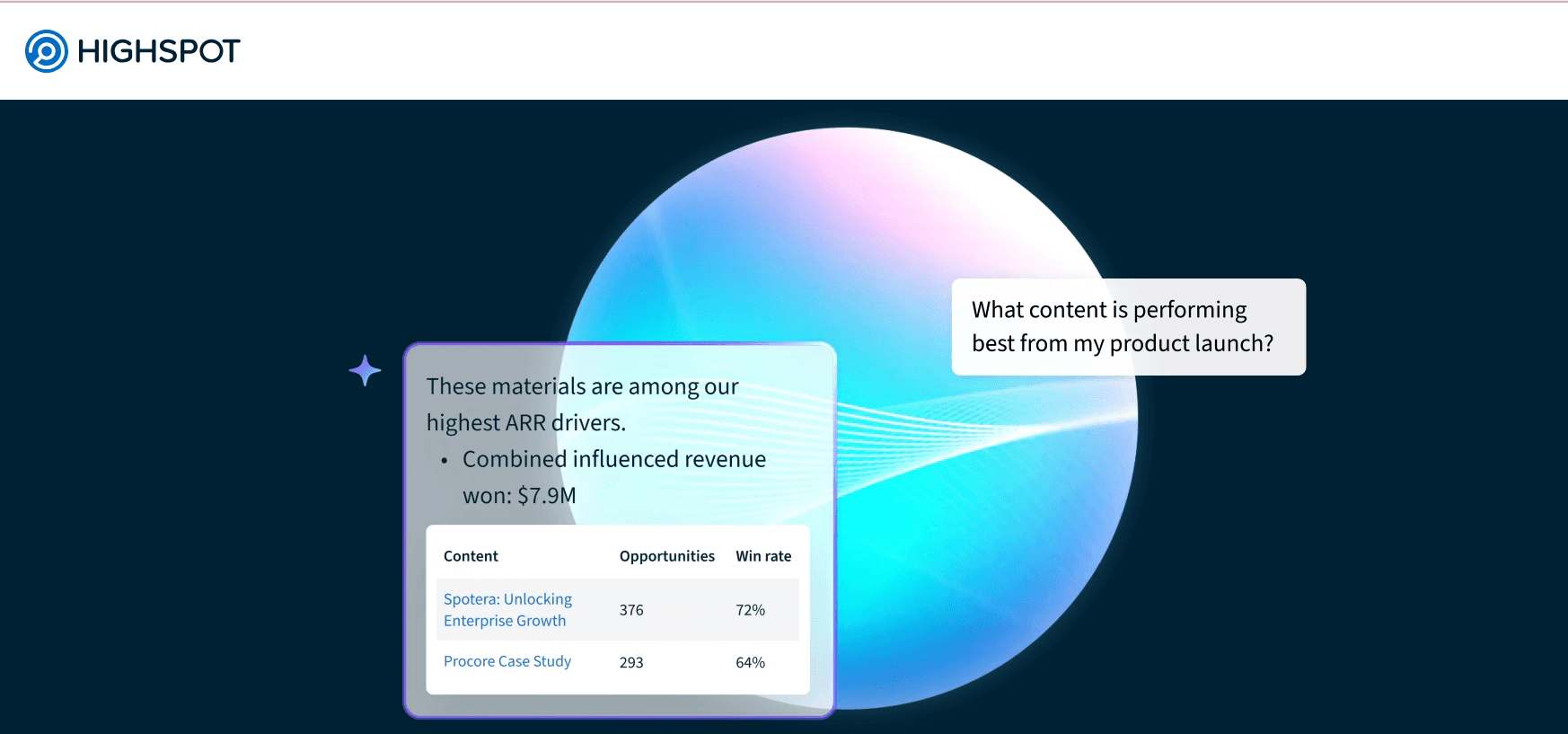
Three former Microsoft executives founded Highspot in 2012 after identifying the biggest problem: siloed content, training, and coaching tools prevented sales teams from executing consistently. The platform now connects over 20 million users and serves enterprise customers that include Uber, Siemens, Vodafone, Visa, Nvidia, Samsung, AWS, OpenAI, MetLife, HSBC, and FedEx.
February 2026 marked Highspot’s merger completion with Seismic. The combined entity was valued at over USD 6.00 billion.
Highspot operates as a unified sales enablement software for enterprises built on Nexus, its proprietary AI and analytics engine. Nexus powers content recommendations, adaptive learning, coaching insights, and deal intelligence across use cases of all types: AI Role Play, sales content management, sales plays and playbooks, buyer engagement, sales training, sales coaching, and partner enablement.
Core Features for Enterprise Teams
Content and AI-Powered Search: Highspot surfaces relevant content for every deal and scenario through AI that understands context rather than keywords alone. The platform automates governance with agents that keep assets compliant and current. Content delivery happens in rep workflow without switching tools.
Training and Coaching: AI identifies skill gaps in teams and gets more personalized training by role and performance. The platform builds skills through AI-driven feedback and Role Play. A skill framework evaluates calls, training, and role-play scenarios, then delivers targeted feedback.
Digital Sales Rooms and Buyer Engagement: Reps create Digital Sales Rooms for structured buyer collaboration. These rooms combine smoothly with email, Slack, and Microsoft Teams.
Integrations and Security: Highspot connects with Salesforce, Outlook, Slack, and 100+ other tools. The platform maintains enterprise-grade security with SOC 2, ISO 27001, and GDPR compliance. Encrypted AI inference and role-based access protect content and data. Highspot commits to never using customer data for AI model training.
Pricing Structure
Highspot uses custom pricing with no published rates. Pricing depends on user count, package level, services, and organizational complexity.
Organization Size | Estimated Cost |
|---|---|
Per User | ~US$75–150/user/month (varies by features and contract) |
Small Team (≈50 users) | US$50,000–100,000/year |
Enterprise | Custom enterprise pricing based on users, modules, and services |
Pros and Cons
Strengths: Unified platform eliminates tool-switching across content, training, coaching, and engagement workflows. AI-powered search delivers contextual results with high accuracy. Digital Sales Rooms provide structured buyer collaboration. Enterprise security has encrypted AI inference and global compliance support without using customer data for model training.
Limitations: Custom pricing lacks transparency with no published rates or free trial. Administrators face a steep learning curve when managing complex implementations. Implementation requires 2 months with dedicated enablement resources. ROI timeline averages 15 months. Workflow and UI customization options remain limited.
Showpad
Overview and Key Capabilities
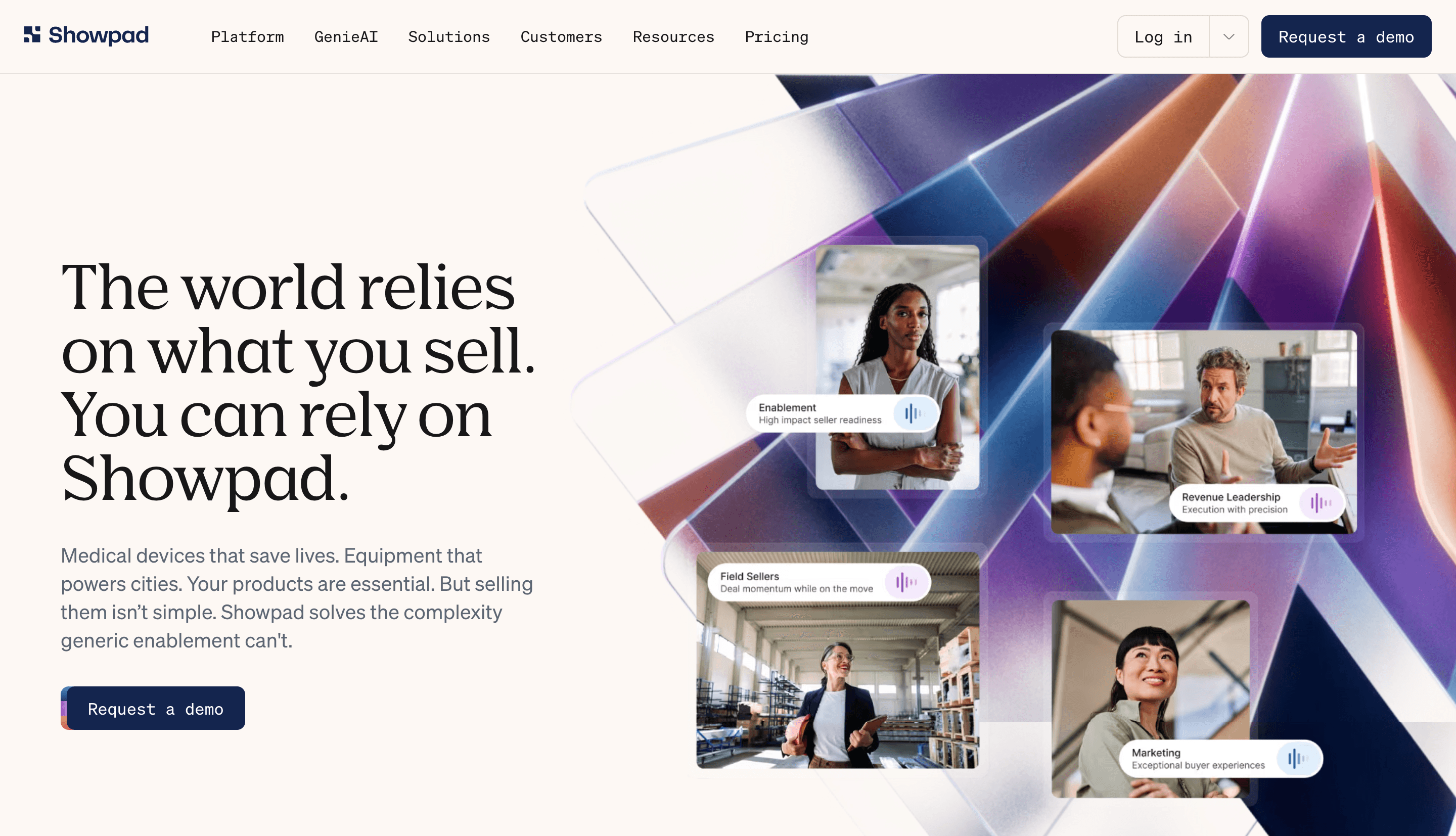
Showpad originated in 2011 in Ghent, Belgium. The company built it as a mobile-first iOS app for field sales content distribution. The platform serves 2,000+ organizations around the world.
Vector Capital merged Showpad with Bigtincan in October 2025 and consolidated three sales enablement software companies (including Brainshark) under unified ownership. Apratim Purakayastha leads the combined entity as CEO.
Showpad positions itself as an AI-native revenue effectiveness platform. The company designed it for field-driven industries that require offline execution, governed AI, and high-SKU portfolio management. The architecture centers on four layers: workspace, GenieAI, trust (governing permissions and compliance), and data (unifying CRM, ERP, product, and engagement data).
GenieAI acts as the intelligent core. The company built it on proprietary company data and approved materials with controls that the organization defines. Major customers include Coca-Cola, Cisco, DuPont, IBM, Nike, and Johnson & Johnson.
Core Features for Enterprise Teams
Content Management: The centralized library uses LibraryIQ, an AI feature that monitors content health. It spots duplicate files, localized variants, and undefined languages. The platform supports 3D models and 360° showrooms for physical products that transform product catalogs into interactive experiences.
Sales Readiness: RolePlay AI simulates customer interactions so sellers can practice pitches without manager time. The platform delivers structured learning through Paths that combine live tasks, interactive courses, and video recordings with immediate leaderboards. Support extends to 12+ languages.
Buyer Engagement: Shared Spaces create secure, branded microsites where sellers and buyers cooperate throughout deals. Engagement data reveals when clients open content and which items hold their attention.
Integrations: Showpad connects with 75+ tools including Salesforce, Microsoft Dynamics, SharePoint, Marketo, and Gong. The platform offers pre-configured integrations plus an open API.
Pricing Structure
Package Type | Cost | Details |
|---|---|---|
Starting Price | USD 25.00 per user/month | Base content management |
Custom Enterprise | Contact for quote | Full platform with GenieAI and advanced features |
Pros and Cons
Strengths | Limitations |
|---|---|
Field-first architecture with offline mobile access | Premium pricing not suited for small businesses |
3D models and AR for product visualization | Content discovery difficult without careful folder management |
Mindtickle
Overview and Key Capabilities
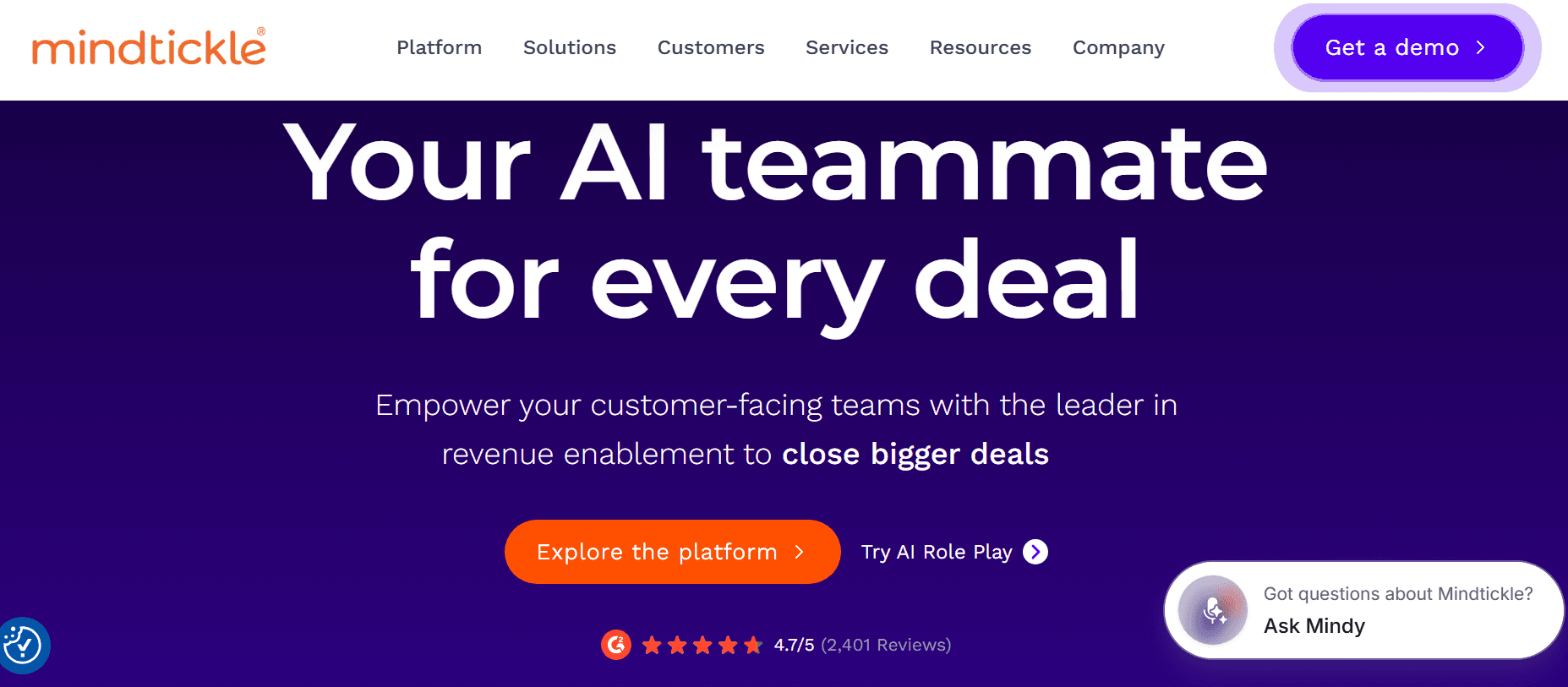
Mindtickle operates as an AI-powered revenue enablement platform focused on sales readiness and rep performance. The company was founded in 2012 with headquarters in San Francisco. The platform serves enterprise sales organizations with training, coaching, content management and readiness tools.
ElevateOS forms the platform’s architecture center, powered by a decade of rep behavior data using agentic AI capabilities to coach, guide and act on every deal. Cisco trained 18,000 sellers in six weeks using Mindtickle’s AI Role Plays mobile experience and achieved a 31% increase in deal sizes.
Core Features for Enterprise Teams
AI Role Plays and Mobile Training: The reasoning engine makes dynamic, unscripted conversations possible where AI buyers interrupt and challenge reps. This creates lifelike simulations. Sellers practice customer conversations on demand through the mobile app with instant, personalized feedback.
Readiness Index Analytics: Proprietary technology defines Ideal Rep Profiles based on competencies and correlates readiness scores with CRM data on quota attainment and pipeline generation. This reveals which skills development activities drive revenue success.
Call AI: Built-in conversation intelligence records and transcribes sales calls, generates automated performance scores, identifies themes and buying signals, and provides sentiment analysis.
Mindtickle Copilot: Generative AI assistant analyzes performance, creates practice scenarios from content uploads, generates call summaries and provides personalized coaching recommendations.
Pricing Structure
Deployment Size | Annual Contract Range | Notes |
|---|---|---|
Small (10-50 users) | USD 50,000–USD 150,000 | Higher per-user costs |
Mid-market (50-200 users) | USD 150,000–USD 400,000 | Volume discounts apply |
Enterprise (200+ users) | USD 400,000–USD 1,000,000+ | Has global rollout, premium support |
Core platform pricing ranges from USD 100–USD 200 per user per year for mid-market deployments. Call AI adds USD 50–USD 100 per user per year as a separate module. Implementation requires a one-time setup fee of USD 3,000–USD 5,000 with 6-8 weeks to complete.
Pros and Cons
Strengths | Limitations |
|---|---|
Performance correlation visibility connects training to quota attainment | Complex navigation interface creates overwhelm at first |
Enterprise-grade scalability handles thousands of simultaneous users | 6-8 week implementation timeline delays results |
Detailed platform eliminates tool fragmentation | Confusing digital content organization |
AI Role Plays deliver measurable gains in productivity | Requires dedicated enablement resources for optimization |
Gong
Overview and Key Capabilities
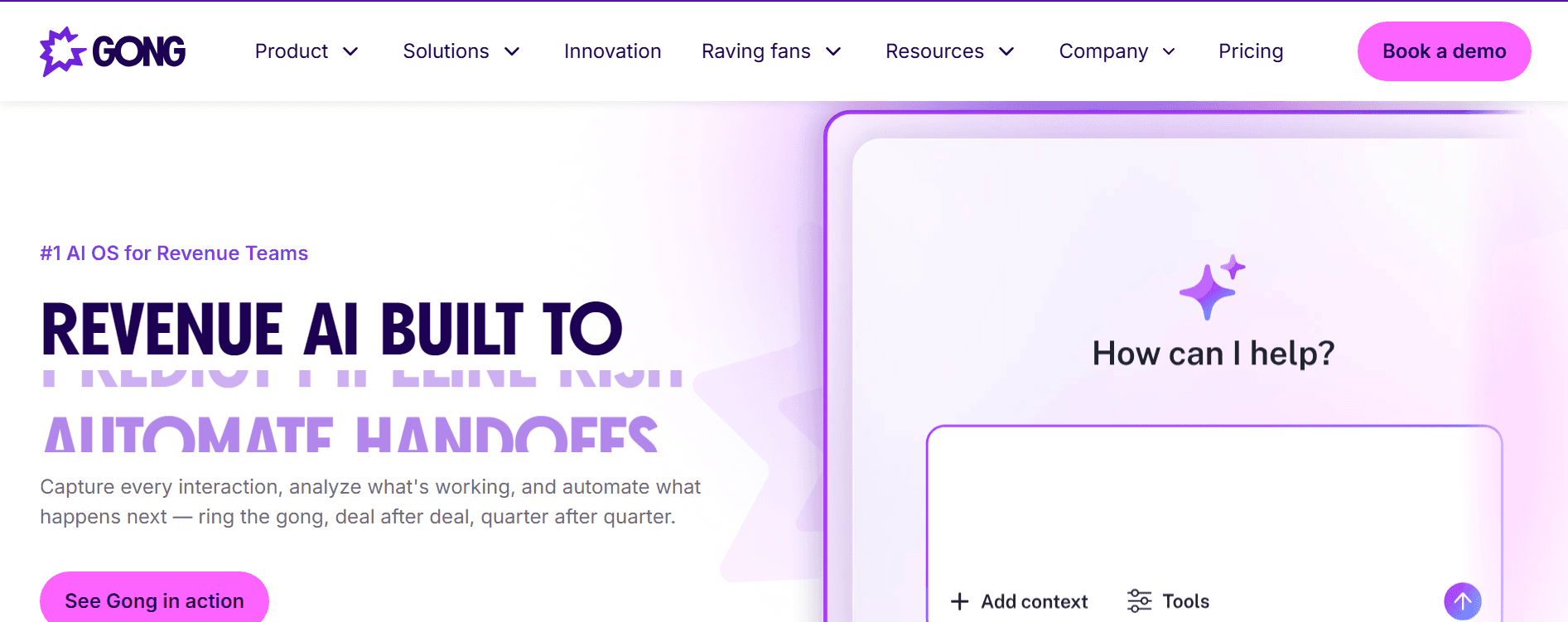
Gong defines the revenue intelligence category through conversation analysis rather than traditional content distribution. The Gong Revenue AI Operating System serves more than 5,000 companies worldwide, including Zillow, PayPal, Shopify, and LinkedIn. The platform captures every customer interaction across calls, emails, and meetings.
The architecture is different from conventional sales enablement software tools. It grounds insights in actual buyer interactions. Proprietary AI models trained on revenue-specific data convert conversation patterns into decisions about which deals to pursue, where teams face risk, and what actions to take next.
Gong added more USD 1.00M+ customers in the last two quarters than in the previous six combined. 50% of customers now run multiple products on the platform.
Core Features for Enterprise Teams
Gong Enable: Delivers AI-powered coaching at scale. It uses ground conversation data to pinpoint skill gaps and prescribe targeted training. AI Trainer converts past calls into realistic role-play scenarios where reps practice discovery and objection handling with instant automated feedback. AI Call Reviewer scores calls and eliminates manual review time.
Initiative Tracking: Links behavior change to business outcomes like win rates and deal size. This proves enablement ROI. Highspot used Gong call snippets to roll out new sales methodology across the globe and achieved a 7% win rate increase.
Microsoft Integration: Partnership with Microsoft embeds Gong insights into Dynamics 365 and Microsoft Teams. Customer interactions sync with AI-generated summaries and next steps without manual data entry.
Pricing Structure
Component | Annual Cost |
|---|---|
Base platform fee | USD 5,000–USD 50,000] |
Per-user license (Foundations) | USD 1,000–USD 1,600 |
Gong Enable add-on | USD 300–USD 800 estimated |
Gong Forecast add-on | USD 700 per user |
Pros and Cons
Strengths: Ground conversation data grounds coaching in actual performance patterns. AI-generated summaries eliminate manual call review time. Deep CRM integrations maintain workflow continuity. Named Leader in Gartner Magic Quadrant for Revenue Action Orchestration.
Limitations: Steep learning curve with complex interface reported by users. High cost structure with mandatory platform fees hits smaller teams hardest. Implementation requires 3-4 weeks with dedicated resources. Calls under 60 seconds aren’t tracked.
Outreach

Overview and Key Capabilities
Outreach operates as a revenue orchestration platform handling prospecting, deal management and forecasting through AI agents. The platform processes over 2 million opportunities monthly.
Traditional sales enablement software tools differ from Outreach, which focuses on sales engagement and execution rather than content management or training infrastructure.
Core Features for Enterprise Teams
Multi-step sequences combine emails, calls and LinkedIn tasks with conditional logic for customized prospect trips. AI analyzes deals to surface risk signals like stalled conversations or missing stakeholders. It assigns health scores and suggests next steps.
Kaia records and transcribes meetings and extracts action items with sentiment analysis immediately. The platform provides pipeline dashboards and forecasting capabilities. AI and machine learning power revenue projections.
Pricing Structure
Tier | Cost per User/Month | Features |
|---|---|---|
Standard | USD 100.00 | Base participation, sequences, CRM sync |
Professional | USD 120.00-140 | Added analytics, AI features |
Enterprise | USD 160.00+ | Full suite, advanced controls |
Implementation fees range from USD 5,000 to USD 25,000. Annual contracts required.
Pros and Cons
Reliable automation saves hours through multi-channel sequences. Deep Salesforce integration maintains bi-directional sync. Pipeline visibility and forecasting help revenue teams track performance. G2 rates Outreach at 4.3/5 because of these capabilities.
Steep learning curve overwhelms new users. Pricing opacity frustrates buyers with hidden add-on costs. Implementation proves expensive and time-consuming. Customer support response times lag.
Salesloft
Overview and Key Capabilities
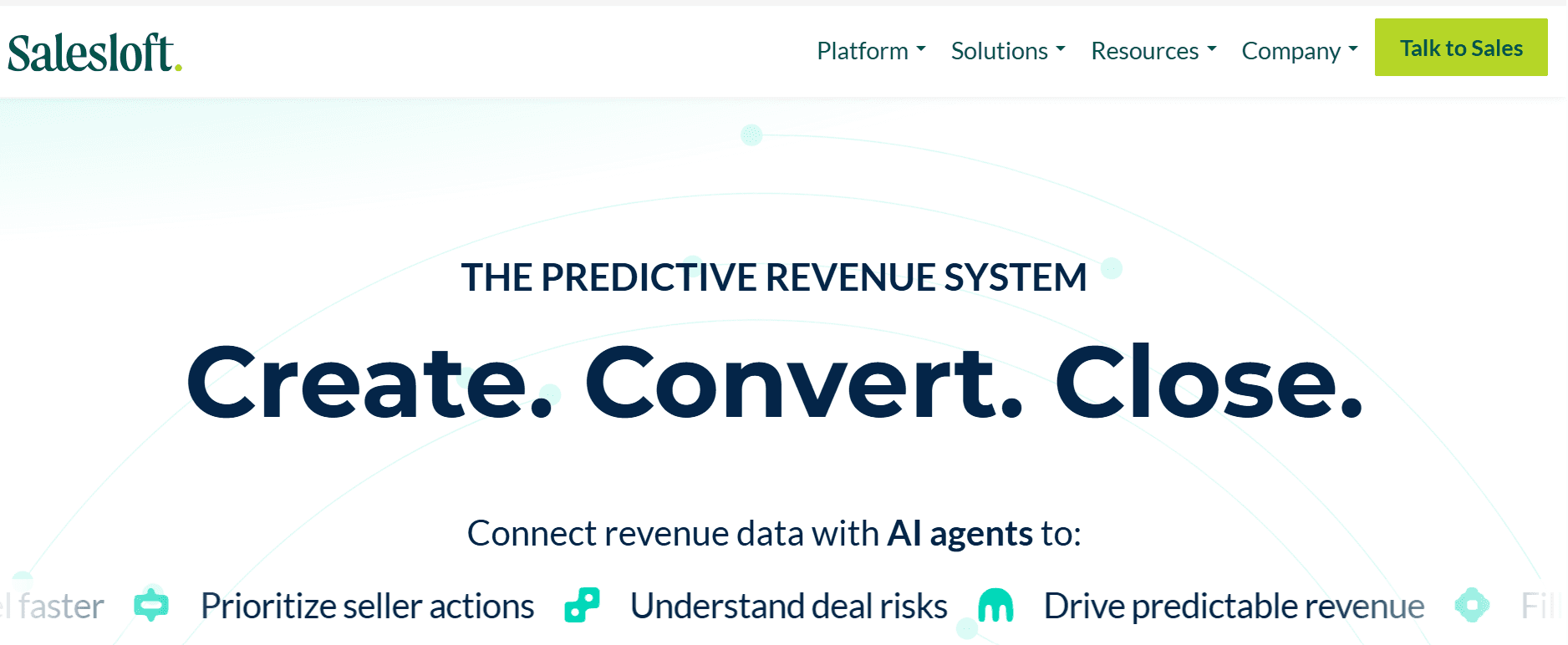
Salesloft positions itself as a revenue orchestration platform rather than point-solution sales engagement software. The platform unifies technologies that were disconnected across the entire buyer-seller trip through AI-driven workflows. Over 5,000 customers use the platform.
The architecture combines six integrated modules. Rhythm uses AI-powered action prioritization with intent signals and CRM data. Cadence provides automated multichannel sequences. Conversations offers call intelligence with AI scorecards. Deals tracks immediate deal progression and risk detection.
Forecast delivers AI-driven forecasting with rollups and scenario planning. Analytics centralizes reporting across the buyer lifecycle. A commissioned Forrester Total Economic Impact study revealed that enterprises using Salesloft can expect USD 12.00 million in increased profits and cost savings over three years.
Core Features for Enterprise Teams
Enterprise-grade capabilities launched in 2022 address complex organizational requirements. Account-based team selling allows multiple account owners to maintain a single shared view per account.
The platform provides enterprise-scale data governance embedded across Cadence, Conversations, and Deals with increased access controls. These controls protect sensitive revenue data, call recordings, and customer records to meet security, compliance, and privacy standards.
Field sellers can execute sales activities on the go with the mobile app. The app offers the most robust capabilities in sales engagement. Salesloft AI Agents work as an extension of revenue teams. They handle tedious tasks, surface insights, and anticipate next moves. The platform integrates easily with Salesforce and 75+ other revenue tools.
Pricing Structure
Salesloft operates on a custom-quote model without published pricing. Two primary packages exist:
Organization Size | Estimated Cost |
|---|---|
Per User | ~US$100–165/user/month (depending on contract size and modules) |
Small Team (≈50 users) | US$60,000–100,000+/year |
Enterprise | Custom pricing based on users, products, and services |
Pros and Cons
The cadence builder supports complex, behavior-based sequences. These sequences mix emails, calls, LinkedIn tasks, and manual touchpoints with excellent forecasting visibility. Conversation intelligence records and transcribes calls automatically while activity data syncs bidirectionally in immediate time. Customers report close rates rising by 25% as Rhythm reduced admin time.
The platform lacks a built-in contact database. This requires separate data provider subscriptions. LinkedIn automation isn’t a core capability. The dialer remains a paid add-on rather than native feature. Users cite onboarding complexity, occasional dialer lag, and steep learning curves as persistent challenges.
Pricing opacity frustrates buyers who navigate the sales process to get actual numbers. Contract terms generate recurring complaints in user reviews.
HeyIris.ai
Overview and Key Capabilities
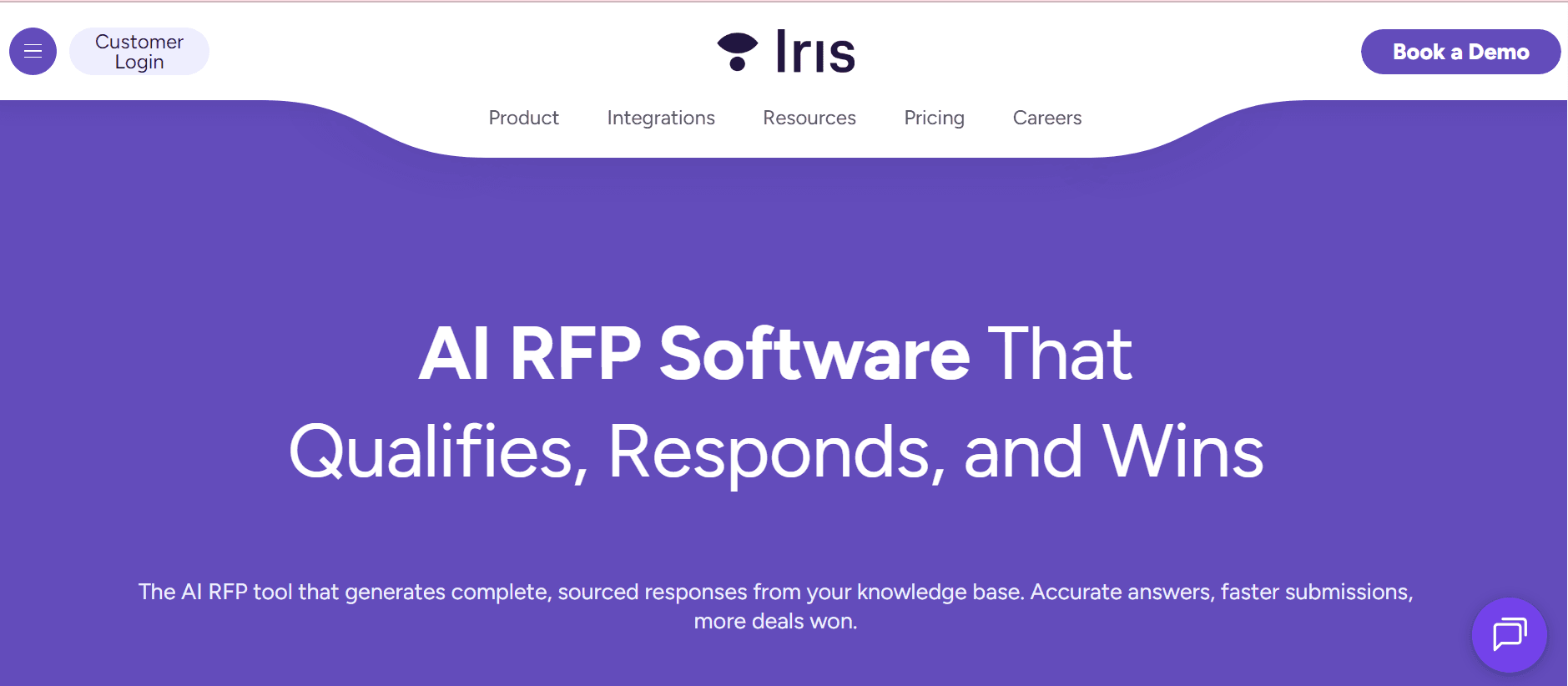
RFP responses consume massive time in enterprise sales teams. HeyIris.ai specializes in this workflow and automates RFPs, DDQs, security questionnaires, and proposals through an AI-native deal desk. The platform earns a 4.9/5 rating on G2 across 67 reviews. Teams report 60% time savings on every RFP response and annual savings that exceed USD 150,000.
General sales enablement software tools differ from HeyIris. HeyIris focuses on document generation rather than content management or training. The platform connects to existing knowledge bases like Google Drive, SharePoint, and Confluence. It generates cited first drafts in minutes rather than hours.
Core Features for Enterprise Teams
Passage-Level Citation: Every AI-generated answer traces back to its source document and specific passage. Compliance teams can verify accuracy before submission. This provenance model distinguishes HeyIris from generic content tools.
Knowledge Ledger: Centralized repository indexes all company information and identifies outdated or inconsistent content across connected systems. The platform has go/no-go analysis, SME assignment, question routing, and automated compliance checks within response workflows.
Integrations: Native connections to Salesforce, Slack, and Google Drive maintain workflow continuity. Multi-format export supports portal autofill.
Pricing Structure
Custom quote model with no published tiers. Team size, annual RFP volume, and integration requirements determine pricing. Per-user pricing with unlimited RFPs and no usage caps. Explore enablement tools that fit your response volume.
Item | Details |
|---|---|
Pricing Model | Per active user (seat-based) |
Collaborator Users | Unlimited (no extra cost) |
RFx Credits | Unlimited |
DDQ Credits | Unlimited |
Security Questionnaire Credits | Unlimited |
Free Trial | No self-service trial; free workshop and proof of concept available |
Public Price | Not disclosed |
Pros and Cons
Strengths | Limitations |
|---|---|
Response quality praised as relevant | Output quality depends on documentation depth |
60% time savings per RFP | Processing can feel slow on complex documents |
User-friendly onboarding with hands-on support | Weak tone adaptation requires manual editing |
Security questionnaire handling with traceability | Limited visual element handling |
Additional Context
Market Consolidation (2025-2026):
Seismic acquired Highspot in February 2026 (combined valuation ~USD 6 billion)
Vector Capital merged Showpad with Bigtincan in October 2025
Gong entered enablement category with Gong Enable
Market Growth:
Global sales enablement platform market growing at 17-19% CAGR
Projections: USD 12-25 billion by early 2030s
Cloud deployment accounts for 82% of market
North America holds 37-43% of global revenue
Conclusion
The right sales enablement platform depends on your organization’s specific requirements. Seismic and Highspot excel at content management. Gong dominates conversation intelligence while Mindtickle guides readiness training. Showpad serves field teams well, and Salesloft and Outreach focus on engagement orchestration. HeyIris.ai solves RFP automation.
Your decision should prioritize revenue attribution over feature lists. Explore platforms that arrange with your actual workflow rather than checking boxes on vendor comparison sheets. Request proof of revenue impact during demos, not just adoption metrics.
The platforms we tested all deliver results when implemented right. Success depends on matching capabilities to your team’s execution model and commitment to adoption.
FAQs
Which sales enablement platform is best suited for large enterprises?
The best platform depends on your specific needs. Seismic excels at content management with strong governance controls, while Gong leads in conversation intelligence and coaching.
What are the key sales enablement trends shaping 2026?
Sales enablement in 2026 has evolved from periodic training events to continuous performance systems. The major trends include AI-powered coaching and content recommendations, workflow-based support that integrates directly into daily tools.
What are the core components of an effective sales enablement strategy?
Effective sales enablement is built on five key pillars: content management (centralized, searchable resources), training and coaching (ongoing skill development), sales plays and playbooks (structured methodologies), buyer engagement tools (digital sales rooms, personalized content), and analytics and insights (measuring impact on revenue outcomes).
How is revenue enablement different from traditional sales enablement?
Revenue enablement extends beyond the sales team to include all customer-facing functions like marketing, customer success, and partner teams. While sales enablement focuses on closing deals, revenue enablement ensures consistent, high-value experiences across the entire customer lifecycle from first conversation through renewal and expansion.
What ROI can enterprises expect from sales enablement platforms?
Companies using unified sales enablement platforms report 42% higher productivity from reps and marketers. Specific outcomes include shorter sales cycles, higher win rates (up to 25% improvement), increased deal sizes (10-31% growth), and faster rep ramp time.
Similar Articles
We build with the best to make sure we exceed the highest standards and deliver real value.