Best Outbound Calling Platforms for Low-Volume Lead Pipelines
Hannah Abouchar

The best outbound calling platform for low-volume, high-value lead pipelines is the one that helps reps make each call count rather than the one that helps them make the most calls.
For teams prospecting a small, well-defined account universe where each conversation matters, the right platform provides local presence dialing to improve connect rates, AI-assisted call preparation to ensure reps enter each call with account-specific context, tight CRM integration to preserve call intelligence without manual logging, and intelligent prioritization that surfaces which accounts to call today based on buying signals rather than alphabetical order.
Nooks, Kixie, and Orum are the strongest options in this category. PhoneBurner is the best option when simplicity and price are the primary constraints.
Rox is not a dialer itself, but layers signal-based prioritization on top of whichever of these platforms a team chooses, determining which accounts get called and with what context.
This guide covers the specific challenges of low-volume precision outbound, what to look for in a platform, a comparison of the leading options, and when phone outreach outperforms email sequencing for high-value pipelines.
The low-volume calling problem
Most outbound calling platforms are engineered for volume. Parallel dialers, predictive dialers, and power dialers are designed to maximize the number of connect attempts per rep per hour, with the underlying assumption that the path to pipeline is through call volume: make 80 calls, get 8 connects, book 2 meetings.
This architecture creates friction for teams operating in the opposite model: a small number of high-value accounts where each conversation matters, where the rep needs to be prepared for the specific person they are about to speak with, and where a poorly timed or poorly prepared call does more harm than no call at all.
For precision outbound callers, the problems with volume-first dialers are specific.
Pre-loaded queues that ignore context.
Volume dialers load a list and work through it sequentially or in rotation. They do not know which account just posted a new VP of Sales hire, which company just closed a funding round, or which contact opened the rep’s email three times this morning.
The call arrives at a random moment in the buyer’s journey because the dialer has no awareness of the buyer’s current context.
Parallel dialing that produces awkward connections.
Parallel dialers initiate multiple calls simultaneously and connect the rep when a human answers.
For high-value enterprise prospects, being connected to a rep who clearly initiated three other calls simultaneously and is gathering context mid-conversation produces exactly the wrong first impression.
Local presence without call prep.
Local presence dialing, which displays a phone number from the prospect’s area code to improve answer rates, is standard in most dialers.
But answer rate improvement is only valuable if the rep is prepared to have a substantive conversation when the prospect picks up. A high connect rate combined with an unprepared rep produces negative first impressions at the accounts that matter most.
CRM logging that requires manual entry.
Many dialers produce call logs that need to be manually transcribed into the CRM after each call. For a team making 15 calls per day to high-value accounts, manual logging is a manageable overhead.
For a team making 80 calls per day, it is the reason call notes are incomplete and CRM records are unreliable.
The right platform for low-volume precision outbound addresses each of these problems: signal-based prioritization instead of list rotation, single-line dialing for enterprise-quality connections, call prep integration that surfaces account context before the call begins, and automatic CRM logging with AI-generated call summaries.
What to look for when leads are few but high-value?
Local presence dialing
Local presence dialing displays a phone number from the prospect’s area code or geographic region when the call is placed. Research consistently shows that calls from local or recognizable area codes connect at meaningfully higher rates than calls from out-of-state or 800-number displays.
For low-volume callers who need each connect attempt to count, local presence is a baseline requirement rather than a premium feature.
The quality of local presence varies across platforms. Some platforms use genuinely local numbers registered to local businesses. Others use VOIP numbers registered to the area code but with call quality or flagging issues that reduce their effectiveness.
Evaluate local presence quality specifically: ask vendors how many numbers they rotate across, how frequently they refresh flagged numbers, and what their connect rate data shows for comparable ICP segments.
Signal-based call prioritization
The most valuable prioritization feature for low-volume precision outbound is not the ability to sort contacts alphabetically or by company size.
It is the ability to sort by buying signal strength: which contacts have opened a recent email, which accounts have crossed a Bombora intent threshold, which companies have a recent leadership hire or funding announcement that creates a specific call context.
A rep who calls the account that showed a G2 Buyer Intent signal yesterday with an opener that references the category research they are doing converts that call into a meaningful conversation at a rate that cold list-order dialing cannot match.
Rox is built specifically to run this prioritization layer, writing the priority flag and call context directly to the CRM record that the dialer reads from.
The intent data for outbound prospecting guide covers the intent signal framework that should inform call prioritization for low-volume precision outbound.
AI-assisted call preparation
For high-value calls to senior buyers at named accounts, arriving unprepared is not a neutral outcome. It is a negative one: the prospect recognizes immediately that the rep does not know their company, their context, or their current situation, and the call ends before it begins in any meaningful sense.
AI call preparation tools pull the account’s recent news, the contact’s LinkedIn activity and professional history, the CRM record of prior interactions, and any relevant product usage or intent signals into a pre-call brief that the rep reviews in the 60 seconds before the call connects.
This brief does not guarantee a good call, but it provides the raw material for an account-specific opening line rather than a generic introduction.
The best platforms surface this pre-call context automatically within the dialer interface rather than requiring the rep to visit a separate research tool, switch to the CRM, and then navigate back to the dialer.
The sales research importance guide covers the research workflow that pre-call AI preparation supports and where it fits in the broader prospecting preparation process.
Automatic CRM logging and call summaries
Manual CRM entry after each call is the task that most reliably degrades with rep workload. When a rep is making 15 precision calls per day to high-value accounts, they can log calls manually with acceptable quality.
When volume increases or the workload extends beyond calls, manual logging quality degrades and CRM records become unreliable precisely for the accounts that matter most.
Platforms that automatically log calls to the CRM with an AI-generated summary of the key points discussed, the next step agreed, and the action items from the conversation eliminate the manual entry requirement without sacrificing the CRM data quality that pipeline management depends on.
For low-volume callers, the accuracy of the call summary matters as much as its existence: a summary that mischaracterizes what was discussed in an important call is worse than no summary.
Call recording and coaching integration
For small teams where each call is a meaningful data point, the ability to review call recordings against a coaching framework is particularly valuable.
A rep who makes 15 precision calls per week has 15 coaching opportunities per week rather than 80 calls that blend together.
Platforms that tag call recordings by topic (discovery question, objection, competitive mention, next step discussion) and surface the specific moments relevant to coaching conversations allow managers to provide targeted feedback on the interactions that carry the most weight.
The coaching sales strategies guide covers how to build a call review and coaching program that produces behavioral improvement from a small call volume rather than only being useful at high-volume call centers.
Platform comparison: outbound calling platforms for low-volume pipelines
Nooks
Overview:
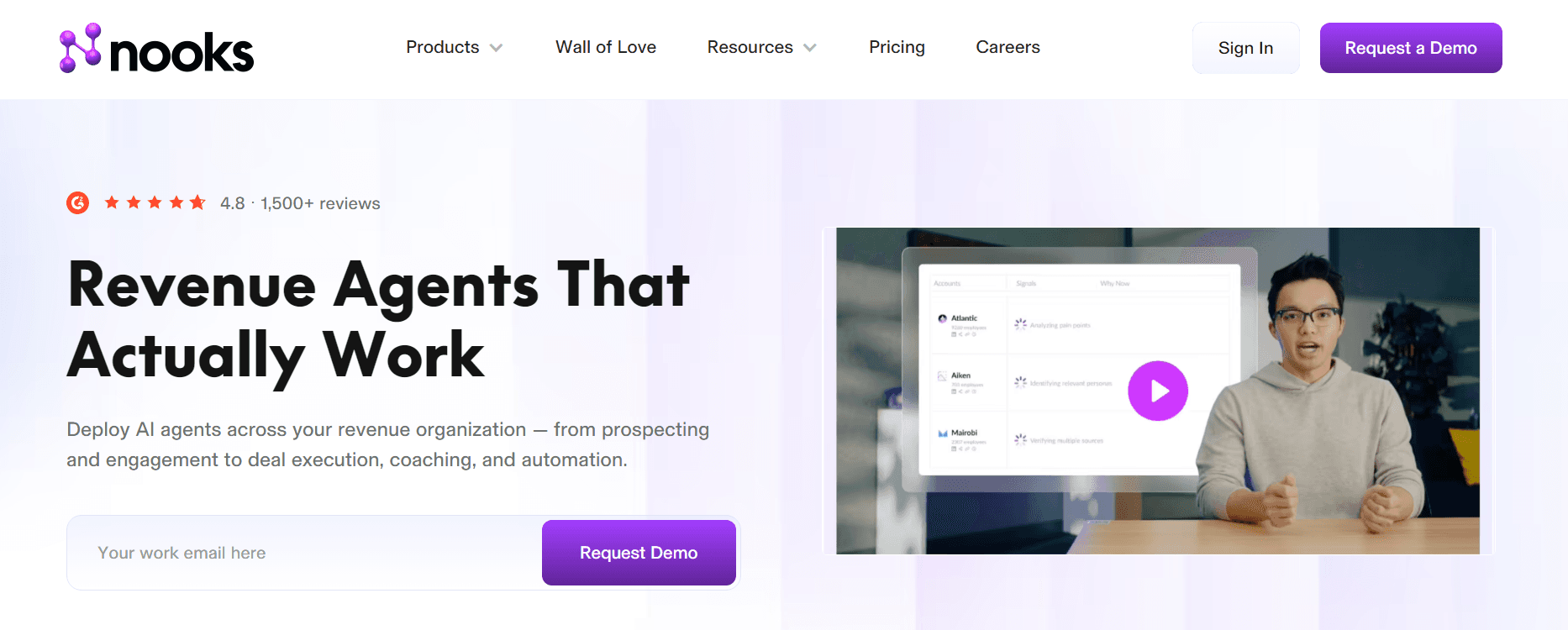
Nooks is an AI-powered sales development platform that combines virtual sales floor capabilities, parallel dialing with AI filtering to detect live human answers, and AI-generated call prep with post-call summaries.
Nooks positions itself as a platform for SDR teams that want to increase the quality and quantity of conversations without proportional headcount growth.
Strengths for low-volume precision outbound:
AI call prep that surfaces account context before the call connects, drawn from CRM data and integrated research sources
AI filtering in the parallel dialing mode that connects the rep only to live human answers rather than voicemails or disconnected numbers, which reduces wasted connects even when call volume is moderate
Virtual sales floor that allows small teams to work collaboratively with shared visibility into call activity, which improves accountability and coaching without requiring a physical office
Post-call AI summaries logged automatically to the CRM with next step extraction
Considerations:
Nooks is built with a team environment and moderate call volume in mind.
For individual contributors making very low call volumes (5 to 10 per day) to named accounts, some of Nooks’ collaborative features add overhead without proportional benefit.
The parallel dialing capability, while filtered for quality, is more suited to semi-precision outbound than to single-line enterprise calling where connection quality is paramount.
Best for:
SDR teams of 3 to 15 reps doing semi-precision outbound with moderate call volumes where AI call prep and collaborative visibility are the primary requirements.
Pricing:
Contact Nooks for current pricing. Positioned for growth-stage sales teams.
Kixie

Overview:
Kixie is a business phone system and sales dialer built for teams that want deep CRM integration, local presence, and powerful automation without the complexity of enterprise communication platforms.
Kixie’s PowerCall dialer and its AI-powered features make it one of the most capable platforms for teams that need both single-line quality calling and intelligent prioritization.
Strengths for low-volume precision outbound:
Local presence across hundreds of area codes with a large, frequently refreshed number pool that maintains connection rates by rotating around flagged numbers
Intelligent call prioritization through its integration with HubSpot, Salesforce, and other CRMs: the dialer can surface call priority based on deal stage, last activity, and engagement signals from the CRM record
PowerDialer mode for single-line precision calls with pre-call screen that shows CRM data before the call connects
Native HubSpot and Salesforce integration with automatic call logging, recording, and AI call summary
SMS and email coordination from the same platform, allowing a multi-touch follow-up immediately after a call without switching tools
Considerations:
Kixie’s call quality and local presence are consistently rated among the best in the category on G2.
The platform is less specialized for AI-assisted research prep than Nooks: it surfaces what is in the CRM but does not pull external research or real-time company news the way AI-first platforms do.
Teams that need pre-call context from sources beyond the CRM will use a separate research tool alongside Kixie.
Best for:
Teams of 1 to 20 that prioritize connect rate quality and CRM integration depth over AI-generated research prep. Particularly strong for HubSpot-native teams.
Pricing:
From approximately $35 per user per month for the basic plan with PowerDialer and local presence. Enterprise plans with full AI features are priced higher.
Orum
Overview:
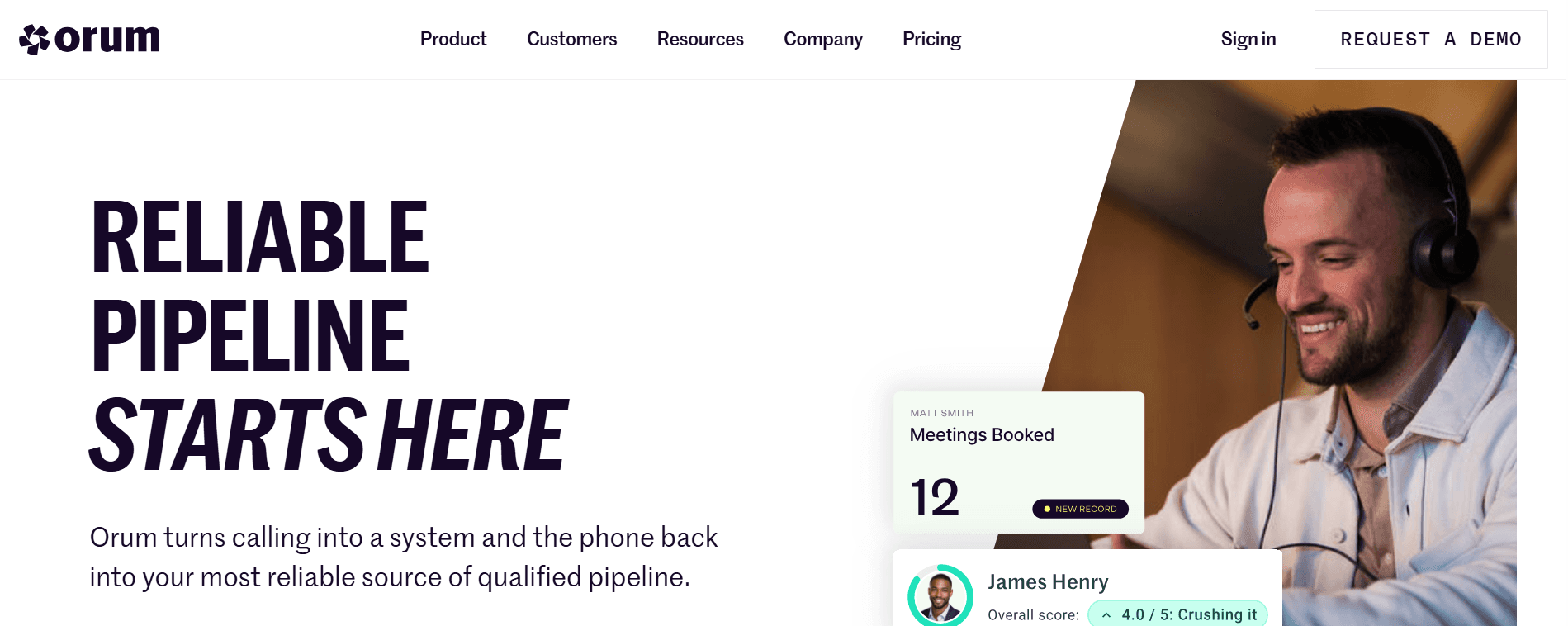
Orum is an AI-powered live conversation platform that uses AI to detect human answers, skip voicemails and gatekeepers, and connect reps only to live conversations.
Orum’s core value proposition is conversation density: maximizing the number of substantive human conversations per hour of dialing time.
Strengths for low-volume precision outbound:
AI-powered answer detection that connects reps to live humans with high accuracy, reducing the time spent navigating voicemail and automated attendants
Conversation intelligence built into the platform that records and transcribes calls, tags topics, and surfaces coaching insights without requiring a separate conversation intelligence tool
Salesforce and HubSpot integration with automatic call logging and CRM record updating after each call
Sales floor functionality that allows managers to listen in, whisper coach, or barge into calls in real time, which is valuable for call coaching on high-stakes enterprise conversations
Considerations:
Orum’s AI answer detection and conversation flow is designed for teams calling at moderate to high frequency.
For teams making 5 to 10 calls per day to senior enterprise contacts, the platform’s answer detection capability is less differentiating because the rep’s connection attempts are inherently lower-volume.
The coaching and conversation intelligence features are strong, but teams making very few calls per day may not generate enough call volume to produce statistically meaningful coaching patterns.
Best for:
Teams making 15 to 50 calls per day who want AI answer detection to maximize conversation density within that call volume, with strong coaching and CRM integration as secondary requirements.
Pricing:
Custom pricing. Typically positioned for sales teams of 5 or more reps.
PhoneBurner

Overview:
PhoneBurner is a power dialer and sales engagement platform that provides single-line dialing, local presence, voicemail drop, and basic CRM integration at a price point accessible to individual contributors and small teams.
It lacks the AI call prep and coaching sophistication of Nooks and Orum but delivers the core calling workflow at a fraction of the cost.
Strengths for low-volume precision outbound:
Single-line power dialer that does not parallelize calls, which maintains connection quality and eliminates the awkward multi-dial connection moment that enterprise prospects notice
Voicemail drop that allows reps to leave a pre-recorded voicemail with one click rather than recording a live voicemail on every unanswered call, which saves 30 to 60 seconds per unanswered call and allows the rep to move to the next call immediately
Local presence across major US area codes with a reasonably refreshed number pool
Basic CRM integration with Salesforce, HubSpot, and others through native connectors
Most affordable platform in this comparison for individual contributors
Considerations:
PhoneBurner’s AI and intelligence capabilities are limited compared to Nooks, Kixie, and Orum. There is no AI call prep, no conversation intelligence, and no signal-based prioritization.
The platform is fundamentally a power dialer with local presence and voicemail drop. For teams where those three features are sufficient and budget is the primary constraint, PhoneBurner delivers strong value.
For teams that need AI-assisted prep and coaching, PhoneBurner requires supplementing with separate tools.
Best for:
Individual contributors and small teams (1 to 5 reps) making 10 to 30 calls per day who need a reliable, affordable power dialer with local presence and voicemail drop but do not require AI-assisted preparation or conversation intelligence.
Pricing:
From approximately $127 per user per month, billed annually.
Comparison table: calling platforms for low-volume, high-value outbound
Rox is not a calling platform and isn't scored against the criteria below. It provides the signal-based prioritization and call-context layer that feeds into whichever dialer you choose see 'How Rox integrates' below.
Feature | Rox | Nooks | Kixie | Orum | PhoneBurner |
|---|---|---|---|---|---|
Single-line precision calling | N/A Rox is not a calling platform | Yes | Yes (PowerDialer) | Yes | Yes |
Parallel/AI-filtered dialing | N/A | Yes | Yes | Yes | No |
Local presence quality | N/A | Good | Excellent | Good | Good |
AI call prep (external research) | N/A | Yes | Limited (CRM only) | Limited | No |
Signal-based prioritization | N/A | Partial | Via CRM integration | Via CRM integration | No |
Post-call AI summary | N/A | Yes | Yes | Yes | No |
CRM auto-logging | N/A | Yes | Yes (deep native) | Yes | Yes (basic) |
Conversation intelligence | N/A | Partial | Partial | Yes | No |
Live coaching capability | N/A | Yes | Partial | Yes | No |
Starting price | N/A | Contact for pricing | From $35/user/month | Custom | From $127/user/month |
Best for low-volume precision | Any team using signal-based call prioritization on top of one of these dialers | SDR teams 3 to 15 | Teams of 1 to 20 | Teams of 5 and up | Individuals and 1 to 5 rep teams |
When low-volume calling beats high-volume sequencing?
Phone outreach is not the right channel for every prospect or every stage of the sales process. But there are specific situations where a well-prepared call to a senior buyer produces a better outcome than any email sequence, regardless of how well personalized the email is.
Senior buyers who do not respond to email
VP and C-level buyers at enterprise accounts receive hundreds of emails per day. Many have executive assistants who screen their email.
A well-prepared, relevant phone call that reaches the buyer directly produces a conversation that email cannot.
For enterprise SaaS and technology sales where the economic buyer is a CRO or VP of Engineering, phone is frequently the only channel that produces a direct conversation with the decision-maker rather than a forwarded email to a junior team member.
Accounts with strong recent context
A company that closed a $50M Series C yesterday has a specific, time-bounded window where a phone call with a rep who references the funding and connects it to a relevant business challenge produces a more receptive conversation than an email in the same context.
Phone outreach allows the rep to adapt in real time to the prospect’s response rather than waiting for an email reply that may arrive days later if it arrives at all.
Late-stage deal acceleration
When a deal has been in the pipeline for 30 days without a signed agreement and email follow-up has produced no response, a well-timed call to the champion or the economic buyer often produces more movement than another email.
The call demonstrates commitment, allows the rep to surface the specific obstacle blocking the deal, and creates an opportunity for a real-time conversation that email cannot replicate.
The sales closing techniques guide covers when to shift from email to phone in the late-stage pipeline management motion.
Re-engaging stalled accounts
Accounts that were engaged 60 to 90 days ago and have since gone quiet are often better re-engaged through phone than email, because the email channel has been established and has produced diminishing returns.
A phone call from the rep creates pattern interruption and allows the rep to acknowledge the gap directly: “I know we have not spoken since March.
I wanted to reach out before the end of the quarter because X has happened at your company since we last talked, and I thought it was worth a conversation.”
Following up on a specific trigger event
When a monitoring tool identifies that a prospect has visited the pricing page three times in the last 48 hours, a phone call within 24 hours is likely to produce a more productive conversation than an email because the prospect is actively evaluating and is receptive to a direct conversation. Email allows the prospect to defer.
A call creates an immediate interaction at the moment of maximum intent. The real-time data guide covers how real-time engagement signals should trigger calling activity as part of the multi-channel outreach motion.
How does Rox integrate with outbound calling platforms?
Rox does not replace an outbound calling platform. It provides the intelligence layer that determines which accounts and contacts to call, when to call them, and what context to reference when the call connects.
For sales teams using Kixie, Orum, Nooks, or PhoneBurner as their calling tool, Rox integrates with the CRM that sits between the two systems.
When Rox identifies a Tier A account based on a signal cluster, it writes the account brief, the priority flag, and the specific calling context to the CRM account record.
The calling platform reads the CRM priority and surfaces that account at the top of the rep’s call queue with the Rox-generated brief visible in the pre-call screen.
The rep sees: this account closed a Series B three weeks ago, posted a RevOps Director role last week, and shows a Bombora intent surge in the revenue intelligence category as of yesterday. They have a specific, contextual reason to call today.
They know what to say in the first 15 seconds. The calling platform executes the call. Rox provided the intelligence that made the call worth making.
This architecture is the reason that signal-based calling outperforms list-based calling for the same account universe. The call volume is similar. The conversion rate from call to conversation to meeting is not.
The best sales prospecting tools guide covers how signal intelligence platforms and calling tools divide the prospecting workflow for teams that use both.
FAQ
Which outbound calling platform is best for low-volume leads that still provide value?
For low-volume, high-value lead pipelines, Kixie is the strongest all-around platform: it delivers excellent local presence quality, deep CRM integration with automatic logging, and a PowerDialer mode that maintains single-line connection quality without parallel dialing. Nooks is the best choice for small SDR teams that prioritize AI call prep and collaborative team features.
Which outbound calling platform is best for lower-volume leads that still deliver value?
For lower-volume precision outbound where each conversation is high-stakes, the platform that most improves the quality of each call, not just the quantity of calls made, is the right choice. Kixie’s local presence quality and CRM-native call prioritization improve connect rates and ensure each call arrives with the CRM context the rep needs.
What should I look for in a calling platform for a small number of high-value accounts?
For a small number of high-value accounts, prioritize: local presence quality to maximize connect rates on a limited number of attempts, signal-based or CRM-signal-informed call prioritization to surface the accounts most likely to be receptive today, AI call prep that provides account-specific context before the call connects, and automatic post-call CRM logging with AI summaries that preserve call intelligence without manual entry.
When does calling outperform email for low-volume outbound?
Calling outperforms email for senior buyers who do not respond to email, for accounts where a recent trigger event creates a specific contextual opening, for late-stage deal acceleration when email has produced no response, for re-engaging accounts that have gone quiet, and for following up immediately on high-intent behavioral signals like pricing page visits or demo request completions.
Do I need a calling platform if I am already using a sales engagement platform?
Most sales engagement platforms, including Outreach and Salesloft, include a built-in dialer. For teams making 20 to 50 calls per day alongside a full email sequencing motion, the embedded dialer in the engagement platform is often sufficient.
The sales engagement tools guide covers how to evaluate whether a dedicated calling platform adds value on top of an existing engagement platform.
Similar Articles
We build with the best to make sure we exceed the highest standards and deliver real value.