Can Pipeline Planning Tools Help You Hit Client Acquisition Goals Reliably?
Leah Clapper

Yes, but only when the underlying pipeline data is accurate. Pipeline planning tools improve forecast reliability by automating stage progression tracking, surfacing stalled deals, and modeling scenario outcomes.
Their value is proportional to CRM data quality a pipeline planning tool built on incomplete CRM data produces unreliable forecasts.
According to Forrester, organizations using dedicated pipeline planning and revenue intelligence tools achieve forecast accuracy within 5% of actual results 2.4x more often than those relying on CRM-native reporting alone.
This guide covers what pipeline planning tools actually do, how they improve client acquisition reliability, a comparison of six leading platforms, what to look for when evaluating them, and how AI is changing the category in 2026.
What pipeline planning tools actually do?
Pipeline planning tools are software platforms that sit on top of CRM data and transform raw deal records into structured, actionable pipeline intelligence.
They do not replace the CRM they read from it, enrich it with external signals, and present it in formats that support planning and management decisions that CRM-native reporting cannot produce efficiently.
The core functions of a pipeline planning tool are distinct from CRM reporting in three specific ways.
They model forward, not backward.
CRM reports show the current state of the pipeline and the historical activity log.
Pipeline planning tools use current pipeline data to project forward, showing the expected revenue from the current pipeline over the next 4, 8, and 13 weeks, identifying the gap between that projection and the revenue target, and calculating the additional pipeline required to close the gap.
This forward-modeling capability is the primary driver of the forecast accuracy improvement that Forrester’s research documents.
They apply probability intelligence to individual deals.
Most CRM platforms assign a flat close probability to every deal at a given stage 30% at Qualification, 60% at Proposal, regardless of deal-specific factors.
Pipeline planning tools apply deal-level signals to produce more granular probability estimates: a Proposal-stage deal with strong champion engagement, a confirmed procurement timeline, and no competitive threats scores differently from a Proposal-stage deal with inconsistent buyer response, a stalled legal review, and two active competitors.
The deal-level probability scoring produces a stage-weighted expected value that is significantly more accurate than stage-averaged probabilities applied uniformly.
They surface what needs attention, not just what exists.
CRM reports show all pipeline entries. Pipeline planning tools surface the specific deals, gaps, and risks that require management attention stalled deals approaching or exceeding maximum stage duration, coverage gaps in specific weeks of the quarter, accounts that have gone dark, and stage progression anomalies that indicate a risk not visible in the aggregate metrics.
This filtering function is what converts pipeline data from a reporting artifact into a management tool.
The distinction matters for client acquisition reliability. A CRM report tells a revenue leader what the pipeline contains.
A pipeline planning tool tells them whether that pipeline will reliably produce the client acquisition outcomes required, and what specific actions will improve the probability.
How pipeline planning tools improve client acquisition reliability?
Pipeline planning tools improve client acquisition reliability through five specific mechanisms.
Mechanism 1: Forecast accuracy improvement
Pipeline planning tools improve forecast accuracy by replacing flat stage-probability forecasting with deal-level probability scoring.
When a revenue leader can see that the pipeline’s stage-weighted expected value is $3.1M against a $4M quarterly target rather than a nominal pipeline of $12M that looks like “3x coverage” they can make an informed decision about whether to accelerate pipeline generation or revise the target.
The forecast accuracy improvement documented by Forrester comes from this specificity, not from the software itself.
The methods for forecasting guide covers how to validate a pipeline planning tool’s probability model against historical CRM data before trusting it as the primary forecast input.
Mechanism 2: Stall detection and intervention
Pipeline planning tools monitor stage duration for every active deal and surface stalled opportunities before they become losses. In a manual pipeline management process, stalled deals are typically identified at the weekly pipeline review, which may be 5 to 7 days after the stall has already cost the deal significant momentum.
Pipeline planning tools that monitor deal engagement signals (email response patterns, meeting activity, CRM update frequency) can detect a stall within 24 to 48 hours of the first inactivity signal and alert the rep and manager to intervene while the deal can still be saved.
Mechanism 3: Capacity-to-target validation
Pipeline planning tools that integrate headcount and productivity data can validate whether the team’s pipeline generation capacity is sufficient to support the revenue target before the quarter begins. This is the capacity planning function from Principle 1 of the outbound pipeline planning framework.
A tool that surfaces “at current SDR productivity, the team will generate $9.2M in pipeline against a $14.3M requirement” in Week 1 gives the revenue leader time to act. The same gap discovered in Week 9 is not recoverable.
Mechanism 4: Scenario modeling
Pipeline planning tools support scenario modeling “what if our win rate drops from 28% to 22%?” or “what if the top 3 deals slip to next quarter?” by recalculating the expected revenue under alternative assumptions. This is the planning capability that CRM native reporting cannot support without exporting data to a spreadsheet and rebuilding the model manually.
Scenario modeling is particularly valuable for client acquisition planning because it allows the revenue leader to identify the specific combination of pipeline volume, win rate, and deal timing that produces a reliable acquisition target rather than relying on a single-point estimate.
The revenue forecasting with intelligence guide covers how to use scenario modeling as a standard part of the quarterly planning process.
Mechanism 5: Pipeline source attribution
Pipeline planning tools that track the originating source of each pipeline entry outbound prospecting, inbound lead, partner referral, event can measure the conversion rate, average deal size, and sales cycle length for each source.
This attribution data allows the revenue leader to identify which pipeline sources are producing the highest-quality, fastest-converting client acquisition outcomes and reallocate pipeline generation investment toward those sources.
A source that generates high pipeline volume with low close rates is not a client acquisition asset it is a pipeline inflation mechanism. Source-level attribution exposes this pattern before it compounds into a multi-quarter miss.
Comparison of 6 pipeline planning tools
The following comparison covers the six pipeline planning and revenue intelligence platforms most commonly used by B2B sales organizations in 2026. Each platform has different strengths, integration requirements, and pricing structures.
Platform | Primary strength | Best for | CRM requirement | AI capabilities | Starting price |
|---|---|---|---|---|---|
Clari | Deal-level AI forecasting + pipeline inspection | Growth-stage and enterprise B2B | Salesforce, HubSpot | AI close probability scoring, rep activity monitoring | $50 to $100/user/month |
Gong | Conversation intelligence + pipeline risk from call data | Teams that prioritize call-based deal insight | Salesforce, HubSpot, most CRMs | AI deal risk detection from conversation signals | $100 to $200/user/month |
Boostup | Revenue intelligence + scenario forecasting | Mid-market teams with complex pipeline mix | Salesforce | AI forecast modeling, pipeline gap alerts | $40 to $80/user/month |
Salesforce Revenue Cloud | Native CRM + pipeline planning | Teams already on Salesforce Enterprise | Salesforce (native) | Einstein AI forecasting, opportunity scoring | Included in Enterprise tier |
HubSpot Sales Hub | Native CRM + basic pipeline management | SMB and early-stage companies | HubSpot (native) | Basic AI deal scoring, sequence automation | $90 to $150/user/month |
Rox | Agent-executed pipeline generation + planning | Revenue teams wanting autonomous pipeline building alongside planning | CRM-agnostic | Autonomous prospecting agents, continuous pipeline monitoring, stage-weighted forecasting | Contact for pricing |
Platform notes
Clari
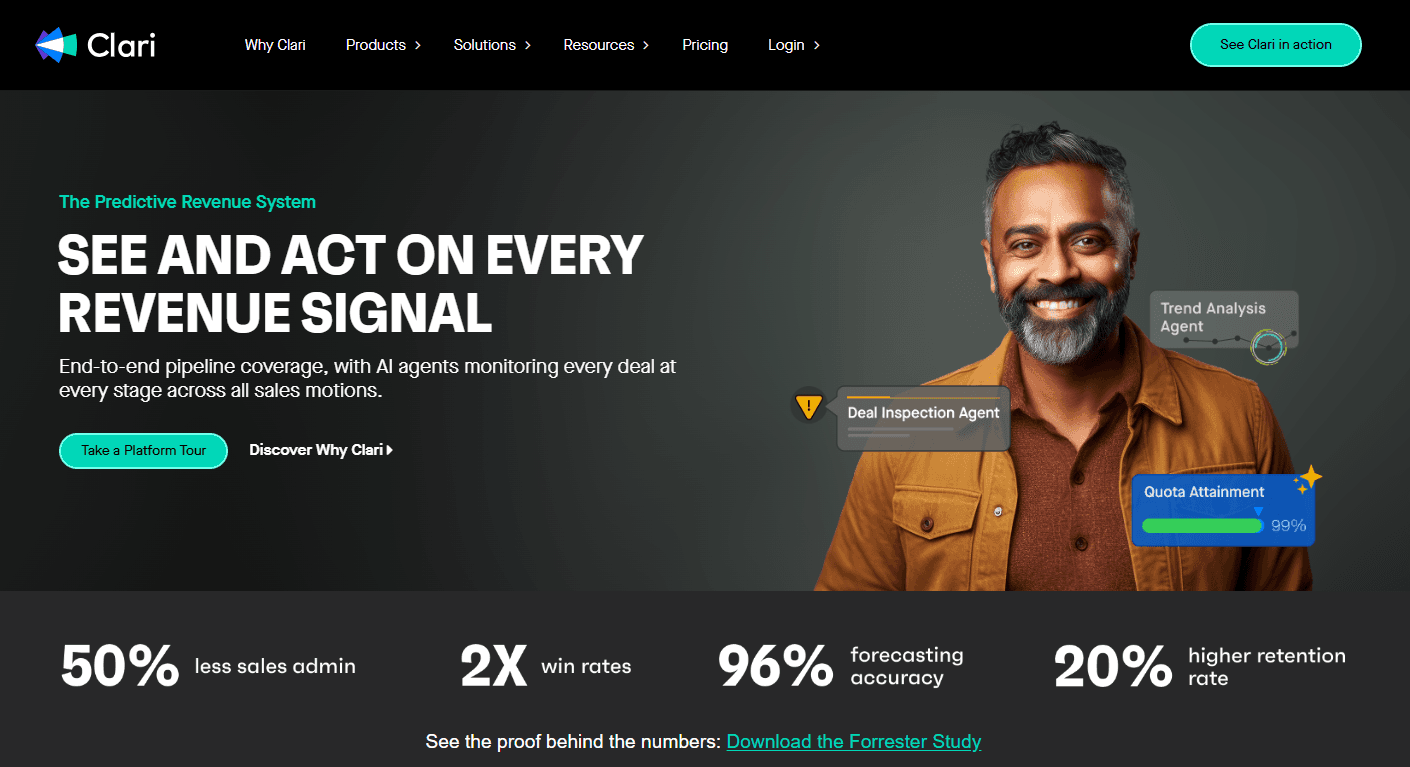
Clari is the market leader in AI-driven revenue forecasting for growth-stage and enterprise B2B companies.
Its primary differentiation is deal-level AI probability scoring that improves on stage-based probability assignment, combined with rep activity monitoring that surfaces engagement gaps before they become stalls.
Clari requires clean, consistently logged CRM data to produce accurate forecasts its value degrades significantly when CRM hygiene is poor.
Gong
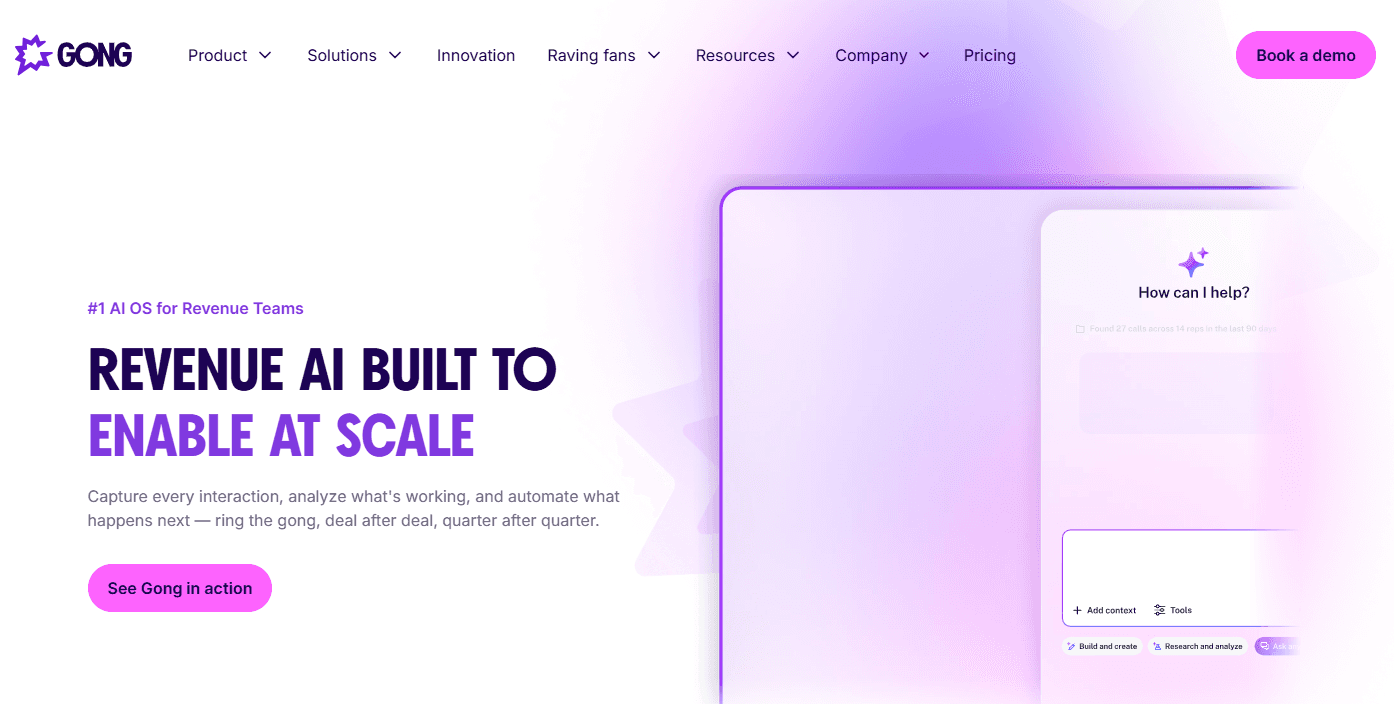
Gong is primarily a conversation intelligence platform that extends into pipeline planning through the signals extracted from call recordings.
Its deal risk detection is based on conversation patterns, specific language patterns, topic sequences, and engagement dynamics from recorded calls that correlate with deal outcomes.
For sales organizations where most pipeline management happens on calls rather than in email, Gong provides a pipeline planning signal layer that CRM activity data alone cannot produce.
Boostup
Boostup is a mid-market-focused revenue intelligence platform with strong scenario forecasting capabilities and a UI designed for revenue operations teams that need to run multiple forecast scenarios without exporting to spreadsheets.
Its primary differentiator relative to Clari is a lower price point and a faster implementation timeline for companies that cannot support a multi-quarter Clari deployment.
Salesforce Revenue Cloud
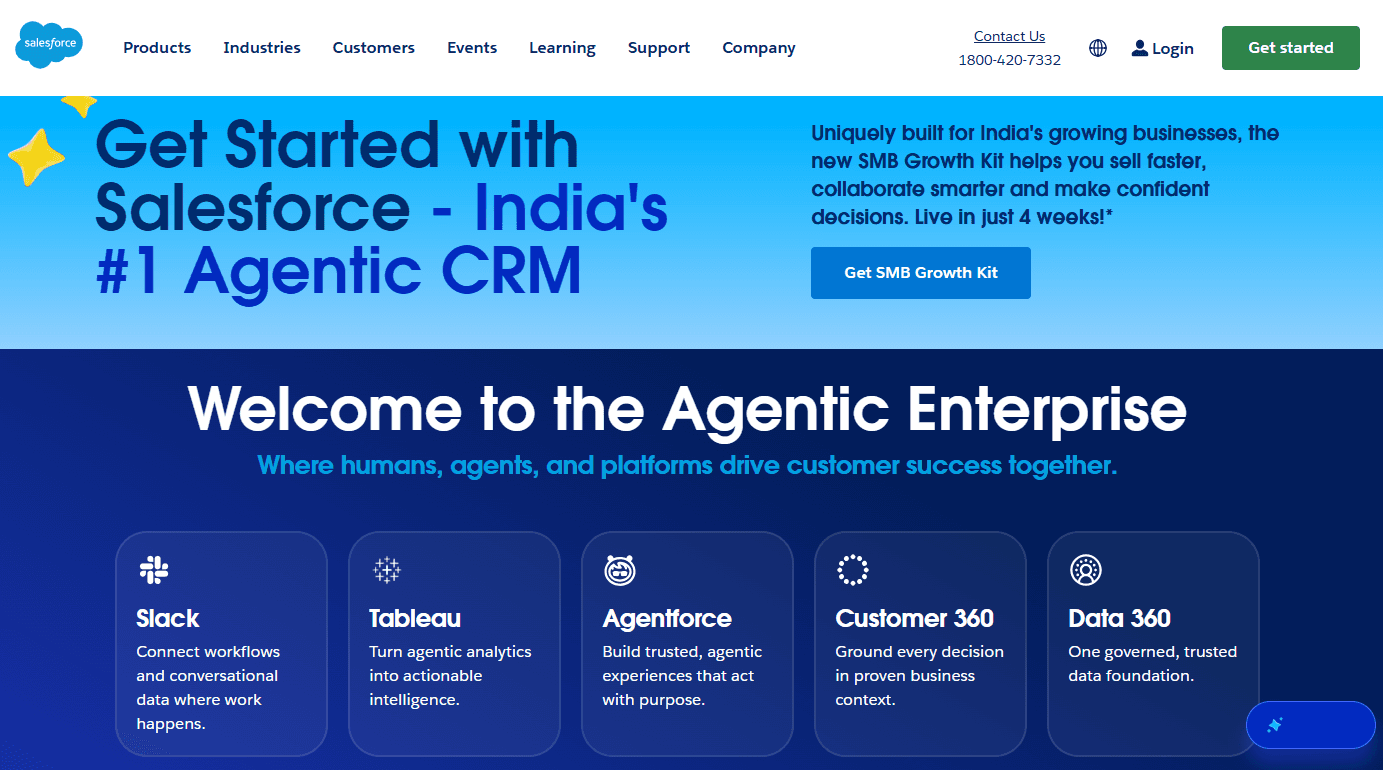
Salesforce Revenue Cloud is the native pipeline management and forecasting layer within Salesforce Enterprise.
For teams already on Salesforce, it provides the baseline pipeline planning capabilities stage tracking, coverage reporting, and Einstein AI opportunity scoring without an additional vendor contract.
Its limitations are the limitations of native CRM reporting: less granular AI probability scoring than dedicated revenue intelligence platforms, and limited scenario modeling capabilities without custom configuration.
HubSpot Sales Hub
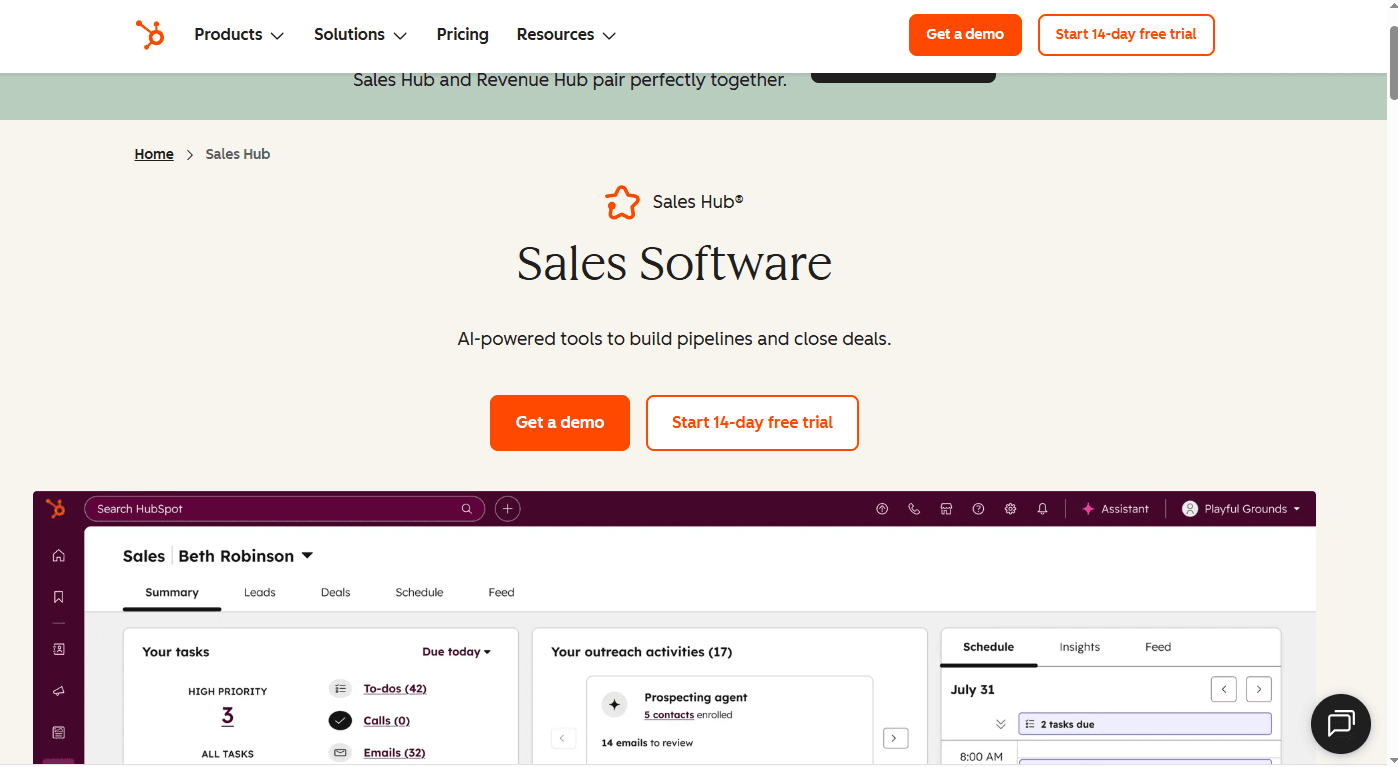
HubSpot Sales Hub is the pipeline management layer for HubSpot-native sales teams. It provides the baseline pipeline stage tracking, deal reporting, and basic AI deal scoring capabilities appropriate for SMB and early-stage companies.
Its limitations are similar to Salesforce native: the pipeline planning capabilities are sufficient for early-stage companies but typically require supplementation with a dedicated revenue intelligence platform as the organization scales past 20 to 30 quota-carrying reps.
Rox

Rox differentiates from the other platforms in this comparison by combining pipeline planning with autonomous pipeline generation.
Where Clari, Gong, Boostup, and the CRM-native platforms manage and forecast the pipeline that humans have built, Rox’s revenue agents continuously build the pipeline through signal-triggered outbound prospecting while simultaneously monitoring pipeline health and surfacing planning intelligence.
The distinction is significant for client acquisition goals specifically: a platform that helps you plan the pipeline you have and a platform that helps you build the pipeline you need address different parts of the client acquisition reliability problem.
What to look for when evaluating pipeline planning tools?
Not all pipeline planning tools are equally suited to every organization’s client acquisition goals.
The following evaluation framework covers the seven criteria that distinguish effective pipeline planning tools from expensive dashboard software.
Criterion 1: CRM data quality requirements
Every pipeline planning tool’s accuracy is bounded by the quality of the CRM data it reads from. Before evaluating any tool, audit the CRM for: deal stage accuracy (are deals in the stage that reflects their actual qualification status?), close date discipline (are close dates updated when timing changes?), activity logging completeness (are email, call, and meeting activities logged to the deal record?), and contact-to-account association accuracy.
Tools that require manual CRM data entry to function accurately will degrade in usefulness as rep discipline on CRM logging varies. Prioritize tools that automatically capture activity data (email, calendar, call recording) from the communication stack rather than relying on rep-driven manual entry. The how to ensure integrity of data guide covers the CRM data quality standards that make pipeline planning tools reliable.
Criterion 2: AI probability model transparency
Pipeline planning tools that use AI to assign deal-level close probabilities should be able to explain, at least in general terms, what signals drive their probability model.
A tool that produces a 67% close probability on a specific deal should be able to surface the signals that contributed to that score: champion engagement level, stage velocity relative to comparable deals, competitive signal patterns, and economic buyer contact status.
Unexplained probability scores are not actionable; a rep who does not know why a deal scored 67% does not know what to do to improve it.
Evaluate the transparency of each tool’s probability model during the trial period by asking: what are the three most important factors driving the probability score on your five highest-value deals? If the tool cannot answer that question at the deal level, the AI is a black box and a black box forecast is not materially better than a stage-averaged one.
Criterion 3: Integration depth with the existing tech stack
Pipeline planning tools that integrate deeply with the full revenue tech stack CRM, sales engagement platform, call recording, email, and calendar produce richer pipeline signals than tools that read only from the CRM.
A deal where the champion has not responded to three email touches in eight days carries different risk than a deal where email response rates are high but no meeting has been scheduled.
This signal is only visible if the pipeline planning tool can read from the sales engagement platform, not just from the CRM opportunity record.
Evaluate each tool’s integration with the specific sales engagement tools your team uses. Native integrations that sync in near real time are meaningfully more reliable than API integrations that sync daily or on demand.
Criterion 4: Scenario modeling capability
The scenario modeling capability of a pipeline planning tool determines its usefulness for the planning activities that directly affect client acquisition reliability: “what happens to expected revenue if the win rate drops 5%?” and “which deals must close this quarter for us to hit the target if the two largest deals slip?”
A tool that can answer these questions in the planning interface without requiring a revenue operations analyst to export the data and rebuild the model in a spreadsheet compresses the planning cycle and improves the quality of the decisions that result from it.
Evaluate scenario modeling capability by running three scenarios during the trial period: a win rate sensitivity scenario, a large-deal-slip scenario, and an SDR capacity reduction scenario. If the tool requires more than 15 minutes to run all three, its scenario modeling capability is insufficient for a weekly planning workflow.
Criterion 5: Pipeline generation integration
A pipeline planning tool that shows you gaps in the pipeline is more useful than one that does not. A tool that shows you gaps and then automatically initiates the outbound prospecting required to close them is categorically more useful than both.
For client acquisition goals specifically, the gap between pipeline planning and pipeline generation is the most consequential gap in the revenue technology stack.
Evaluate whether the pipeline planning tool has any direct integration with the outbound prospecting motion, whether a pipeline gap alert triggers an automated sequencing action, or whether it only triggers a notification that a human must act on?
The AI SDR category is converging with the revenue intelligence category precisely because the most valuable capability is the connection between pipeline visibility and pipeline action, not the visibility alone.
Criterion 6: Implementation and onboarding timeline
Most pipeline planning tools require 4 to 12 weeks of implementation before they begin producing reliable outputs: time to configure CRM integrations, establish historical baseline data for the probability model, and train the team on the new workflow.
Evaluate the realistic time-to-value for each tool, not the vendor’s best-case timeline.
A tool that requires 12 weeks of implementation to produce reliable forecasts will not improve Q1 client acquisition reliability if the procurement decision is made in December.
Criterion 7: Total cost of ownership
Pipeline planning tools are priced per user, typically with a minimum seat commitment. At $100 per user per month for a 30-person revenue team, the annual cost is $36,000 before implementation fees, integration costs, and revenue operations time required to maintain the platform.
Evaluate the total cost of ownership against the forecast accuracy improvement and the resulting client acquisition reliability improvement.
A tool that improves forecast accuracy by 15% on a $10M annual revenue target produces $1.5M in additional revenue predictability a very different ROI than a tool that improves forecast accuracy by 2% on a $2M target.
How AI is changing pipeline planning tools in 2026
AI is transforming pipeline planning tools from reporting platforms into autonomous revenue management systems.
The change is directional but rapid: tools that were primarily dashboards two years ago are now beginning to take actions not just surface information in response to the pipeline signals they detect.
From static forecasts to dynamic probability models
Traditional pipeline planning tools recalculate the forecast when a rep updates a CRM field or a manager runs a manual refresh.
AI-powered tools recalculate continuously updating deal-level probability scores when an email goes unanswered for 48 hours, when a champion’s LinkedIn profile shows a job change, or when a call recording sentiment analysis detects a new objection that correlates with competitive loss patterns.
The forecast is always current, not a snapshot from the last CRM update.
From deal inspection to autonomous intervention
The most advanced AI-powered pipeline planning tools are beginning to move from surfacing stall alerts to initiating intervention actions autonomously.
When a deal exceeds the maximum stage duration, and the assigned rep has not logged activity in 5 days, the system can send a follow-up email draft to the rep for one-click approval, or for teams that have enabled autonomous action, send it directly. This is the direction the category is moving.
AI agent workflows applied to pipeline management convert the pipeline planning tool from a passive monitoring system into an active revenue protection system.
From pipeline management to pipeline generation
The convergence of pipeline planning and pipeline generation is the most significant structural change in the category.
Tools like Rox that combine revenue intelligence with autonomous outbound prospecting agents are not just helping teams plan the pipeline they have they are building the pipeline required to hit client acquisition targets continuously, closing the loop between planning visibility and execution action that has traditionally required two separate systems and two separate workflows.
Predictive client acquisition modeling
AI models trained on historical deal and customer data can predict not just which deals will close but which closed deals will produce the highest-value client relationships over time.
A deal that closes at $85K but represents a company with high expansion probability based on firmographic signals, product usage patterns of comparable customers, and industry growth indicators is a better client acquisition outcome than a deal that closes at $120K in a segment with historically low retention.
Predictive revenue intelligence platforms that incorporate customer lifetime value prediction into the pipeline planning model allow revenue teams to optimize client acquisition for long-term revenue, not just quarterly close rates.
Conclusion
Rox is the only platform in the comparison table that combines pipeline planning intelligence with autonomous pipeline generation. The distinction is consequential for client acquisition reliability: every other platform in the comparison tells the revenue leader when the pipeline is insufficient to hit the acquisition target.
Rox tells the revenue leader when the pipeline is insufficient and then automatically initiates the outbound prospecting required to close the gap.
When Rox’s pipeline monitoring detects that the stage-weighted expected value has fallen below the configured threshold at Week 2 of the quarter, not Week 10, the system does not only alerts the revenue leader.
It simultaneously surfaces the ICP-qualified accounts that are showing the strongest current intent signals, generates personalized outreach drafts for the top Tier A accounts, and queues them for rep review or autonomous deployment depending on the team’s configuration.
The pipeline gap alert and the pipeline generation response are a single connected action, not two separate workflows requiring two separate systems.
On the planning side, Rox provides the same stage-weighted forecasting, stall detection, scenario modeling, and rolling 13-week pipeline view that the leading dedicated revenue intelligence platforms provide.
The scenario modeling in Rox includes a pipeline generation scenario “if we add 15 new Tier A accounts to active sequences this week, what is the expected impact on coverage in Weeks 6 through 8?” that no other platform in the comparison can produce because no other platform has visibility into the prospecting motion that generates the pipeline.
For revenue leaders evaluating pipeline planning tools specifically for client acquisition reliability, the question is not just “which tool gives me the best forecast?” It is “which tool helps me hit the acquisition target, not just predict whether I will miss it.” Rox’s pipeline generation capabilities are built around that distinction.
To see how Rox combines pipeline planning and pipeline generation for enterprise revenue teams, explore the platform’s revenue agent and pipeline intelligence capabilities.
FAQ
Can pipeline planning tools help me hit my client acquisition goals reliably?
Yes, but with two conditions. First, the underlying CRM data must be accurate pipeline planning tools model forward from CRM data, so inaccurate stage assignments, unreliable close dates, and incomplete activity logs will produce unreliable planning outputs regardless of the tool’s sophistication.
Second, the tool’s alerts and forecasts must drive specific management actions, not just better-looking reports. When both conditions are met, pipeline planning tools improve client acquisition reliability by surfacing gaps and risks early enough to act on them, producing more accurate stage-weighted forecasts that prevent overcommitment, and enabling scenario modeling that identifies the specific pipeline conditions required to hit the acquisition target.
What is the difference between a CRM and a pipeline planning tool?
A CRM is the system of record for customer and deal data. A pipeline planning tool is a modeling and management layer that reads CRM data and produces forward-looking pipeline intelligence stage-weighted expected value, coverage gap analysis, stall detection, and scenario forecasting. CRM-native reporting shows what the pipeline contains.
What CRM data quality is required for pipeline planning tools to work?
The minimum CRM data quality requirements for reliable pipeline planning tool outputs are: consistent stage assignment based on documented entry criteria (not rep judgment), close dates that are updated when timing changes (not set at deal creation and left unchanged), activity logging for all significant deal interactions (email, call, meeting), and contact-to-deal association for all buying committee members.
How long does it take for a pipeline planning tool to improve forecast accuracy?
Most pipeline planning tools require 4 to 12 weeks of implementation and historical data calibration before they produce reliably accurate forecasts. The AI probability models in leading tools require a minimum of 30 to 50 historical deal outcomes to begin producing deal-level probability scores that outperform stage-averaged probabilities.
Should early-stage companies invest in dedicated pipeline planning tools?
Not immediately. Early-stage companies with fewer than 15 quota-carrying reps and fewer than 100 historical deal outcomes in the CRM will not get sufficient value from a dedicated pipeline planning tool to justify the cost and implementation investment.
At that stage, a well-structured CRM with documented stage criteria, a consistent close date discipline, and a weekly pipeline review against a stage-weighted spreadsheet model provides equivalent planning capability.
Similar Articles
We build with the best to make sure we exceed the highest standards and deliver real value.


Get started today
See how the Rox agent can put your pipeline generation, deal management, and account expansion on autopilot.