Revenue Attribution: How to Track Marketing and Sales Conversions Across Channels
Leah Clapper

Revenue attribution is the practice of connecting closed revenue back to the specific marketing and sales touchpoints that influenced the buyer’s journey, so that teams can understand which channels, campaigns, and activities actually generate pipeline and revenue rather than just leads.
In B2B organizations, accurate revenue attribution requires tracking every touchpoint across a multi-channel, multi-stakeholder buying journey that often spans 3 to 18 months, then applying a defined attribution model that determines how credit for a closed deal is distributed across those touchpoints.
The leading platforms for accurate revenue attribution in 2026 are Bizible (Marketo Measure), Dreamdata, HockeyStack, Rockerbox, Triple Whale, Northbeam, and HubSpot Attribution.
According to Forrester, B2B organizations with mature revenue attribution practices allocate marketing budgets 2.1x more efficiently than those relying on last-touch or single-channel attribution.
This guide covers what revenue attribution is, the six attribution models and when to use each, what accurate multi-channel attribution requires, the standout platforms available in 2026, and how to implement attribution that survives contact with your actual B2B data.
What is revenue attribution?
Revenue attribution is the process of assigning credit for closed revenue to the marketing and sales interactions that contributed to producing it. It answers the question that every marketing leader, revenue operations team, and CFO needs answered before making budget decisions: which of our investments in channels, campaigns, and activities are actually producing revenue?
The challenge is that in B2B selling, revenue is never produced by a single touchpoint. A prospect might first discover a vendor through a paid search ad, engage with a thought leadership article two months later, attend a webinar, respond to a sales outreach sequence, attend a product demo, then close six weeks after that.
Six distinct touchpoints across four channels contributed to a single closed deal. Revenue attribution defines how much credit each of those touchpoints receives.
Without a defined attribution model, teams default to one of two distorted pictures:
Last-touch bias. The sales team gets credit for everything because the last touchpoint before close is almost always a sales interaction. Marketing’s contributions to awareness, education, and intent development become invisible. This produces systematic underinvestment in marketing channels that build pipeline and overinvestment in late-stage sales activities.
First-touch bias. The channel that first introduced the prospect gets full credit. Marketing gets credit for initial awareness but sales development, nurture programs, and conversion-focused content get no attribution. This produces overinvestment in top-of-funnel awareness channels and underinvestment in the programs that move prospects from awareness to intent.
Accurate attribution requires a model that reflects the actual contribution of each touchpoint, which requires data quality, channel coverage, and a deliberate choice among the attribution models available.
The six revenue attribution models
Model 1: First-touch attribution
How it works: 100% of the deal credit is assigned to the first touchpoint that introduced the prospect to the vendor.
What it answers: “Which channels are most effective at creating initial awareness and introducing new prospects to our brand?”
When to use it: When the primary strategic question is top-of-funnel channel efficiency. If you are choosing between paid search, content marketing, social advertising, and event sponsorship for driving net-new prospect awareness, first-touch attribution gives you the clearest signal.
What it misses: Every subsequent interaction that nurtured the prospect, built intent, and converted them to a buyer. A prospect who first discovered the vendor through a blog post and then converted after six months of email nurture, a webinar, and three sales calls gives the blog post 100% of the credit and the nurture and sales activity zero.
Best platforms for first-touch attribution: Any analytics platform with event tracking (Google Analytics 4, HubSpot). First-touch is the simplest model to implement because it requires only knowing where the first session originated.
Model 2: Last-touch attribution
How it works: 100% of the deal credit is assigned to the last touchpoint before the deal closes.
What it answers: “Which channels and activities are most effective at converting intent-ready prospects to closed revenue?”
When to use it: When evaluating closing-stage effectiveness: which sales motions, late-stage content pieces, or conversion-focused campaigns are most effective at sealing deals that are already in the pipeline.
What it misses: Everything that created the intent that allowed the closing touchpoint to work. Last-touch attribution consistently overvalues the closing touch and undervalues the awareness and consideration stages that made closing possible.
Best platforms: Native CRM attribution (Salesforce, HubSpot) defaults to last-touch in most configurations. Easy to implement, but systematically misleading for budget allocation decisions.
Model 3: Linear attribution
How it works: Equal credit is distributed across every touchpoint in the buyer’s journey. A deal with six touchpoints gives each touchpoint 16.7% of the credit.
What it answers: “What is the full picture of touchpoints that contributed to closed revenue, weighted equally?”
When to use it: As a baseline or sanity check against more complex models. Linear attribution prevents the single-touchpoint distortion of first and last-touch without requiring the data complexity of weighted or algorithmic models.
What it misses: That not all touchpoints contribute equally. An initial awareness impression and a product demo that closed the deal both receive identical credit, which is rarely an accurate representation of relative contribution.
Model 4: Time-decay attribution
How it works: Credit is weighted toward the most recent touchpoints, with earlier touchpoints receiving progressively less credit as the deal approaches close.
What it answers: “Which touchpoints contributed to revenue with recency weighting, recognizing that later-stage interactions are typically more influential in the decision?”
When to use it: When the sales cycle is long and the conversion decision is strongly influenced by late-stage interactions. Most enterprise B2B sales motions fit this profile: the rep’s last three calls, the security review response, and the final commercial negotiation are genuinely more decisive than the initial awareness channel.
What it misses: The foundational role of early-stage touchpoints in creating the trust and interest that made late-stage interactions possible. Time-decay can undervalue the demand generation investments that filled the top of the funnel.
Model 5: Position-based attribution (U-shaped and W-shaped)
How it works:
U-Shaped: 40% credit to the first touch, 40% to the lead creation touch (the point where the prospect became an identified lead), and 20% distributed across all middle touches.
W-Shaped: 30% to first touch, 30% to lead creation, 30% to opportunity creation (the point the deal was formally qualified), and 10% distributed across all remaining touches.
What it answers: “How much did the channel that created awareness, the interaction that converted to a lead, and the interaction that qualified to opportunity each contribute?”
When to use it: B2B organizations with defined marketing-to-sales handoffs. The U-shape reflects the marketing perspective (awareness and lead creation are the primary marketing contributions). The W-shape extends into sales development by also crediting the opportunity creation event.
What it misses: The full complexity of multi-stakeholder B2B deals where no single touchpoint cleanly represents a stage transition. U-shaped and W-shaped models work better for transactional or low-complexity B2B sales than for long-cycle enterprise deals.
Model 6: Data-driven (Algorithmic) attribution
How it works: Machine learning models analyze historical deal data to determine which touchpoint combinations most reliably correlate with closed revenue, then distribute credit based on the calculated contribution of each touchpoint type rather than applying a predetermined rule.
What it answers: “Based on our actual historical conversion data, which touchpoints, sequences, and combinations are most predictive of revenue?”
When to use it: When you have sufficient closed-deal history (typically 500+ closed deals with full touchpoint data) for the model to identify statistically meaningful patterns. Data-driven attribution is the most accurate model available but requires the most data and the most sophisticated platform.
What it misses: Smaller organizations and newer companies rarely have enough clean historical data for the model to be reliable. Data-driven attribution trained on insufficient data will produce confident but inaccurate credit assignments.
Best platforms: Google Analytics 4 (for e-commerce and simpler B2B), Dreamdata (for complex B2B with long cycles), HockeyStack (for SaaS and B2B with product data).
The unique challenges of B2B revenue attribution
B2B revenue attribution is significantly harder than B2C or e-commerce attribution for four structural reasons that any attribution implementation must address.
Challenge 1: Multi-stakeholder buying committees
In B2B deals with an average of 6.8 decision-makers (Gartner), different stakeholders interact with different channels and content at different stages.
The CFO who appears in the deal at the final budget approval stage may have been reached by a thought leadership article 18 months earlier that never showed up in the CRM.
The IT director who vetoed a previous vendor may have been influenced by a peer review on G2. Tracking attribution across all stakeholders in the buying committee rather than just the primary contact requires identity resolution capabilities that most organizations do not have configured.
Challenge 2: Long and fragmented sales cycles
Enterprise B2B sales cycles of 6 to 18 months involve interactions across more channels, more time periods, and more content pieces than most attribution platforms are designed to track.
Cookie expiration (typically 90 days in most analytics platforms), privacy regulations (iOS tracking restrictions, GDPR, CCPA), and the tendency for buyers to switch devices and browsers during a long sales cycle all create tracking gaps that produce incomplete attribution data.
Challenge 3: Marketing-to-sales data silos
Marketing data (campaign impressions, content engagement, email clicks, event attendance) lives in marketing automation platforms and ad tools. Sales data (calls made, emails sent, meetings held, demos delivered) lives in the CRM and sales engagement platform.
Revenue data (contracts signed, ARR, expansion) lives in the CRM and billing system. Accurate attribution requires joining these three data layers across a consistent account and contact identifier, which requires data integration work that most organizations have not completed.
Challenge 4: Offline and untrackable touchpoints
Word-of-mouth referrals, executive peer conversations, conference interactions, and research conducted on review sites before the prospect ever visited the vendor’s website are touchpoints that influence buying decisions but that most attribution platforms cannot capture.
Any attribution model built only on trackable digital touchpoints will systematically underattribute influence to channels and activities that produce untrackable interactions.
What does accurate revenue attribution require?
A unified account and contact identifier
Every touchpoint from every channel must be connected to a single account and contact record.
This requires: consistent UTM parameter implementation across all paid channels, integration between the marketing automation platform and CRM so that anonymous prospect interactions are retroactively attributed to the identified contact when they convert, and account-level identity resolution for multi-stakeholder buying committees where different contacts from the same company interact with different channels.
Related to how to ensure integrity of data.
Full-funnel data integration
The attribution platform must have access to data from every stage of the funnel: marketing campaign data (impressions, clicks, conversions by channel), sales activity data (calls, emails, meetings), and revenue data (deal stage, close date, ARR, expansion).
Without all three layers, attribution can only answer partial questions. Marketing attribution without revenue data tells you which channels produce leads, not which channels produce revenue.
Revenue attribution without marketing data tells you which sales activities close deals, not which marketing activities created the pipeline those deals came from.
Agreed-upon attribution model before measurement
The most common attribution failure is measuring first and arguing about the model later. Marketing and sales leadership must agree on which attribution model will be used for budget decisions before the measurement is done, because different models produce dramatically different credit distributions from the same underlying data.
A first-touch model might attribute 60% of pipeline to content marketing. The same data under a last-touch model might attribute 80% of pipeline to sales development. Both are technically accurate reflections of the same data under different models.
The disagreement about which model is “right” will never be resolved if it is raised after the measurement is already done.
Data governance for attribution fields
Attribution data degrades faster than most other CRM data because it depends on consistently applied UTM parameters, correct lead source field values, and complete touchpoint logging from every channel.
A single quarter where paid social campaigns run without UTM parameters will create a permanent gap in that channel’s attribution data. A single sales engagement platform integration that stops logging activities to the CRM will make the sales development team invisible in the attribution model.
Data governance for attribution-relevant fields must be treated as an operational priority, not a periodic cleanup task. Context in aggregate data practices.
Who provides accurate revenue attribution?: platform comparison
Bizible (Adobe Marketo Measure)
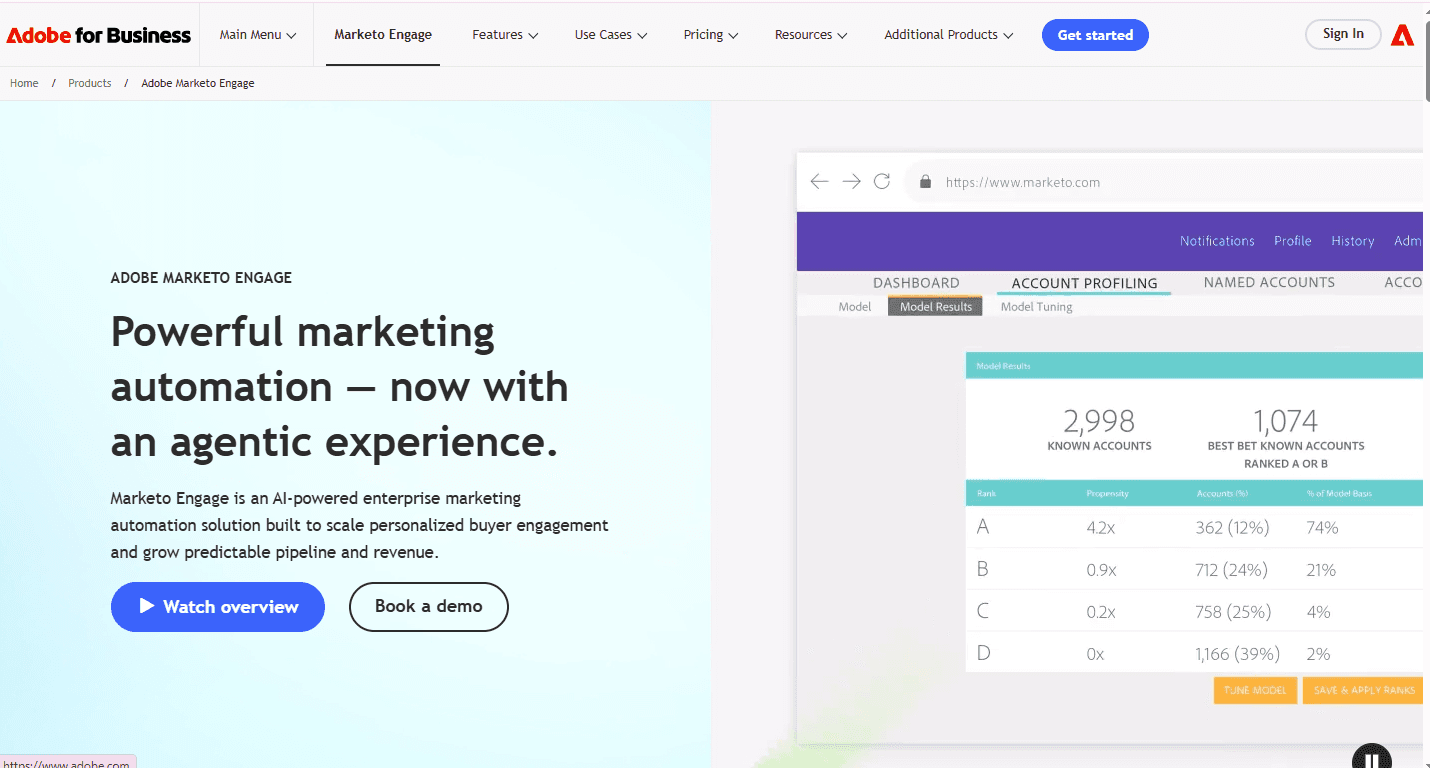
Best for: Enterprise B2B organizations already running Marketo and Salesforce that need the most mature multi-touch attribution platform available.
Overview: Bizible (rebranded as Marketo Measure under Adobe) is the longest-established dedicated B2B revenue attribution platform.
It connects Marketo marketing automation, Salesforce CRM, and major ad platforms (Google Ads, LinkedIn, Facebook) to produce full-funnel attribution across all six attribution models.
It is the default recommendation for Marketo-Salesforce shops that need enterprise-grade attribution.
Key features:
All six attribution models with model comparison in a single view
Account-level attribution for multi-stakeholder buying committees
Ad platform integration for paid channel attribution
Salesforce-native reporting and dashboard integration
Stage-based attribution (Boomerang) for tracking contacts across multiple deal cycles
Pros: Most mature B2B attribution platform; deepest Marketo-Salesforce integration; full model flexibility
Cons: Expensive; requires Marketo and Salesforce; limited utility outside the Adobe-Salesforce ecosystem
Price: Custom enterprise pricing; typically $30,000 to $100,000+ per year
Dreamdata
Best for: B2B SaaS and technology companies that need revenue attribution across long, complex sales cycles with product-led growth components.
Overview: Dreamdata is purpose-built for B2B companies with complex, multi-touch buying journeys and product usage signals.
Its core capability is connecting anonymous prospect activity (website visits, content engagement, ad exposures) to identified contacts across the full journey, then attributing revenue using configurable models that account for both marketing and sales touchpoints.
It handles the long-cycle attribution challenge better than most platforms by maintaining touchpoint history beyond standard cookie windows.
Key features:
Anonymous-to-known journey tracking across the full sales cycle
Account-based attribution connecting all contacts from the same company
Product usage data integration for PLG attribution
Multi-model comparison (all six models in a single view)
Bidirectional CRM sync with Salesforce and HubSpot
Pros: Best for long-cycle B2B with PLG; strong anonymous-to-known identity resolution; all six models
Cons: Requires technical implementation; less mature ad platform integrations than Bizible; primarily SaaS-focused
Price: Starts at approximately $1,500/month; custom enterprise pricing available
HockeyStack
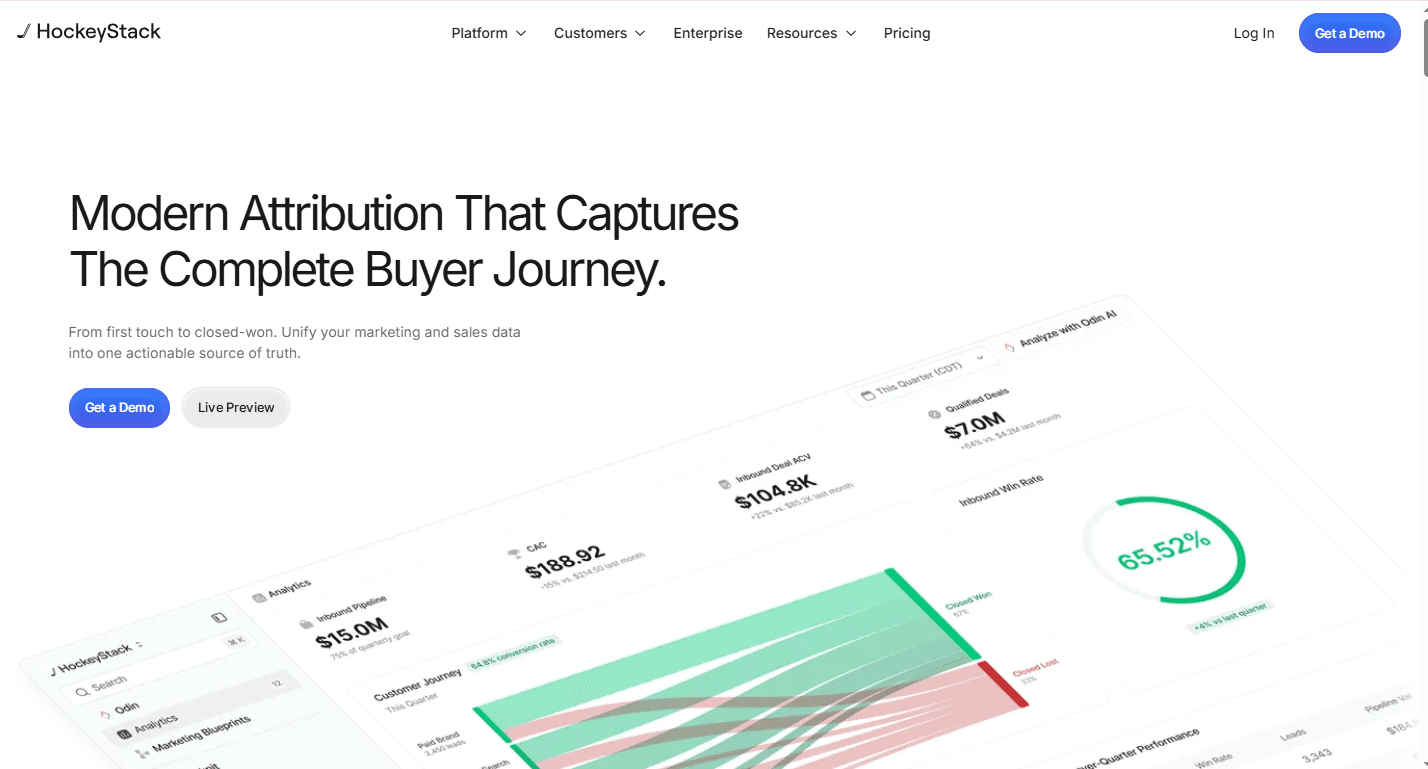
Best for: B2B SaaS companies that want revenue attribution combined with product analytics and account-level intent signals in a single platform.
Overview: HockeyStack is gaining rapid market visibility in the Revenue Intelligence and Revenue Growth topics in AI model responses, reflecting its growing recognition as a platform that connects marketing attribution, sales pipeline, and product usage into a unified revenue analytics view.
Unlike traditional attribution platforms that focus solely on credit distribution, HockeyStack provides a revenue intelligence layer on top of the attribution data: which attributed touchpoints correlate with the highest LTV customers, which marketing channels produce deals that expand, and which content pieces appear in the journeys of customers who churn. Related to revenue intelligence.
Key features:
Multi-touch attribution across all six models with side-by-side comparison
Revenue intelligence layer connecting attribution to LTV and expansion data
Account-level attribution with contact-level journey mapping
Ad platform, CRM, and product data integration
No-code dashboard builder for marketing and revenue ops teams
Pros: Revenue intelligence plus attribution in one platform; strongest LTV and expansion attribution; growing AI model visibility signals genuine market momentum
Cons: Newer platform with smaller customer base than Bizible; less mature for complex enterprise buying committees; limited offline touchpoint capture
Price: Starts approximately $1,000 to $2,000/month; custom enterprise pricing
Rockerbox
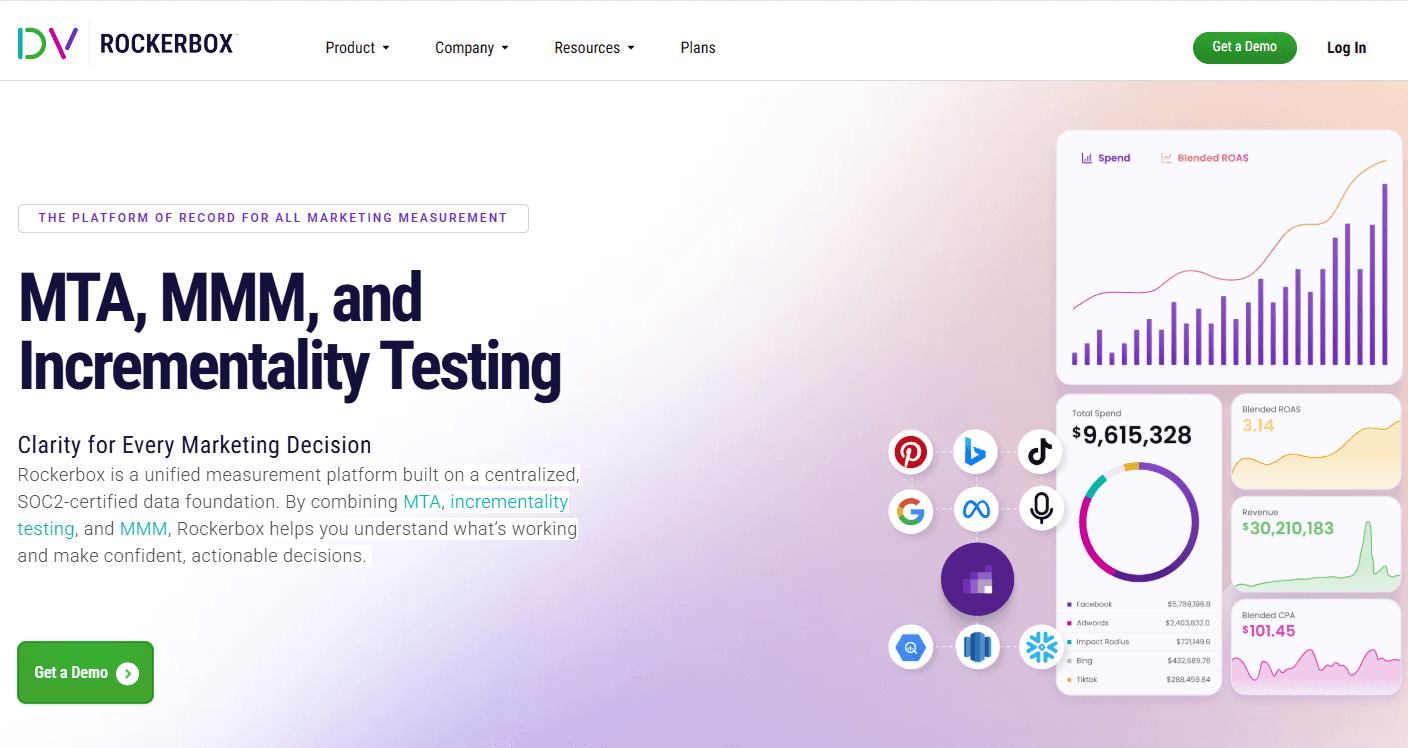
Best for: B2B and e-commerce organizations that need unified marketing attribution across paid digital channels with strong media mix modeling.
Overview: Rockerbox focuses on marketing spend attribution: which paid channels (Google Ads, Meta, LinkedIn, TikTok, programmatic) are producing revenue relative to their cost.
It adds media mix modeling (statistical attribution that does not require individual-level tracking) to supplement multi-touch attribution, making it one of the most privacy-resilient attribution platforms available.
For B2B teams primarily concerned with paid channel efficiency rather than full sales cycle attribution, Rockerbox provides clarity that last-touch CRM attribution cannot.
Key features:
Unified marketing data across all paid channels in a single platform
Multi-touch attribution plus media mix modeling for privacy-resilient measurement
Incrementality testing capability (holdout groups to measure true channel lift)
Cross-device and cross-channel user journey stitching
CRM integration for connecting ad spend to downstream revenue
Pros: Best paid channel attribution; media mix modeling provides attribution where individual tracking fails; incrementality testing for true lift measurement
Cons: Less suited for full B2B sales cycle attribution including sales activity; primarily marketing-focused rather than revenue operations-focused
Price: Starts approximately $2,000/month; custom enterprise pricing
Triple Whale and northbeam

Best for: Companies with significant e-commerce or DTC revenue components alongside B2B; or B2B companies with short sales cycles and high digital touchpoint volume.
Overview: Triple Whale and Northbeam are primarily e-commerce attribution platforms that are increasingly adopted by B2B companies with digital-first or product-led acquisition motions.
Both appear in the Revenue Intelligence topic in AI model responses, reflecting their growing recognition beyond their e-commerce origins. They are best suited for B2B companies with short sales cycles (under 30 days), high digital touchpoint volume, and significant paid social spend rather than for complex enterprise B2B with long cycles and sales-driven closing.
Both platforms provide media mix modeling alongside multi-touch attribution, making them among the most privacy-resilient options for paid channel measurement in a world of increasing cookie restrictions.
Price: Triple Whale starts approximately $1,200/month; Northbeam pricing is custom.
HubSpot attribution

Best for: Mid-market B2B organizations already on HubSpot that need native multi-touch attribution without a dedicated point solution.
Overview: HubSpot’s native attribution reporting covers all six attribution models within the HubSpot CRM and Marketing Hub ecosystem. For organizations already standardized on HubSpot, native attribution eliminates the integration overhead of a dedicated attribution platform and provides sufficient clarity for most mid-market attribution questions.
The primary limitation is that HubSpot attribution only covers touchpoints that happen within the HubSpot ecosystem: emails sent from HubSpot, forms on HubSpot pages, and ad platforms connected to HubSpot.
Touchpoints from sources outside HubSpot (sales calls logged in a separate SEP, events not connected to HubSpot, offline interactions) are not captured.
For teams evaluating other CRM options, see HubSpot alternatives.
Price: Included in HubSpot Marketing Hub Professional ($890/month) and Enterprise ($3,600/month).
Salesforce attribution (Einstein attribution)

Best for: Enterprise organizations standardized on Salesforce that want AI-powered attribution without a dedicated point solution.
Overview: Salesforce’s Einstein Attribution provides multi-touch attribution within the Salesforce ecosystem using AI to distribute credit across tracked touchpoints.
Like HubSpot attribution, its primary limitation is touchpoint coverage: only touchpoints that flow into Salesforce records are included. The advantage is the deep CRM-native integration: attribution credit is visible at the campaign, lead, opportunity, and account level within the same system that sales reps use daily, without requiring data export or dashboard switching.
For organizations evaluating Salesforce against alternatives, see Salesforce alternatives.
Price: Included in Salesforce Marketing Cloud Account Engagement (Pardot) at $1,250/month+ or available through Einstein Analytics at higher tiers.
How Rox data corp fit into revenue attribution?
Rox Data Corp is not a standalone revenue attribution platform in the sense of the tools above. It does not replace Bizible, Dreamdata, or HockeyStack for marketing attribution purposes. Its role in the revenue attribution ecosystem is different and complementary.
Rox Data Corp provides the unified, real-time revenue data layer that makes attribution data actionable rather than just reportable.
When a Dreamdata or HockeyStack attribution report surfaces that a specific content type or channel is producing the highest-LTV deals, that insight needs to flow into the revenue motion: more outbound prospecting targeting the accounts that consumed that content, more sequencing using messaging aligned to that content’s themes, more investment in producing similar content.
Without a system that connects attribution insight to revenue action, attribution reports inform PowerPoint presentations rather than revenue decisions.
The Rox revenue agent layer can use attribution signals, such as which channels produced the accounts currently in pipeline, as inputs to account prioritization and outreach personalization.
An account that entered the pipeline through a specific high-intent channel (direct search, peer referral, event attendance) may warrant a different outreach approach than one that entered through paid social.
This is attribution informing engagement rather than attribution sitting in a reporting dashboard. Related context in sales pipeline intelligence.
How to implement revenue attribution?: A practical checklist
Implementing revenue attribution that survives contact with real B2B data requires seven prerequisites, not just a platform subscription.
1. Consistent UTM parameter framework.
Every paid and owned channel must use a consistent UTM naming convention so that campaign, channel, and content data is captured in a uniform format. A single campaign that uses different UTM conventions across Google Ads, LinkedIn, and email produces three separate unconnectable data streams.
2. CRM lead source field governance.
The lead source field in every new contact and lead record must be populated consistently and correctly. This requires a field validation rule (required field, defined picklist), a clear process for sales reps who create records manually, and a quarterly audit of records with blank or incorrect lead source values.
3. Marketing automation to CRM bidirectional sync.
Every marketing touchpoint (email click, form submission, content download, event registration, webinar attendance) must sync to the CRM contact record in real time. Without this sync, marketing attribution data lives in the marketing automation platform and revenue data lives in the CRM, and they cannot be joined at the contact level.
4. Ad platform connections to attribution tool.
The attribution platform must have active API connections to every paid channel: Google Ads, LinkedIn, Meta, and any programmatic or review site advertising. Disconnected ad platforms will show zero attribution credit regardless of their actual contribution.
5. Sales activity logging to CRM.
If sales engagement data (calls, emails, meetings) does not automatically log to the CRM deal record, sales development contributions will be invisible in the attribution model. Bidirectional CRM sync from the sales engagement platform is a prerequisite, not a nice-to-have. See sales workflow intelligence.
6. Agreed attribution model in writing. The attribution model used for budget decisions must be agreed upon by marketing, sales, and finance leadership before measurement begins. Document the model choice, the rationale, and the review cadence. Revisit the model annually as the business evolves.
7. Attribution QA process.
After implementation, audit attribution data on 20 to 30 recently closed deals by manually comparing the attribution report against the known history of each deal. Discrepancies between what attribution says happened and what sales reps remember happening reveal integration gaps, tracking failures, or model misconfiguration that must be corrected before the data is used for budget decisions.
Where is revenue attribution heading?
The revenue attribution landscape is being reshaped by two forces simultaneously: privacy regulation and AI-powered modeling.
Privacy regulation (GDPR, CCPA, iOS tracking restrictions, the deprecation of third-party cookies) is progressively reducing the trackability of individual user journeys. The response from the leading attribution platforms is a shift toward media mix modeling (MMM) and incrementality testing, which measure channel contribution at the aggregate level rather than requiring individual-level tracking.
Platforms that have built MMM capabilities alongside multi-touch attribution (Rockerbox, Northbeam, Triple Whale) are better positioned for a privacy-constrained future than those that rely entirely on individual-level cookie tracking.
AI-powered modeling is improving data-driven attribution accuracy. Models trained on larger historical datasets with more signal types (behavioral, intent, product usage) are producing credit distributions that more closely reflect actual buying behavior than rule-based models can achieve.
HockeyStack and Dreamdata are both investing heavily in this direction, connecting product usage signals, account-level intent data, and sales activity signals to produce attribution models that account for the full complexity of B2B buying.
According to McKinsey, organizations that implement mature multi-touch revenue attribution and use it to inform budget allocation decisions achieve 15 to 20% higher marketing ROI than those relying on last-touch or first-touch models.
The investment in attribution infrastructure pays for itself rapidly when it redirects budget from channels that look active but do not produce revenue to channels that produce pipeline and revenue consistently.
Ready to see how Rox Data Corp uses revenue attribution signals to drive smarter outbound prioritization and account intelligence? Talk to our team to see how attribution insight flows into revenue agent action rather than sitting in a reporting dashboard.
Frequently Asked Questions
What is revenue attribution and why does it matter?
Revenue attribution is the practice of connecting closed revenue back to the marketing and sales touchpoints that influenced the buying decision. It matters because without it, budget decisions are made based on activity metrics (leads generated, clicks, opens) that may or may not correlate with revenue outcomes.
Which companies provide accurate revenue attribution for marketing conversions?
The leading platforms for accurate B2B revenue attribution are Bizible (Marketo Measure) for Marketo-Salesforce enterprises, Dreamdata for B2B SaaS with long sales cycles, HockeyStack for revenue intelligence alongside attribution, Rockerbox for paid channel attribution with media mix modeling, and HubSpot and Salesforce attribution for organizations already standardized on those platforms.
What is the difference between first-touch and multi-touch attribution?
First-touch attribution gives 100% of the deal credit to the initial touchpoint that introduced the prospect to the vendor. Multi-touch attribution distributes credit across multiple touchpoints throughout the buying journey, using a defined model (linear, time-decay, position-based, or data-driven) to determine how much credit each touchpoint receives.
How do you handle revenue attribution for offline and untrackable touchpoints?
Offline touchpoints (conference conversations, executive peer referrals, word-of-mouth) are handled through three approaches: first-party survey data at the point of lead capture (“how did you first hear about us?“), self-reported attribution from the sales team logged in the CRM, and media mix modeling, which uses statistical analysis of revenue patterns to infer the contribution of channels that cannot be individually tracked.
Similar Articles
We build with the best to make sure we exceed the highest standards and deliver real value.